
Call Us
+86-15800763021
Send Us
Add
775 Chihua Road, Zhelin Town, Fengxian District, Shanghai
- All
- Product Name
- Product Keyword
- Product Model
- Product Summary
- Product Description
- Multi Field Search
Views: 0 Author: Site Editor Publish Time: 2026-08-11 Origin: Site

Curd integrity directly dictates the profitability of your facility. Even minor mechanical shear during processing causes significant fat and protein losses in the whey. Scaling production often introduces aggressive pumping, turbulent agitation, and poorly designed transfer points. These factors shatter the delicate coagulum structure. Shattered curds lower your overall yield and create inconsistent moisture levels in the final product. You must protect the curd structure from the moment it forms until it reaches the pressing or packaging stage. Evaluating and integrating specialized, low-shear equipment into your cheese production line solves this problem. This guide details the exact equipment and evaluation criteria needed to optimize your facility for gentle curd handling. You will learn how to select vats, pumps, and transfer systems that preserve yield and maintain strict quality standards.
Yield Preservation: Gentle handling minimizes fines and fat loss in whey, directly improving the mass balance and profitability of the production run.
Equipment Specificity: Standard sanitary pumps are insufficient; specialized low-shear pumps (like sine or peristaltic) and optimized cheese vats are mandatory for curd integrity.
Process-Specific Configurations: A white cheese production line requires vastly different handling tolerances compared to a cheddar cheese production line due to differing moisture targets and curd firmness.
You must establish strict baseline metrics for curd integrity. Focus on keeping whey fat content below 0.25–0.30%. Whey protein and fines levels should remain below 100–150 mg/L. Exceeding these benchmarks indicates severe mechanical damage. A 1% increase in whey fines translates directly to massive yield losses. Over an annual production cycle, losing that 1% per 100 lbs of processed milk destroys profit margins. You can calculate this loss by measuring the mass balance of fat and protein retained in the cheese versus what escapes into the whey stream.
To properly track these metrics, plant managers should implement a daily sampling routine. Pull whey samples directly from the primary drainage point before any clarification occurs. This gives the most accurate representation of mechanical damage inflicted during the vat and transfer stages. Compare these daily numbers against historical averages to spot equipment wear or operator errors early.
| Whey Fat Content (%) | Whey Fines (mg/L) | Curd Integrity Status | Required Action |
|---|---|---|---|
| Under 0.25% | Under 100 | Excellent | Maintain current parameters |
| 0.26% - 0.30% | 100 - 150 | Acceptable | Monitor pump speeds |
| 0.31% - 0.40% | 151 - 250 | Poor | Audit valve positions and pipe bends |
| Over 0.40% | Over 250 | Critical Failure | Halt production, inspect agitators and pumps |
Mechanical shear breaks down the physical matrix of the curd. Turbulence and pressure drops within standard piping systems exert forces that the fragile coagulum cannot withstand. When curds hit sharp pipe bends or restrictive valves, they shatter. Synergistic stress accelerates this structural breakdown. This occurs when physical shock combines with thermal shock. Pumping hot curds through cold pipes, or subjecting them to rapid temperature shifts while under mechanical strain, causes immediate fragmentation.
Fluid dynamics play a massive role here. Laminar flow is the goal. When fluid velocity exceeds the optimal threshold for the pipe diameter, the flow becomes turbulent. This turbulence creates micro-eddies that tear the curd particles apart from the outside in. The longer the transfer distance under turbulent conditions, the higher the percentage of fines generated.
Shattered curds ruin the final product. They lead to highly uneven moisture distribution across the cheese block. This moisture variance causes severe texture defects. You will notice pastiness, chalkiness, or a crumbly mouthfeel in the aged product. Commercial graders will downgrade cheese exhibiting these defects. Downgraded cheese sells for a fraction of the premium price, compounding the initial financial loss from the reduced yield.
Furthermore, uneven moisture leads to unpredictable ripening. Areas with high moisture may develop off-flavors or unwanted bacterial growth, while dry areas fail to develop the target flavor profile. This inconsistency damages brand reputation and leads to rejected shipments from distributors.
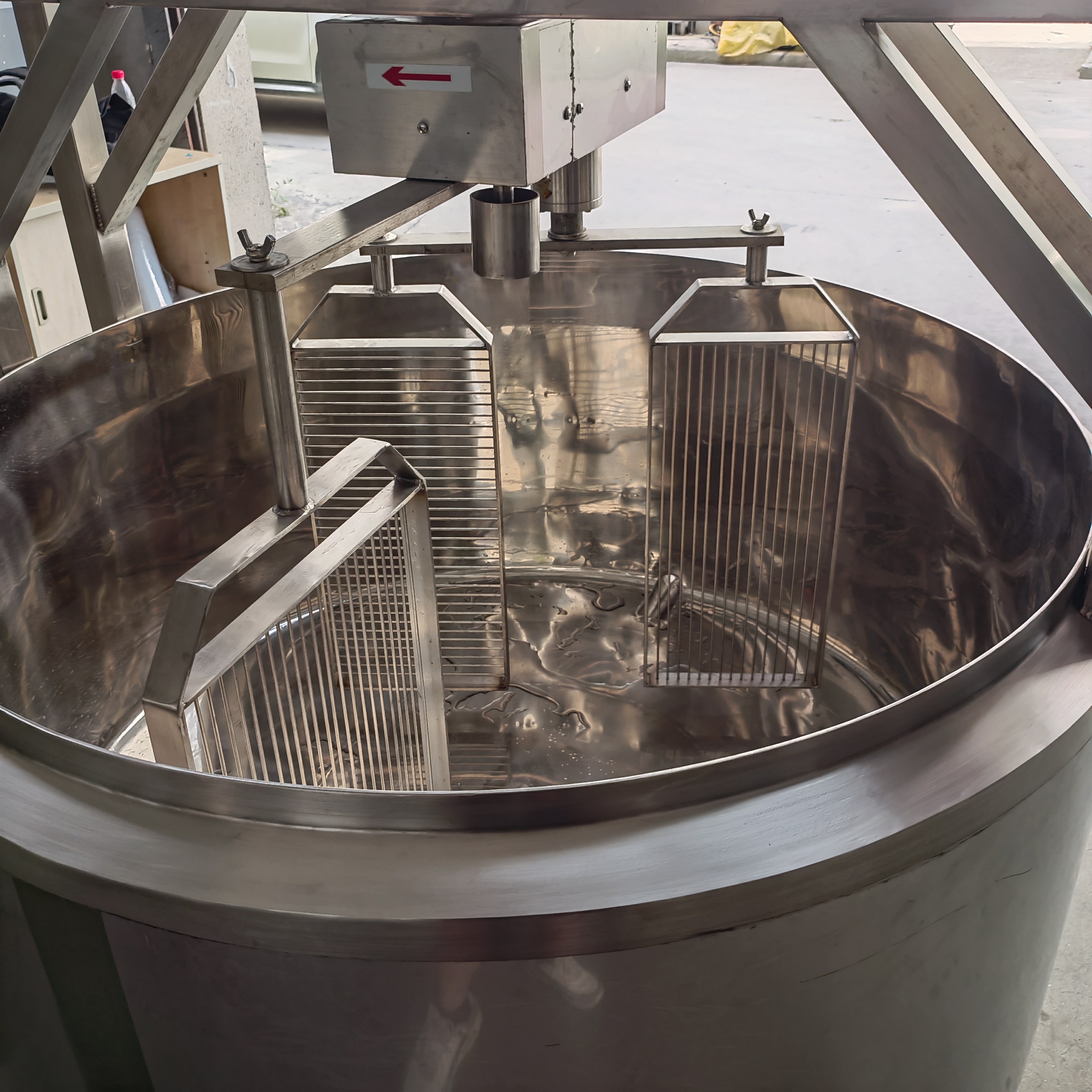
The geometry of your cheese vat dictates initial agitation dynamics. Double-O and enclosed horizontal designs minimize dead zones better than standard O-shape vats. Eliminating dead zones prevents localized over-agitation. Blade geometry is equally critical. Razor-sharp, ultra-thin cutting blades slice the coagulum cleanly. Thick wire grids compress and tear the curd, causing immediate fat loss. You must also control cutting speed profiles. Variable speed drives allow for progressive speed-reduction curves. This transitions the process smoothly from gentle cutting to controlled syneresis without tearing the fragile curd particles.
Inspect vat blades weekly for dullness or burrs.
Calibrate variable speed drives monthly to ensure accurate RPM readouts.
Verify that the agitator shaft seals are intact to prevent air ingress, which causes foaming and structural damage.
Run a dye test annually to visually confirm the absence of dead zones during the agitation cycle.
Standard centrifugal pumps destroy curd structure. You must evaluate lobe, peristaltic, and sinusoidal pumps for transfer applications. Sine pumps serve as the industry standard for this task. They minimize pulsation and deliver virtually zero shear during transfer. Piping architecture also requires careful design. Utilize 3D or 5D long-radius bends instead of standard 90-degree elbows. Select full-port valves over restrictive butterfly valves. These choices prevent velocity spikes and eliminate physical obstructions in the flow path.
When installing a new transfer system, the layout is just as important as the pump itself. Minimize the total number of elevation changes. Every time the curd-whey mixture is forced upward, it requires more pump pressure, which increases slip inside the pump housing. Slip is a primary cause of mechanical shear.
Separating whey from the curd requires gentle handling to prevent compaction. Rotary screening drums and perforated draining belts offer excellent low-shear separation. The transfer point onto these screens is highly critical. Low-fall-height distributors prevent impact damage. Gentle curd distribution plates spread the product evenly across the draining surface. This prevents clumping and ensures uniform moisture reduction before the curd enters the molds.
Elevating the vat allows gravity to feed the draining and pressing equipment. Gravity systems eliminate the need for mechanical pumps, drastically reducing shear. However, gravity systems have limitations. Facility height constraints often make elevation impossible. Excessive drop heights in a gravity system will still cause impact damage. When gravity feeding is not viable, you must rely on specialized mechanical conveyance. Vacuum transport systems, flumes, and low-friction mechanical belts provide safe alternatives when calibrated correctly.
High-moisture, unripened curds demand extreme care. A white cheese production line handles exceptionally fragile products like Feta or Queso Fresco. You must implement ultra-low agitation protocols. Specialized block-molds are necessary to support the weak structure. Many modern facilities use automated ultrafiltration systems. These systems bypass traditional curd cutting entirely, preserving the delicate matrix. Dosing and distribution equipment must operate smoothly to prevent structural collapse before the curd sets in the molds.
The timing of the transfer is also highly sensitive. If the curd is moved before it has achieved the correct pH and firmness, it will disintegrate upon entering the molds. Operators must rely on precise pH meters and automated timers rather than visual estimation.
Milled and salted curds require different handling parameters. A cheddar cheese production line relies on continuous cheddaring belts or traditional manual milling. Automated milling, salting, and pneumatic conveying equipment must be perfectly calibrated. If the pneumatic velocity is too high, the equipment will pulverize the curd before pressing. You must also manage the curd carefully during the recovery and recycling of salty whey to prevent cross-contamination and structural degradation.
Salt distribution must be uniform. If the salting mechanism dumps heavy loads in concentrated areas, it forces operators to over-agitate the curd to mix it properly. This late-stage agitation is a massive source of fines. Invest in precision rotary salters that dust the curd evenly as it moves along the belt.
Gentle handling mechanisms often feature complex internal geometries. Sine pumps and specialized valves have moving parts and seals that complicate sanitation. You must balance gentle handling capabilities with Clean-in-Place compatibility. The cheese making machine must allow for verifiable sanitation without requiring daily manual teardowns. Inspect the equipment for dead legs and ensure all seals are fully accessible to CIP chemicals.
Flexible elements degrade over time. Sine pump scraper gates, peristaltic hoses, and vat seals face constant abuse. They endure daily CIP chemicals, thermal cycling, and continuous mechanical stress. Evaluate the expected lifecycle of these wear parts before purchasing. Frequent component failure leads to unplanned downtime and potential product contamination. Choose equipment with durable, food-grade elastomers designed for high-temperature applications.
Programmable Logic Controllers provide superior consistency over manual operation. PLC integration manages pump speeds, valve actuation, and agitator RPMs automatically. The system adjusts these parameters based on real-time viscosity, turbidity, and temperature data. Relying on manual control introduces human error. Operators may rush the process, increasing shear and damaging the curd. Automation locks in the optimal speed curves for gentle handling.
Continuous production lines offer higher throughput but carry a higher potential for shear if not perfectly calibrated. Batch processing makes it easier to control gentle handling parameters. However, batch systems require a larger facility footprint and offer lower overall throughput. You must weigh these conceptual trade-offs against your facility size and production goals. Select the configuration that maximizes yield without compromising your spatial constraints.
Retrofitting new low-shear pumps into existing, undersized piping creates severe risks. Small pipe diameters increase flow velocity, friction, and shear. This negates the benefits of the new pump. You must mandate a comprehensive hydraulic audit of your facility before purchasing equipment. Ensure your pipe diameters match the optimal flow velocity required by the new low-shear pumps.
Operators often override automated parameters to speed up production runs. This operator error destroys curd integrity. You must develop strict standard operating procedures. Utilize role-based access control on all Human-Machine Interface panels. Lock the knife and pump speed curves so only authorized personnel can alter them. Proper training ensures operators understand the financial impact of overriding gentle-handling protocols.
Audit your current whey fat and protein losses to establish a clear baseline for improvement.
Evaluate your facility layout to determine if gravity-feed systems are structurally viable.
Match your pump and vat selection strictly to the specific moisture and firmness requirements of your cheese variety.
Engage with process engineers to conduct a comprehensive hydraulic and site audit before purchasing new equipment.
Request pilot-scale equipment trials to validate low-shear performance on your specific product formulations.
A: Sinusoidal and peristaltic pumps are superior for handling shear-sensitive solids. Sine pumps maintain product integrity with virtually zero pulsation, preventing the structural fragmentation common with centrifugal pumps.
A: Double-O vats utilize overlapping counter-rotating agitators to eliminate dead zones. This ensures uniform cutting and prevents both under-cutting and over-agitation of localized curd pockets, maximizing yield.
A: Dull blades or thick wire knives tear and crush the curd rather than slicing it. This mechanical tearing releases substantial fat and protein into the whey, driving up curd fines and reducing yield.
A: White cheese requires high-moisture, ultra-low-shear handling to protect fragile curds. Cheddar production involves aggressive milling, salting, and continuous belt pressing, requiring equipment calibrated to handle firmer curds without pulverizing them.
A: Test your whey for suspended fines using centrifugal sediment tests. Measure the whey fat percentage via standard chemical analysis, and meticulously track your overall cheese yield per batch.
A: No. While gravity feeding reduces mechanical shear from pumps, improper valve selection, excessive drop heights, or high-angle slide chutes can still cause severe impact damage to the curd.
A: Upgrading equipment typically pays for itself rapidly through increased yield. By preserving fat and protein that would otherwise be lost to the whey, facilities often see a return on investment within 12 to 18 months.