Call Us
+86-15800763021
Send Us
Add
775 Chihua Road, Zhelin Town, Fengxian District, Shanghai
- All
- Product Name
- Product Keyword
- Product Model
- Product Summary
- Product Description
- Multi Field Search
Views: 0 Author: Site Editor Publish Time: 2026-10-06 Origin: Site

In commercial dairy processing, precision dictates your final yield. A single degree of temperature fluctuation can turn a premium batch of Feta or Halloumi into unsellable waste. One of the most critical stages in this manufacturing process is the salt bath. Simply tossing freshly pressed curds into a generic vat of saltwater is a recipe for disaster. Achieving a perfect crumbly texture, optimal flavor, and extended shelf life requires rigorous thermal control.
Industrial white cheese equipment must incorporate robust cooling systems to halt the acidification process instantly. Active chilling ensures even salt absorption. It also prevents the delicate protein matrix from melting or degrading. In this technical guide, we will explore the objective science and mechanics behind thermal management in dairy plants. Whether you are upgrading your current facility or troubleshooting structural inconsistencies on the plant floor, understanding refrigeration will help you make informed operational decisions.
Looking at the current dairy processing landscape, there is a massive shift toward energy-efficient thermal management. Global energy costs are fluctuating constantly. Meanwhile, consumer demand for clean-label, preservative-free foods is surging at an unprecedented rate. Dairies are aggressively moving away from chemical additives.
Instead, modern facilities rely entirely on mechanical interventions. Precise thermal control during the salting phase has become the baseline standard for ensuring food safety. Boutique and mid-sized plants failing to adopt active cooling struggle to meet modern retail compliance. Upgrading to automated, refrigerated holding systems is no longer a luxury; it is a strict compliance requirement for scaling operations.
Before evaluating specific machinery, operators must understand what this stage achieves biochemically. It is not merely a method of flavoring. It is a complex biochemical intervention.
At its core, this phase is the systematic process of submerging freshly formed blocks into a highly concentrated saline solution. For high-moisture dairy products, this step is non-negotiable. The bath dictates the final flavor profile and initiates rapid surface firming. When the block enters the liquid, a dynamic kinetic exchange begins. Sodium chloride molecules migrate into the matrix, while internal moisture is expelled into the surrounding environment.
Modern processing systems allow operators to select between two primary mediums: standard water and whey. Empirical evidence from dairy science indicates that whey—which repurposes the residual liquid expelled from the cheese vat during the curd-cutting phase—is often superior. The whey is naturally balanced with inherent calcium levels and pH. In contrast, standard potable water requires operators to manually buffer the solution with calcium chloride and lactic acid. Regardless of the base liquid utilized, maintaining a consistently cool temperature is vital to prevent organic spoilage.
Investing in commercial infrastructure without integrating a dedicated chiller is a fundamental operational risk. Unregulated temperatures inevitably lead to inconsistent batch quality, higher rejection rates, and severe financial loss.
When fresh curds leave the pressing stations, the lactic acid bacteria introduced during the inoculation phase are still highly active. If placed into a warm bath, these bacteria will aggressively ferment residual lactose into lactic acid. This uncontrolled fermentation causes the pH to plummet. The result is a sour, crumbly product. By utilizing a refrigerated brine tank, operators can rapidly drop the internal core temperature. This sudden thermal shock renders the bacteria dormant, locking in the desired flavor profile instantly.
High moisture and butterfat content uniquely characterize these products. The physical state of milk fat is highly sensitive to ambient fluctuations. If the solution exceeds safe thermal thresholds, typically above 15 degrees Celsius, the butterfat begins to liquefy. It leaches out into the surrounding water. This phenomenon clouds the tank and creates a massive sanitation hazard. It also leaves the block with a soft, mushy, and structurally compromised texture. Active chilling ensures that fats solidify upon contact, maintaining the sharp edges necessary for automated packaging.
This entire process relies heavily on the scientific principle of osmosis. Empirical studies demonstrate that temperature dictates this kinetic exchange rate. Warm liquids accelerate osmosis unnaturally. The block expels water too violently. Chilled liquid, however, slows down the exchange. This methodical pace allows for an even distribution of sodium throughout the entire block. It prevents the common defect of a heavily salted, dehydrated exterior masking a bland interior.
To illustrate the stark contrast in production outcomes, consider the following performance metrics observed on the plant floor.
| Production Parameter | Uncooled System | Active Cooling System |
|---|---|---|
| pH Stability | Unstable; rapid drop leading to sourness | Locked instantly; consistent flavor profile |
| Butterfat Retention | High loss; cloudy water and slimy texture | Excellent; fats solidify creating sharp edges |
| Salt Distribution | Uneven; harsh exterior, bland core | Uniform and steady osmotic exchange |
| Contamination Risk | High; warm liquid breeds yeast and mold | Minimal; thermal stress inhibits pathogens |
| Overall Yield | Lower due to excessive moisture loss | Optimized; retains target moisture levels |
High-quality machinery does not operate in isolation. It functions as a highly integrated, sequential ecosystem. Plant engineers must look at the macro view of the facility.
The production journey begins in specialized jacketed heating vessels. Capacities often range from 500 Liters up to 10,000 Liters for industrial turnkey projects. Precision heating and automated stirring mechanisms set the foundational stage for moisture content. Any thermal inconsistencies here will carry over and magnify during later phases.
Once the curds achieve the correct consistency, they are transferred into a cheese mould. Mechanical pressing is usually kept very light, often relying entirely on gravity. These micro-perforated containers allow for initial whey drainage while shaping the blocks.
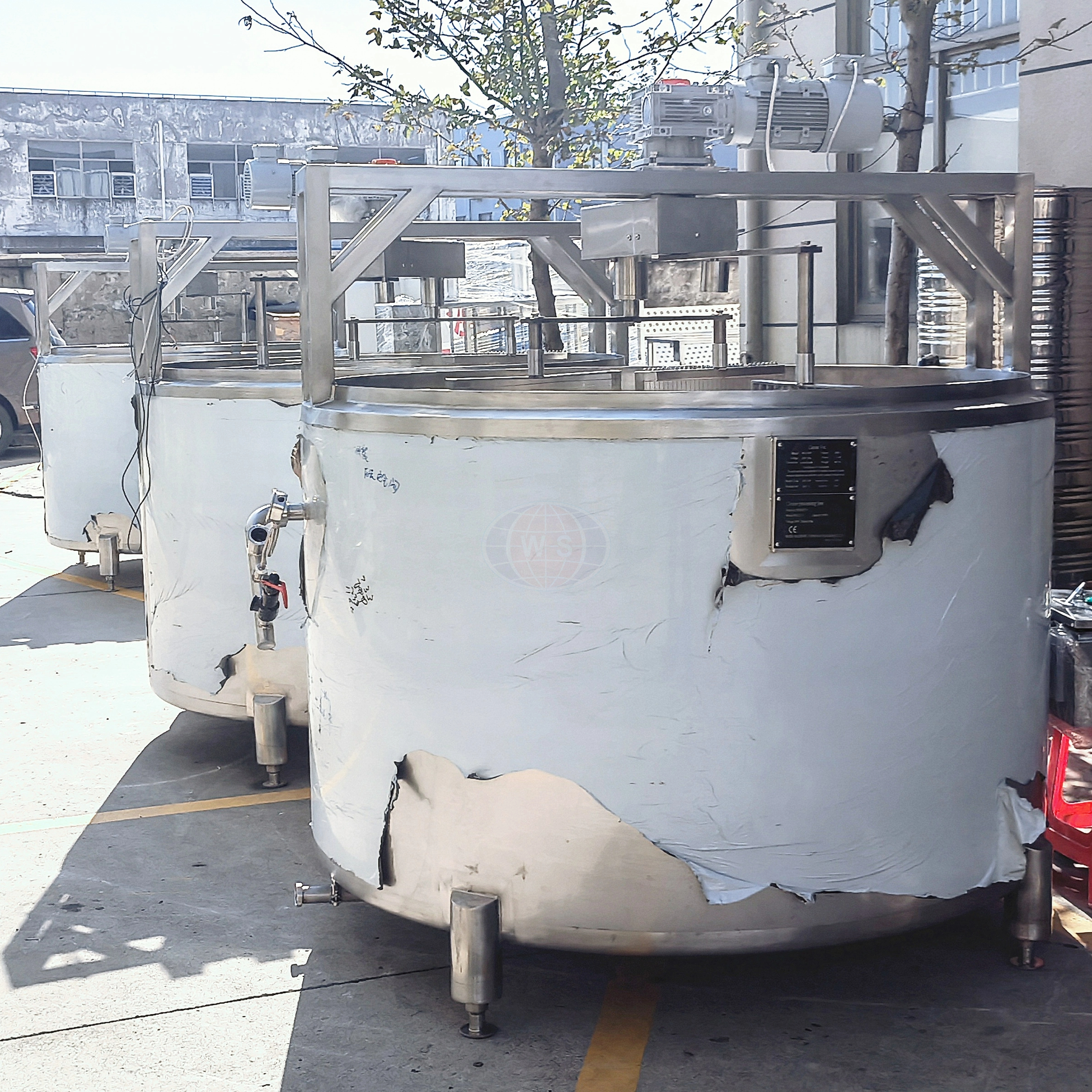
Following the demoulding process, the still-warm blocks are transferred directly into the bath. When configuring a commercial Feta cheese line, engineers must ensure the cooling capacity can handle sudden thermal loads. Hundreds of kilograms of warm product entering the bath simultaneously require robust titanium plate heat exchangers or high-efficiency glycol jackets to stabilize the temperature instantly.
Transitioning dairy producers often run into severe quality control issues when scaling up without proper infrastructure. Operating an uncooled system introduces predictable pitfalls.
Elevated temperatures cause calcium to leach out of the matrix at an accelerated rate. Calcium acts as the structural glue holding the casein proteins together. When it leaches out, the protein structure dissolves. If your product feels excessively slimy or slippery to the touch upon removal, inadequate refrigeration is almost certainly the root cause.
Because heat accelerates osmosis, the block will expel its internal water too quickly. It absorbs sodium at an uncontrollable rate. The physical result is a dry, chalky texture. It carries an overwhelmingly harsh flavor profile that completely masks delicate dairy notes. Dropping the bath temperature by just a few degrees can entirely resolve this defect.
If your operation is purchasing a new production line, evaluating technical specifications is paramount for long-term success. Do not settle for generic holding vessels.
First, material construction is critical. Always demand tanks constructed from high-grade, corrosion-resistant SUS316L stainless steel for all product-contact surfaces. Standard SUS304 will pit, rust, and degrade rapidly when continuously exposed to high saline concentrations. Second, ensure the system includes automated, sanitary CIP centrifugal pumps. Stagnant liquid creates temperature and salinity gradients. Gentle circulation keeps the liquid moving, ensuring uniform chilling and preventing localized spoilage zones.
Finally, your heating vessels, pressing stations, and chilling systems must work in software harmony. Opt for suppliers offering complete end-to-end lines rather than piecemeal machines. This reduces transfer times and minimizes the window for bacterial contamination.
Producing premium dairy products consistently at a commercial scale requires mastering strict temperature control. Active refrigeration is not an optional luxury feature. It is a fundamental engineering requirement for halting acidification, preserving structural texture, and extending shelf life. By investing in integrated processing machinery, you safeguard physical quality and your brand reputation.
Ready to upgrade your dairy facility? Stop losing yield to poor thermal management. Explore industrial-grade, corrosion-resistant solutions and complete turnkey projects tailored for your exact capacity needs by visiting WFoodMachinery today.
For the vast majority of high-moisture dairy products, the ideal temperature is strictly maintained between 10 degrees Celsius and 12 degrees Celsius, or 50 degrees Fahrenheit to 54 degrees Fahrenheit. This specific range effectively halts bacterial fermentation while allowing for proper, steady osmotic exchange.
Yes, standard potable water can be used, but it requires precise chemical modification. Operators must add calcium chloride and a small amount of food-grade acid to match the exact pH and calcium levels of the curds. Without these adjustments, pure water aggressively pulls calcium out of the matrix, causing a degraded surface.
The duration depends entirely on physical dimensions and the target salinity of the final product. It ranges from a few hours for light surface firming to several days for long-term preservation and deep flavor development.
Saline solutions are highly corrosive to industrial metals. Standard alloys, such as SUS304, experience severe pitting and rust over time. SUS316L contains molybdenum, which drastically increases the alloy's resistance to chloride-induced corrosion. This makes it essential for maintaining a sanitary environment.
Indirectly, yes. Warm environments cause excessive butterfat loss and rapid, uncontrolled moisture expulsion. Both of these defects reduce the final marketable weight of your batches. Proper chilling helps retain target moisture and fat levels, thereby optimizing overall profitability.
Higher temperatures increase the kinetic energy of the water molecules, forcing the curds to expel whey much faster. If the bath is too warm, the final product will have a significantly lower moisture content, resulting in a dry, crumbly texture rather than a smooth, sliceable block.
Yes, many facilities retrofit existing unjacketed tanks by installing external titanium plate heat exchangers combined with sanitary circulation pumps. The liquid is pumped out of the tank, passed through the chilled plates, and returned to the bath, creating a continuous, temperature-controlled loop without needing to replace the entire vessel.