Call Us
+86-15800763021
Send Us
Add
775 Chihua Road, Zhelin Town, Fengxian District, Shanghai
- All
- Product Name
- Product Keyword
- Product Model
- Product Summary
- Product Description
- Multi Field Search
Views: 0 Author: Site Editor Publish Time: 2026-08-11 Origin: Site

Balancing extended shelf life and aseptic packaging requirements with product integrity remains the most critical challenge in commercial thermal processing. Plant managers must destroy bacterial spores to achieve ambient shelf life without preservatives. Achieving this goal requires precise temperature control and reliable equipment. Selecting an incompatible sterilizer leads to rapid system fouling. It causes severe flavor degradation, often introducing unwanted cooked notes into delicate beverages. Worse, the wrong equipment fails entirely when processing high-viscosity and particulate-rich liquids. This operational failure ultimately destroys production margins and halts supply chains. To avoid costly specification errors, plant engineers and production managers must evaluate specific fluid dynamics carefully. You must assess operational uptime requirements and lifecycle costs before making a capital investment. This evaluation determines exactly when a tubular architecture outperforms plate or direct-heating alternatives. Understanding the mechanical limits of your heat exchanger ensures continuous, safe production. It protects both your product quality and your bottom line.
Processors must assess the required D-value and Z-value carefully. These metrics dictate how you achieve commercial sterility. The D-value represents the time required at a specific temperature to reduce the microbial population by ninety percent. The Z-value measures the temperature increase needed to reduce the D-value by one log cycle. Complete spore destruction must be balanced against the risk of organoleptic degradation. For example, dairy products are highly susceptible to the Maillard reaction. This chemical reaction between amino acids and reducing sugars causes browning and off-flavors.
You need to establish acceptable thermal profiles for your specific product matrix. Decide between rapid heating and cooling requirements versus gradual temperature gradients. Gradual gradients often allow for gentle sterilization. They maximize nutritional retention and preserve natural flavor profiles. Rapid thermal shock can destabilize emulsions and damage heat-sensitive vitamins. A well-designed Tubular UHT Sterilizer provides the exact residence time required. It ensures lethality targets are met without over-processing the fluid.
When evaluating thermal impact, consider the F0 value. This value measures the total lethality delivered to the product, expressed in equivalent minutes at 121.1°C. Achieving the target F0 value guarantees safety, but exceeding it degrades quality. Operators must tune the holding tube length and flow rate to hit this target precisely. In a tubular system, the predictable flow dynamics make calculating and maintaining the F0 value straightforward. There is minimal channeling or bypassing, which ensures every drop of product receives the exact same thermal treatment.
Continuous production cycles depend heavily on fouling resistance. Evaluate the impact of protein and mineral burn-on inside the heat exchanger. When proteins denature at high temperatures, they adhere to the stainless steel surfaces. Beta-lactoglobulin in milk is particularly prone to this behavior. This buildup creates an insulating layer. It reduces heat transfer efficiency and forces the system to consume more energy to maintain sterilization temperatures. Excessive burn-on eventually restricts flow and forces operators to halt production.
Define the target duration for uninterrupted processing. You must know how long the line can run before mandatory CIP interventions become necessary. Frequent cleaning cycles reduce overall plant throughput. They also increase chemical and water consumption. Choosing the right equipment design minimizes these interruptions. Corrugated tube profiles induce turbulence, which naturally scrubs the tube walls during operation. This mechanical action delays fouling and extends your production window significantly.
Mineral scaling presents another major challenge. Calcium phosphate precipitates out of dairy products at temperatures above 80°C. This hard scale bonds tightly to heat transfer surfaces. Removing it requires aggressive acid washes. Tubular systems handle this scaling better than plate systems because the open tube geometry takes longer to plug. You can push a tubular system for 12 to 16 hours on high-fouling products, whereas a plate system might choke after just 6 hours.
Thermal processing generally falls into direct or indirect heating categories. Direct steam injection or infusion delivers high thermal shock. It heats the product rapidly by mixing culinary steam directly into the fluid. This method achieves sterilization temperatures almost instantly. However, it consumes significant utilities and dilutes the product temporarily. The added water must be flashed off in a vacuum chamber later. This process adds complexity and requires strict moisture control.
Indirect heating methods offer a gradual temperature profile. They keep the heating medium and the product completely separated by a metal barrier. This separation prevents dilution and simplifies the process. Indirect systems provide superior energy recovery compared to direct systems. We position tubular systems firmly within the indirect heating category. They act as the perfect bridge between gentle product handling and robust mechanical performance. They offer the reliability of indirect heating while handling complex fluids that other indirect systems cannot.
Direct systems require culinary-grade steam. Generating this steam demands specialized boiler treatments and filtration to ensure no boiler chemicals enter the food product. This requirement adds another layer of operational expense. Indirect systems use standard plant steam or pressurized hot water as the heating medium. The physical barrier between the utility and the product eliminates the risk of chemical contamination, simplifying utility management across the facility.
Plate systems are highly cost-effective and compact. They utilize a series of corrugated metal plates clamped together. They are ideal for strictly low-viscosity, clear liquids. Water or clear apple juice process exceptionally well in plate heat exchangers. However, plate gaskets face severe mechanical limitations under high operational pressures. The elastomeric seals degrade over time, especially when exposed to harsh CIP chemicals and extreme temperatures. This degradation leads to leaks and potential cross-contamination.
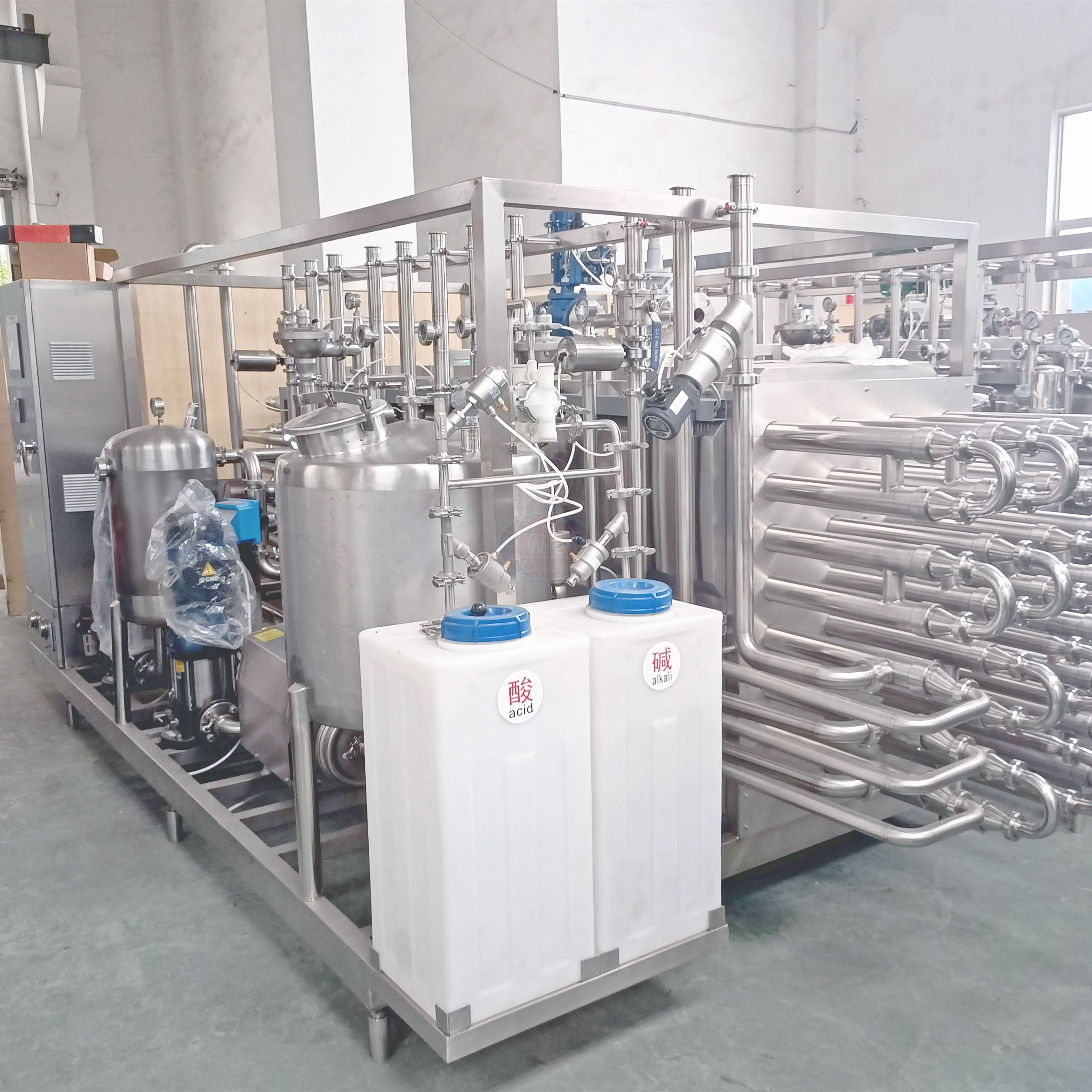
A UHT Sterilizer Machine utilizes fully welded or seamless tube construction. This eliminates the weak points found in gasketed plate systems. Tubular designs handle higher pressures safely. They process a much wider variety of fluid types without leaking or failing. The absence of complex gasket networks reduces maintenance downtime. It also provides a higher hygienic standard, as there are fewer crevices for bacteria to hide.
Consider the pressure drop across the system. Plate heat exchangers generate high pressure drops due to the narrow, tortuous paths between the plates. Pumping viscous fluids through these narrow gaps requires massive pump energy and often exceeds the pressure rating of the frame. Tubular systems offer a much lower pressure drop. The straight, open channels allow thick fluids to flow easily, reducing the load on your timing pumps and extending the life of your homogenizer valves.
Table: Heat Exchanger Technology Comparison
| Performance Metric | Plate Heat Exchanger | Tubular Heat Exchanger |
|---|---|---|
| Viscosity Limit | Low (Clear liquids, water, milk) | High (Purees, creams, sauces) |
| Particulate Handling | Poor (Prone to clogging) | Excellent (Up to 1/3 tube diameter) |
| Maximum Pressure | Typically up to 10-15 bar | Often exceeds 30 bar |
| Maintenance Needs | High (Frequent gasket replacement) | Low (Welded construction) |
| Footprint | Compact | Larger (Requires more floor space) |
Complex matrices require specific fluid dynamics for successful processing. Fresh milk, fruit juices, and heavy fruit purees all behave differently under heat. Dairy desserts, heavy creams, and chocolate milk present unique viscosity challenges. Non-Newtonian fluids, like purees, change viscosity under shear stress. A tubular geometry handles these variations effortlessly. The open channel design allows thick fluids to pass without generating excessive pressure drops.
Engineers follow a strict rule for particulate processing. Particle sizes must remain below one-third to one-fifth of the tube diameter. This ratio ensures unobstructed flow. It prevents particles from bridging across the tube and causing a blockage. It also guarantees uniform heat penetration straight to the particulate core. If a particle is too large, the outside may overcook while the inside remains unsterilized. Tubular systems provide the necessary space and flow characteristics to sterilize diced fruits and pulp safely.
When processing fluids exceeding 1000 centipoise, standard pumps struggle to maintain flow. The tubular design mitigates this by offering a larger cross-sectional flow area. This reduces the shear stress on the product. High shear can destroy the texture of yogurts and puddings, leading to a watery final product. By maintaining a low-shear environment, the tubular system preserves the mouthfeel and structural integrity of premium viscous foods.
Oat, soy, and almond milks introduce specific fouling challenges. Their starches and proteins behave differently than dairy proteins under high heat. Oat milk, for instance, contains beta-glucans that can gel and stick to heating surfaces. Soy proteins denature rapidly and form stubborn deposits. These characteristics make plant-based beverages notoriously difficult to process in standard plate heat exchangers.
Corrugated tubular designs create localized turbulence within the fluid stream. This turbulence mitigates boundary layer buildup along the tube walls. It prevents localized overheating of sensitive plant bases. The continuous mixing action ensures even heat distribution. Tubular systems provide safe and scalable sterilization. They help manufacturers meet the rapidly growing global demand for plant-based alternatives without sacrificing production efficiency.
Emulsion stability is another critical factor. Plant-based milks often rely on added emulsifiers and stabilizers to prevent separation. Rapid temperature spikes can break these emulsions, causing the fat to separate and form a layer on top of the beverage. The gradual heating profile of a tubular system protects the emulsion. It allows the stabilizers to hydrate properly and maintain a uniform suspension throughout the heating and cooling phases.
Some production lines require downstream homogenizers or aseptic fillers. These components often generate high back-pressure. Aseptic homogenizers, placed after the heating section, force the fluid through narrow valves at extreme pressures. This setup prevents contamination but puts immense stress on the upstream heat exchanger. Concentric and multi-tube configurations maintain exceptional mechanical integrity under these conditions.
They easily withstand internal pressures exceeding 20 to 30 bar. Plate systems simply cannot handle this level of stress without blowing gaskets. The welded tubes contain the pressure safely. Tubular systems become mandatory when your process demands sustained high-pressure operation. They provide the structural strength necessary to support complex aseptic processing lines.
High back-pressure also prevents the product from boiling inside the heat exchanger. When heating fluids to 140°C, the system pressure must remain well above the vapor pressure of water at that temperature. If the pressure drops, the product flashes into steam, causing cavitation and severe damage to the equipment. The robust construction of tubular systems allows operators to maintain high system pressures safely, ensuring the product remains in a liquid state throughout the entire sterilization cycle.
Multi-tube configurations offer impressive product-to-product heat regeneration capabilities. In this setup, the hot, sterilized product flows counter-current to the incoming cold, raw product. The heat transfers through the tube walls, pre-heating the raw fluid while simultaneously cooling the sterilized fluid. Facilities often recover 85 to 90 percent of their thermal energy using this method. This recovery drastically reduces utility consumption rates for both steam and chilled water.
Calculate the financial impact of this efficiency over a ten-year lifespan. The savings quickly offset initial equipment costs. Compare these utility consumption rates directly against direct steam injection systems, which offer zero product-to-product regeneration. The energy efficiency of indirect tubular heating becomes undeniably clear. Lower utility bills directly improve the profitability of high-volume beverage production.
To maximize regeneration, engineers design systems with extended regeneration zones. These zones use longer tube lengths to increase the surface area available for heat transfer. While this increases the physical footprint of the machine, the reduction in boiler fuel and cooling tower load justifies the space. You must evaluate your local utility rates to determine the optimal regeneration percentage for your specific facility.
Elastomeric plate gaskets require frequent replacement. This ongoing maintenance adds significant lifecycle costs. Opening a plate heat exchanger, replacing hundreds of gaskets, and re-tightening the frame is labor-intensive. It requires specialized tools and significant downtime. In contrast, the welded construction of a tubular system is incredibly low-maintenance. There are no internal gaskets to replace.
You must weigh the higher initial footprint and CapEx of tubular systems. Compare them against the long-term OpEx savings. You will spend less on maintenance and spare parts. Reduced CIP chemical usage also lowers daily operating expenses. Tubular systems drain easily and require less chemical volume to achieve proper cleaning velocities. This efficiency reduces environmental impact and lowers waste treatment costs.
Consider the cost of unexpected downtime. A blown gasket on a plate heat exchanger halts production immediately. You lose the product currently in the system, and you must spend hours cleaning up the spill and replacing the seal. Tubular systems eliminate this specific failure mode. The welded tubes provide predictable, reliable operation day after day. This reliability allows production managers to schedule maintenance proactively rather than reacting to emergencies.
Repeated thermal cycling causes expansion and contraction. When stainless steel heats to 140°C during sterilization, it expands significantly. When it cools during CIP or shutdown, it contracts. This continuous movement introduces a risk of tube fatigue and weld failure. If the inner tubes expand at a different rate than the outer shell, the resulting stress will crack the welds. You must manage mechanical stress proactively during the design phase.
Specify floating headers or expansion joints in the system design. A floating header allows the internal tube bundle to move independently of the outer shell. Modular U-bends also help absorb thermal stress safely. These engineering features prevent catastrophic leaks. They extend the equipment lifespan and ensure the system can handle daily temperature fluctuations without structural damage.
Vibration presents another mechanical risk. High-velocity fluid flow and nearby homogenizers generate vibrations that travel through the piping. Over time, this vibration causes metal fatigue at the mounting points. Secure the tubular heat exchanger to a rigid frame using heavy-duty, vibration-damping pipe hangers. Isolate the heat exchanger from the homogenizer using flexible stainless steel braided hoses to prevent vibration transmission.
Dead legs or inadequate flow velocity present severe biological risks. Unsterilized zones lead directly to product contamination. If CIP fluids cannot reach every internal surface, bacteria will survive and multiply. You must guarantee turbulent flow regimes inside corrugated tubes. Laminar flow simply glides over surface deposits, leaving soil behind. Turbulent flow creates a scrubbing action that removes denatured proteins and minerals.
Automate CIP flow rates to achieve Reynolds numbers greater than 4000. This mathematical threshold guarantees turbulence. Utilize conductivity sensors to validate chemical clearance thoroughly. These sensors detect the presence of cleaning acids or caustics in the rinse water. Proper validation ensures the system is completely sterile and free of chemical residue before the next production run begins.
Implement a strict CIP protocol to maintain hygiene. Follow these standard steps for effective cleaning:
A: Solid particulates must not exceed one-third to one-fifth of the internal tube diameter. This engineering rule prevents particles from bridging and causing blockages. It also ensures heat penetrates uniformly to the core of the particulate, guaranteeing commercial sterility without overcooking the liquid carrier.
A: Tubular systems use fully welded or seamless stainless steel tubes, eliminating internal gaskets. They handle high viscosity, particulates, and extreme pressures safely. Plate sterilizers use clamped corrugated plates with elastomeric gaskets. Plate systems are compact and cost-effective but are limited to low-viscosity, clear liquids at lower operating pressures.
A: Corrugated tubes induce localized fluid turbulence. This turbulence disrupts the thermal boundary layer along the tube wall. It improves heat transfer efficiency and mechanically scrubs the surface during operation. This action significantly reduces protein burn-on, delaying fouling and extending continuous production run times.
A: Yes. A single tubular system offers unmatched production versatility. Its open channel design accommodates varying fluid dynamics seamlessly. Operators can transition from processing clear apple juice to heavy mango puree on the same machine by adjusting flow rates and thermal profiles via the automation system.
A: Plant-based beverages contain starches and proteins that foul easily. Tubular systems utilize indirect heating with gradual temperature gradients. Combined with the turbulence generated by corrugated tubes, this prevents localized overheating. It protects sensitive oat, soy, and almond bases from thermal degradation and off-flavors.
A: Multi-tube configurations typically achieve product-to-product heat regeneration rates between 85 and 90 percent. The hot sterilized product pre-heats the incoming cold product through the tube walls. This highly efficient process drastically reduces the consumption of utility steam and chilled water.
A: Run times vary based on the product matrix. Clear juices can run for 24 hours or more. High-protein dairy or complex plant-based emulsions typically run for 8 to 12 hours before fouling dictates a CIP cycle. Corrugated designs maximize these windows compared to smooth tubes or plate systems.