Call Us
+86-15800763021
Send Us
Add
775 Chihua Road, Zhelin Town, Fengxian District, Shanghai
- All
- Product Name
- Product Keyword
- Product Model
- Product Summary
- Product Description
- Multi Field Search
Views: 0 Author: Site Editor Publish Time: 2026-01-23 Origin: Site

Preparation ensures high juice quality by selecting ripe oranges and controlling juice temperature.
Filling uses advanced machines to maintain hygiene and accuracy, preventing spills and waste.
Packaging locks in freshness and supports traceability, ensuring safe distribution of juice.
Automation in the production line boosts efficiency, reduces errors, and enhances product safety.
Regular quality checks during each step help maintain high standards and protect consumer health.
You begin the juice filling line by selecting ripe oranges and preparing them for extraction. The whole fruit extraction principle dominates the industry, producing over 75% of global citrus juice. You use advanced equipment such as belt presses, screw presses, and centrifuges to separate juice from pulp and ensure clarity. The process starts with fruit receiving and unloading, where you assess maturity and juice content for quality control. You focus on pulp control, oil removal, and enzyme deactivation to maintain quality and safety. Modern processing technologies help you balance product quality, operational efficiency, and food safety. Automated extraction methods, like metal cups with sharpened tubes or serrated reamers, allow you to maximize yield and consistency. You mix the extracted juice to achieve stable pulp levels and a uniform taste.
Equipment Type | Description |
|---|---|
Belt Presses | Extract juice from large batches of fruit efficiently. |
Screw Presses | Provide continuous extraction for various produce. |
Centrifuges | Separate juice from pulp, ensuring high yield and clarity. |
Commercial Orange Juicers | Designed for high-volume extraction in factories. |
Automatic Citrus Juicers | Enhance efficiency with fully automated systems. |
Industrial Juicing Machines | Handle significant quantities for large-scale production. |
You protect juice quality and safety by pasteurizing and sterilizing the product. Traditional pasteurization uses a temperature of 90°C for 60 seconds. This step inhibits microbial growth and extends shelf life. You heat the juice quickly to minimize Vitamin C loss while reducing harmful microorganisms. Hot-fill processes after pasteurization help maintain quality, but you must watch for spoilage bacteria like Alicyclobacillus acidoterrestris. You monitor temperature closely to avoid overheating, which can cause quality defects and reduce consumer appeal. Proper storage conditions after pasteurization are essential for preventing spoilage and ensuring the juice remains safe for consumption.
You prepare bottles for filling by blowing and rinsing them to remove contaminants. For PET bottles, you use air rinsing with high-pressure sterile air to eliminate dust particles. For glass bottles, you apply water rinsing, spraying sterile water or cleaning solution inside each bottle. You rely on bottle washing machine performance as a key quality control checkpoint. Rigorous sanitation practices reduce microbial load and help maintain juice quality. You ensure every bottle meets strict standards before moving to the next stage of the juice filling line.
Air rinsing: Used for PET bottles to remove dust.
Water rinsing: Used for glass bottles to clean with sterile water or solution.
Quality control and monitoring play a vital role throughout the preparation stage. You check fill volume accuracy, seal integrity, sensory evaluation, and Brix level and pH verification to meet quality standards. Cold chain management ensures proper temperature during storage and transport, preserving product quality.
Modern juice filling machines form the heart of the orange juice filling production line. You rely on these machines to deliver speed, accuracy, and hygiene. They help you fill every bottle or container with the right amount of juice, keeping the process efficient and safe for consumers.
You start the filling process by making sure each container is in the correct place. Juice filling machines use automation to move bottles into position. Automatic bottle feeding systems guide containers onto the conveyor. The machine orients, spaces, and stabilizes each bottle. This step reduces human error and keeps the line moving smoothly.
You can adjust the filling volume for different bottle sizes. Quick-change parts let you switch between container shapes and sizes without slowing down production. This flexibility is important for a juice filling machine, especially when you handle many types of juice packaging.
Once containers are in place, the juice filling machine begins dispensing juice. You can choose from several filling methods:
Volumetric filling measures a set amount of juice for each bottle.
Gravimetric filling uses weight to control the amount of juice.
Sterile filling keeps the process clean and safe.
Automated filling systems allow for high-speed filling.
No-drip nozzles prevent spills and keep the line clean.
The juice filling machine follows a clear sequence:
You calibrate the machine for the correct fill level.
The filling nozzles dispense juice into each container.
The system monitors the process and makes adjustments if needed.
After filling, the containers move to the next step for sealing or capping.
Containers travel along a conveyor system. Some juice filling machines include rinsing or sterilizing units to clean bottles before filling. This keeps the juice safe and fresh.
Type of Machine | Description |
|---|---|
Fully Automatic Juice Filling Machine | Designed for high-speed, high-volume production, integrating multiple processes for efficiency. |
Semi Automatic Juice Filling Machine | Offers a balance of automation and operator control, suitable for medium-scale operations. |
Manual Juice Filling Machine | Ideal for small production volumes, allowing for flexibility and lower initial costs. |
Specialty Juice Filling Machines | Includes machines for specific applications like pulp handling, pouch filling, and non-standard shapes. |
You can see how different juice filling machines fit different needs. A fully automatic juice filling machine works best for large-scale production. A semi automatic juice filling machine gives you more control for medium-sized batches.
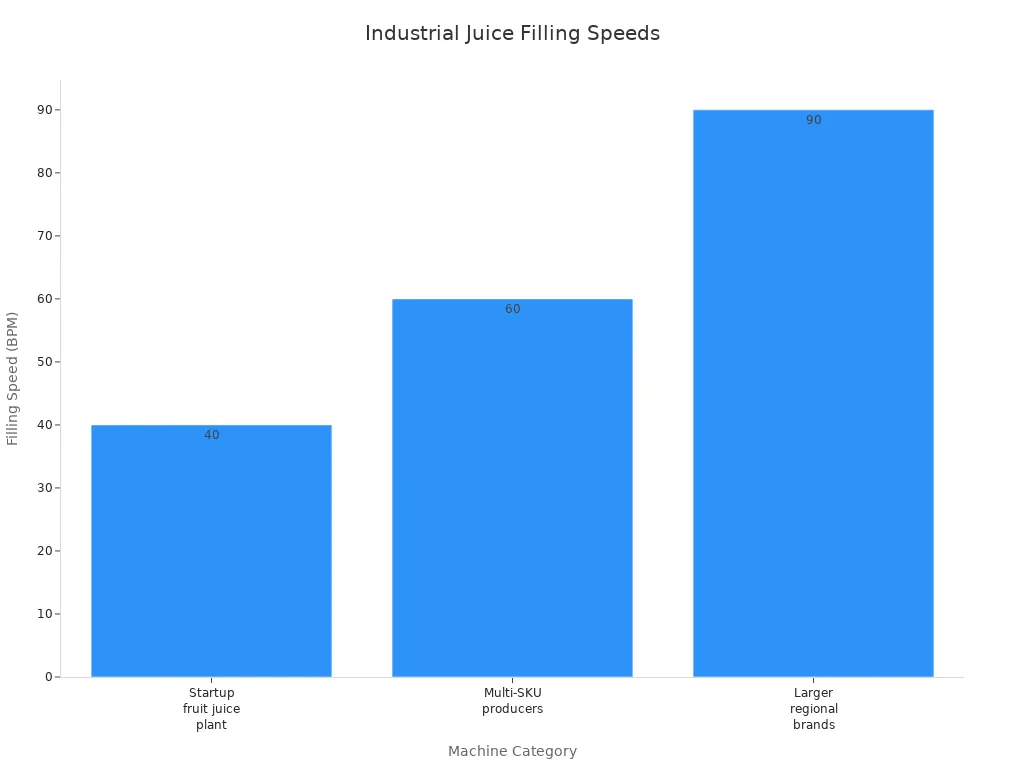
Filling Speed (BPM) | Best For | Typical Technology |
|---|---|---|
40 BPM | Startup fruit juice plant, short runs, limited SKUs, lower daily volumes | Linear gravity for clear juice; compact rotary for hot-fill small PET |
60 BPM | Multi-SKU producers with frequent changeovers; moderate daily demand | Rotary level fill for clear; volumetric (flowmeter) for pulpy juices |
90 BPM | Larger regional brands; multiple SKUs with hot-fill capability | Rotary hot-fill monoblock (rinse–fill–cap), servo flowmeter or high-speed gravity depending on product |
You must keep the filling process accurate and clean. Juice filling machines use precise measurement tools to make sure every bottle has the right amount of juice. You measure at a consistent temperature because heat can change the volume of juice. For bottles with unusual shapes, you use special methods to keep measurements correct.
You also control the flow rate during dispensing. The juice filling machine lets you pour juice smoothly, which prevents over-pouring and reduces waste. No-drip nozzles and controlled pouring keep the area clean and help maintain freshness.
Feature | Description |
|---|---|
Precise pouring | The design allows users to control the flow rate, preventing over-pouring. |
Easy and controlled | Facilitates a smooth dispensing experience, minimizing spills. |
Reduces spills | Designed to minimize product waste during dispensing. |
Maintains freshness | Ensures the product remains fresh from fill to the last drop dispensed. |
You follow strict hygiene protocols to prevent contamination. You inspect filling volume and sample bottles at least twice a day. You check cap tightening and printing quality as needed. You also perform visual inspections to catch any problems early.
Protocol Description | Frequency |
|---|---|
Filling volume inspection | 10 bottles checked at least 2 times a day |
Cap tightening check | As required |
Sampling and visual inspection | At least 2 times a day |
Printing quality check | As needed |
You secure every bottle with advanced capping and sealing technologies. Juice filling and sealing machines use high-speed capping to handle different cap types and bottle shapes. These machines feature hygienic, corrosion-resistant designs and user-friendly controls. You rely on snap cappers for plastic containers, which use pressure to create a tight seal. Juice sealing machines apply heat and force, preserving freshness and preventing leaks. You test seal integrity using vacuum leak testing and dye penetration testing. These methods help you spot weak seals and protect juice quality.
Testing Method | Description |
|---|---|
Vacuum Leak Testing | Place sealed packages in a vacuum chamber; air bubbles show leaks. |
Dye Penetration Testing | Use colored dye to reveal faulty seals. |
Safety standards guide your work. You check for proper soluble solids, acidity, color, and absence of defects. You make sure every bottle meets requirements for flavor, maturity, and low microbial load. You know that lapses in safety can harm consumers and damage your company’s reputation.
You apply labels and codes to each bottle using juice filling and capping machines. Labeling and packaging provide essential information for consumers and regulators. You include product identity, ingredient lists, nutritional facts, allergen warnings, and net contents. You add traceability codes and farm information to help track the juice through the supply chain.
Information Type | Description |
|---|---|
Consumer Information | Details about the product. |
Ingredient Lists | All ingredients in the juice. |
Allergen Warnings | Alerts for allergens. |
Traceability Codes | Track product through supply chain. |
Record Requirements | Key Data Elements for tracking events. |
Traceability Plan | Procedures and contacts for traceability. |
Farm Information | Farm name, address, and contact details. |
You follow regulatory requirements for labeling. You clearly state the type of juice, list ingredients by weight, and provide nutritional information. You include allergen details, net contents, and manufacturer contact information. Automation and software solutions help you maintain traceability and ensure product safety.
You prepare bottles for distribution using a juice bottling machine and automated palletizers. You build layers of cases on pallets, alternating orientation for stability. You use a pusher to slide layers onto the pallet. Stretch wrappers secure the load, and you move pallets to cold storage before shipping.
Step | Description |
|---|---|
1 | Build layers of cases on pallets, alternate orientation for stability. |
2 | Use a pusher to slide layers onto the pallet. |
3 | Wrap pallets with stretch wrappers for stability. |
4 | Transport pallets to cold storage before loading onto trucks. |
Automated palletizing increases throughput and reduces manual labor. You improve worker ergonomics and efficiency. Packaging preserves food quality and extends shelf life. You use recyclable cartons or bottles to meet environmental expectations. You ensure every bottle is ready for safe, traceable distribution.
You see how preparation, filling, and packaging steps work together in the orange juice filling production line to deliver safe, high-quality juice. Each step uses advanced technology and strict hygiene controls. The table below shows how these steps protect juice quality:
Step | How It Ensures Safety and Quality |
|---|---|
Preparation | Clean equipment prevents contamination |
Filling | Automated machines maintain hygiene and temperature |
Packaging | Sealing keeps juice fresh and safe |
Modern production uses automation and improved packaging to keep juice fresh and reduce waste. You benefit from these advancements every time you enjoy a bottle of juice. Appreciate the care and technology behind every sip.
You use a juice production line to process, fill, and package juice efficiently. This system includes machines for extracting juice, filling bottles, and sealing containers. You benefit from automation, which improves speed and maintains product safety.
You rely on sterilization and pasteurization to kill harmful microbes. Machines maintain clean surfaces and control temperature. You check bottles for cleanliness before filling. These steps help you deliver safe orange juice to customers.
You can use PET, glass, or carton bottles. Machines adjust to different shapes and sizes. You select bottles based on juice type and shelf life. Each bottle type supports hygiene and freshness in the fruit juice filling production line.
You use labeling to provide product information, traceability codes, and safety warnings. Labels help you meet regulations and build trust with customers. Accurate labeling supports tracking and recalls in the juice bottling production line.
You gain faster speeds and fewer errors with automation. Machines handle filling, capping, and packing. You reduce manual labor and improve consistency. Automation helps you maintain quality and efficiency in the juice beverage production line.