Call Us
+86-15800763021
Send Us
Add
775 Chihua Road, Zhelin Town, Fengxian District, Shanghai
- All
- Product Name
- Product Keyword
- Product Model
- Product Summary
- Product Description
- Multi Field Search
Views: 0 Author: Site Editor Publish Time: 2026-11-25 Origin: Site

You are pushing thousands of liters of juice through your facility daily. Scaling production brings massive revenue potential, but it also introduces a terrifying risk. A single contaminated batch can instantly destroy your brand reputation. Modern beverage processing cannot rely on manual scrubbing. It requires precise, automated sanitation to protect profit margins and consumer safety. Clean-In-Place technology is the absolute core of this food safety infrastructure.
Selecting the correct cleaning protocol is never a one-size-fits-all decision. Your specific physical and chemical line characteristics dictate the rules. Processing clear apple juice, pulpy orange nectar, or complex botanical fruit blends each demands a unique sanitation approach. This comprehensive guide breaks down how to evaluate equipment capabilities, master cleaning chemistry, leverage smart automation, and ultimately lock in the perfect cycle for your operational needs.
Looking at the broader beverage manufacturing sector, we are witnessing a massive operational shift. Facing increasingly strict municipal wastewater regulations and soaring energy costs, facility managers are aggressively abandoning traditional, resource-heavy cleaning methods. Current market analysis reveals a surging adoption of data-driven optimization. Modern automatic juice production lines now utilize smart algorithms that analyze real-time soil loads. These systems dynamically adjust cycle times and water usage rather than relying on rigid timer presets.
Concurrently, the booming consumer market for cold-pressed, unpasteurized juices has introduced unique microbial challenges. Without a thermal kill step, facilities are forced to rethink their sanitization limits. We are seeing a strong pivot toward advanced chemical oxidizing agents that leave zero toxic environmental footprint, ensuring absolute commercial sterility without compromising the raw nature of the product.
Implementing a standardized cleaning protocol is a fundamental requirement in modern beverage manufacturing. Specialized automated systems function as the primary defense against microbial contamination. They ensure heavy machinery is sanitized seamlessly between batches without requiring complete disassembly.
Imagine the internal piping after a heavy production run of mango nectar. The stainless steel surfaces are coated in sticky natural sugars, fibrous fruit pulp, complex carbohydrates like pectin, and varying levels of titratable acidity. These complex fruit-derived soils present severe sanitation hurdles.
When left uncleaned, these organic compounds create an optimal breeding ground for spoilage organisms. Yeast, mold, and acid-tolerant bacteria thrive in these sugary environments. Alicyclobacillus is a prime example. If these microorganisms establish a biofilm inside holding tanks, they become highly resistant to standard sanitizers. A robust cleaning cycle must physically and chemically strip these soils from surfaces before biofilm formation even begins.
The efficiency of your sanitation protocols directly influences final product safety and overall facility profitability. An optimized process minimizes non-productive downtime during flavor changeovers. Transitioning from a pungent ginger-citrus blend to a delicate pear juice requires absolute residue removal to prevent disastrous flavor carryover.
Automated cleaning protocols actively extend the shelf life of the packaged juice. By ensuring absolute commercial sterility in the holding tanks and piping networks before the filling process initiates, manufacturers effectively mitigate the risk of premature spoilage. This proactive approach protects brand integrity and slashes the likelihood of costly product recalls.
A highly functional cleaning system relies on specialized hardware components working seamlessly together. Understanding these physical assets is the first step toward optimizing your plant sanitation workflow.
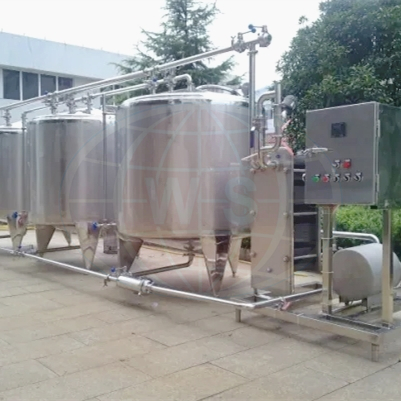
The centralized operational hub is where the cleaning chemistry is prepared and dispatched. This modular unit houses chemical storage tanks, high-pressure centrifugal pumps, tubular heat exchangers, and automated dosing valves. When engineering this setup, you must carefully evaluate the total volume of the piping network and the dimensions of the largest holding tank.
Industrial-grade solutions, such as a high-performance CIP Skid, offer customizable capacities ranging from 500L up to 10,000L. Depending on your throughput, you might select a 3-tank setup for standard acid, alkali, and water distribution. For higher volume operations, a 4-tank configuration handles complex chemical recovery processes. Driven by advanced Siemens PLC controls, these units guarantee that cleaning fluids are consistently delivered at the exact flow rate and temperature required to achieve turbulent flow.
Chemical dissolution alone will never clean a large-scale vessel. You need mechanical kinetic force to physically dislodge soils. This critical action is delivered via a specialized Spray Ball securely mounted at the top of processing tanks.
Static devices have no moving parts. They rely on a high volume of fluid cascading down the tank walls, making them suitable for simple rinsing tasks in clear juice tanks. Dynamic rotary jet heads are a completely different beast. They rotate on multiple axes, directing high-impact jets of cleaning fluid in a precise 360-degree pattern. These dynamic units are absolutely essential for blasting away stubborn dried-on fruit pulp, seeds, and pectin build-up in massive blending tanks.
The distribution of these cleaning fluids relies entirely on a complex network of hygienic piping and automated valve matrices. Mixproof valves are critical here. This advanced valve technology prevents cross-contamination. It ensures that aggressive cleaning chemicals running through one pipeline cannot accidentally bleed into an adjacent pipeline carrying the actual consumable juice product.
Selecting the appropriate sequence of cleaning steps drives operational efficiency. Different juice profiles leave behind wildly different types of residue. This necessitates highly tailored cleaning protocols.
The 3-step sequence is a streamlined process designed specifically for manufacturing environments dealing with light soil loads. An ambient water pre-rinse flushes out the majority of loose sugars. Next, a heated alkaline wash is circulated to dissolve remaining organic matter. Finally, fresh potable water removes all traces of the cleaning chemicals.
This rapid CIP Cycle is best suited for simple, clear beverages such as filtered apple, white grape, or clarified cranberry juice. In these applications, heavy particulate matter and stubborn pectin are entirely absent.
More demanding applications make a comprehensive 5-step sequence mandatory. This expanded protocol includes a high-volume pre-rinse, an extended heated alkaline wash to break down sticky fibers, an intermediate water flush, a targeted acid wash to dissolve inorganic mineral scaling, and a final rinse followed by thermal sanitization.
This heavy-duty wash is an absolute requirement for high-pulp juices, thick nectars, and smoothies. It is also critical for production lines that suffer from stubborn calcium deposits derived from hard facility water or specific fruit profiles.
Facilities must strategically choose between single-use and recovery systems. Single-use setups dump the water and chemicals down the drain after exactly one cycle. This minimizes cross-contamination risks but drastically increases consumable overhead. Recovery systems capture the alkaline and acidic solutions, filter them, and store them for subsequent cycles. They demand a higher initial capital expenditure but significantly slash chemical consumption and wastewater treatment costs.
The efficacy of any automated sanitation process relies heavily on the precise application of industrial cleaning chemistry. Utilizing the correct chemical agents at exact strengths ensures soils are completely eradicated without degrading the stainless steel infrastructure.
Sodium Hydroxide serves as the primary cleaning agent in beverage processing. Its high alkalinity triggers saponification and hydrolysis, effectively dissolving complex sugars, proteins, and sticky pectin residues.
Maintaining the exact Caustic Concentration is a delicate operational balance. A concentration between 1% and 2% by volume is typically sufficient for standard juice processing. For heavy burn-on soils found inside pasteurizers, the concentration must be aggressively increased to 3%. If the concentration dips too low, the organic matter will not dissolve. If it spikes too high, you waste expensive chemicals and rapidly degrade the elastomers and seals within the piping network.
Alkaline solutions excel at obliterating organic matter, but they are completely ineffective against inorganic build-up. Calcium, magnesium, and fruit-derived oxalates form a hard mineral scale on equipment surfaces over time. An acid wash utilizing Nitric or Phosphoric acid at a concentration of 0.5% to 1.5% combats this phenomenon. The acid effectively dissolves the mineral scale, restoring the microscopic smoothness of the stainless steel.
Cleaning removes the soil, but sanitization actually kills the microorganisms. Thermal sanitization circulates hot water above 85 degrees Celsius for 15 to 30 minutes to achieve microbial death. Chemical sanitization utilizes agents like peracetic acid, which is highly effective at ambient temperatures and breaks down into environmentally safe byproducts right before the next juice batch commences.
Modernizing a facility means systematically removing human error from the sanitation equation. Advanced sensor technology transforms a historically manual cleaning process into a highly reliable, data-driven operation.
A Return Conductivity sensor is a critical analytical instrument installed on the return line of the centralized skid. It continuously measures the electrical conductivity of the liquid flowing back from the processing tanks. Cleaning chemicals contain highly mobile ions, exhibiting a distinctly higher electrical conductivity than fresh municipal water.
The plant automation system uses these real-time readings to determine exactly what fluid is currently in the pipe. When the sensor detects the conductivity has reached the specific setpoint associated with a 2% alkaline solution, the system definitively confirms the required chemical strength has been achieved. This guarantees cleaning efficacy and officially initiates the cycle timer.
Operators in older manual systems often relied on arbitrary visual timers to determine when to switch from a chemical wash back to a water rinse. This guesswork frequently resulted in the premature dumping of expensive cleaning agents.
Smart sensors optimize this fluid transition perfectly. As the chemical is pushed back to the recovery tank by the incoming rinse water, the conductivity drops. The exact millisecond the conductivity matches that of fresh water, the system instantly redirects the flow to the drain. This unparalleled precision prevents chemical waste and shrinks the overall water footprint of the automatic juice production line.
Selecting the appropriate sequence is a critical engineering decision. Implementing a generic cleaning protocol across all product types invariably leads to either inadequate sanitation or massive resource waste.
The particulate content and viscosity of your product are the primary factors in determining the necessary cleaning sequence. Clear juices primarily leave behind water-soluble sugars and light organic residues. These soils lack complex structural matrices and are relatively easy to flush away. A standard 3-step sequence is typically sufficient. The mechanical action required is minimal, meaning a standard static spray device can effectively distribute the cleaning fluids.
Highly viscous products like mango puree or orange juice with heavy pulp present severe cleaning challenges. These beverages contain high levels of insoluble fibers and pectin. Pectin forms sticky gel-like deposits that adhere stubbornly to stainless steel surfaces. Cleaning these pectinaceous soils requires a comprehensive 5-step sequence that includes an intermediate rinse and a mandatory acid wash. Rotary jet heads are required to provide high-impact mechanical scrubbing.
| Parameter | Clear Juices | High-Pulp / Viscous Juices |
|---|---|---|
| Recommended Sequence | 3-Step Standard Wash | 5-Step Heavy-Duty Wash |
| Primary Soil Type | Water-soluble sugars, light organics | Insoluble fibers, pectin, heavy organics |
| Alkaline Concentration | 1.0% - 1.5% | 2.0% - 3.0% |
| Spray Device Type | Static Spray Ball | Rotary Jet Head |
| Acid Wash Requirement | Periodic Weekly / Monthly | Mandatory Every Cycle |
Modern beverage facilities frequently process multiple SKUs on the exact same equipment to maximize asset utilization. Switching from a heavily spiced ginger blend to a delicate white grape juice introduces a massive risk of sensory contamination. Essential oils found in citrus products are hydrophobic. They resist being washed away by water alone and embed themselves into the microscopic pores of polymer gaskets.
Your cleaning protocol must be adapted to neutralize these aromatic compounds. This often involves extending the chemical circulation time or introducing specific food-safe surfactants into the mix to emulsify the stubborn essential oils. A highly precise automated system ensures the transition between different chemical phases is executed flawlessly.
The thermal treatment applied to the juice drastically alters the nature of the residual soils. Cold-pressed juice lines operate at low temperatures, meaning the sugars and proteins remain in their natural unbaked state. The primary concern here is microbial control. The focus is on thorough sanitization and removing raw organic matter without the complication of heat-induced soil adhesion.
Pasteurized lines utilizing Ultra-High Temperature processes face severe thermal fouling. When juice is exposed to high heat in a heat exchanger, proteins denature and sugars undergo rapid caramelization. This creates a hard baked-on crust that is exceptionally difficult to remove. Pasteurized lines demand the most aggressive cleaning protocols available, operating at elevated temperatures and strictly mandating a subsequent acid wash.
Designing the perfect cleaning protocol is only the first step. Maintaining and optimizing that system ensures long-term operational success. An inefficient cleaning process jeopardizes food safety and drains plant profitability through excessive utility consumption.
The absolute foundation of any successful automated cleaning operation is the TACT principle. TACT represents the four interdependent variables of cleaning: Time, Action, Concentration, and Temperature. Understanding how these variables interact is essential for field troubleshooting.
The defining characteristic of the TACT principle is interdependence. If you drop the temperature to protect a sensitive sensor, you must proportionally increase the chemical concentration or extend the contact time to achieve the exact same cleaning efficacy.
Even the most advanced automated systems require proactive mechanical maintenance. Neglecting the physical infrastructure will eventually lead to catastrophic hygiene failures.
Spray devices are highly susceptible to clogging, particularly in facilities processing pulpy juices. A single clogged orifice creates a dangerous shadow inside the tank where cleaning fluids never reach. Bacterial biofilms will flourish unseen in these dry areas. Routine visual inspections and manual cleaning of these devices are non-negotiable. Pump seals must be inspected for wear to prevent chemical leaks, and heat exchangers must be periodically descaled to maintain thermal transfer efficiency.
Choosing the correct cleaning parameters is not merely a compliance checkbox. It is the ultimate safeguard for your juice production line. By carefully balancing mechanical action, precise chemical concentrations, and smart automation, beverage manufacturers can achieve a flawless sanitation process batch after batch.
Stop guessing with your plant sanitation. Protect your brand reputation, eliminate chemical waste, and maximize your production uptime by upgrading to intelligent, fully automated systems. Explore the high-performance CIP solutions at WFOOD Machinery to find the exact engineering match for your specific processing volume and liquid profile.
Temperature settings depend on the specific cycle phase and the type of soil. Pre-rinses are typically run at ambient or warm temperatures around 35 to 45 degrees Celsius to prevent baking sugars onto the tank walls. The alkaline wash phase usually requires elevated temperatures between 70 and 85 degrees Celsius to effectively break down organic fats and proteins. Final thermal sanitization phases push water temperatures above 85 degrees Celsius to ensure complete microbial destruction.
The frequency is dictated by production schedules and product characteristics. At a minimum, a full cycle must be executed immediately after a production run concludes or before a major flavor changeover. For continuous operations processing highly viscous or high-protein liquids, a mid-run cleaning cycle may be required every 12 to 24 hours to prevent severe thermal fouling in heat exchangers. Cold-pressed raw juice lines often require more frequent sanitization intervals to maintain strict microbial control.
The duration is entirely dependent on the complexity of the beverage. A standard 3-step cycle designed for clear juices typically requires 30 to 45 minutes to complete the pre-rinse, chemical wash, and final rinse phases. A comprehensive 5-step cycle required for a high-pulp production line or a heavily fouled pasteurizer is much more involved. Incorporating intermediate rinses and mandatory acid washes extends the total cleaning duration to approximately 60 to 90 minutes.
Maintaining an alkaline concentration between 1.0% and 2.0% is generally sufficient to achieve saponification and dissolve residual sugars and light pectin in standard processing environments. Operational parameters must be adjusted for severe fouling. For heavy burn-on soils found in thermal pasteurizers or highly viscous fruit purees, the concentration is typically increased to 2.5% or 3.0% to provide the necessary chemical aggression.
These sophisticated sensors measure the electrical resistance of liquids. Because water has low conductivity and cleaning chemicals have high conductivity, these sensors accurately detect the exact moment the fluid phase transitions inside the pipes. This precision prevents the automation system from flushing expensive reusable chemicals down the drain prematurely. It also significantly minimizes the volume of clean municipal water used during the rinse phases, driving substantial utility savings.
Yes, modern engineering allows for highly efficient parallel cleaning. A multi-channel centralized skid is specifically designed with independent pumps, heat exchangers, and dosing systems. This architecture allows a facility to clean different sections of a production line simultaneously. The system can perform an alkaline wash on a raw ingredient holding tank on channel one while simultaneously executing an acid wash on the filler block on channel two.
When dealing with sticky, fibrous, or pulpy juice residues, a dynamic rotary jet head is highly recommended over a traditional static device. Static devices rely entirely on cascading water to remove soils, which lacks the necessary kinetic energy to dislodge dried fruit fibers. A rotary jet head utilizes an internal gear mechanism to shoot concentrated high-impact jets of fluid in a precise 360-degree pattern, providing aggressive mechanical scrubbing action.