
Views: 0 Author: Site Editor Publish Time: 2026-08-27 Origin: Site


Commissioning a commercial water bottling facility involves high capital expenditure and massive operational stakes. Selecting a vendor based solely on initial equipment cost often leads to integration failures. Unscheduled downtime and compliance breaches quickly erode profitability. A fragmented approach to sourcing machinery creates severe operational bottlenecks across the plant floor. You must weigh the long-term return on investment of purchasing a dedicated system from an established water processing plant manufacturer against the operational limitations of private-label outsourcing. Building your own facility provides absolute control over quality, output, and production schedules. A reliable drinking water production line supplier must function as an end-to-end integrator. They ensure every machine communicates flawlessly from raw water intake to final palletization. We will explore a comprehensive framework for vetting suppliers based on engineering capabilities, equipment reliability, and lifecycle support.
Sourcing individual machines like blow molders, fillers, and labelers from different vendors creates immediate integration risks. An integrated, end-to-end system ensures mechanical and software synchronization across the entire facility. Piecemeal sourcing often results in severe finger-pointing between multiple vendors when line synchronization fails. If the filler jams because the blow molder outputs inconsistent preforms, no single vendor takes responsibility. A turnkey partner guarantees the production sequence operates seamlessly. This sequence includes raw water treatment, blow molding, filling, capping, labeling, and final packaging.
When you buy a filler from one company and a labeler from another, the conveyors between them become a battleground. The PLC from the filler might not communicate the correct speed to the labeler's PLC. This causes bottles to back up, crash, and fall off the line. A single supplier designs the entire conveyor logic. They program the accumulation tables to absorb micro-stoppages. If the labeler runs out of glue, the system automatically slows down the filler instead of crashing the line. This level of integration requires a deep understanding of fluid dynamics and mechanical timing.
| Evaluation Metric | Piecemeal Sourcing | Turnkey Integration |
|---|---|---|
| System Synchronization | High risk of software and mechanical mismatch. | Pre-engineered for seamless communication. |
| Vendor Accountability | Fragmented; prone to vendor disputes. | Single point of contact and responsibility. |
| Installation Time | Lengthy; requires custom integration onsite. | Streamlined; pre-tested before shipment. |
| Conveyor Logic | Requires third-party programming. | Native speed-matching and accumulation. |
A credible manufacturer requires a detailed raw water analysis before proposing any equipment. They must evaluate Total Dissolved Solids (TDS), microbial load, and heavy metals. This data dictates the specific filtration media and membrane configurations required. Equipment specifications must align perfectly with target production capacities, measured in Bottles Per Hour (BPH). The system must also accommodate specific container formats like PET, glass, or gallon jugs. A capable supplier designs the line to handle diverse bottle sizes and shapes efficiently. They will provide clear metrics on their system's tooling changeover times to minimize production interruptions.
Raw water from a municipal source behaves differently than water drawn from a deep limestone aquifer. High silica content will foul reverse osmosis membranes rapidly if you do not install the correct pre-treatment dosing systems. A competent supplier will ask for a seasonal water report. They know that turbidity spikes during spring runoffs. They will size the multi-media filters to handle these worst-case scenarios. If they just quote a standard filter block without looking at your water chemistry, walk away. You will end up replacing expensive RO membranes every three months.
A reliable supplier guides investors through the complex decision matrix of automation levels. Semi-automated lines require lower initial capital but demand higher labor dependency. Fully automated lines optimize operational expenditures and significantly lower contamination risks. You must evaluate parameters for scaling automation as production demands grow over time. Modular designs allow you to upgrade from manual packing to robotic case packers without replacing the core filler. The right supplier ensures your initial layout leaves physical and systemic room for these future automation upgrades.
Consider the end-of-line packaging. Starting with manual palletizing makes sense for a 2,000 BPH line. When you scale to 12,000 BPH, human operators cannot keep up. The supplier should design the initial floor plan with an empty 400-square-foot zone at the end of the line. They should also install a PLC with enough spare I/O ports to connect a robotic palletizer later. This forward-thinking approach prevents you from having to tear up concrete or replace main control panels when you expand.
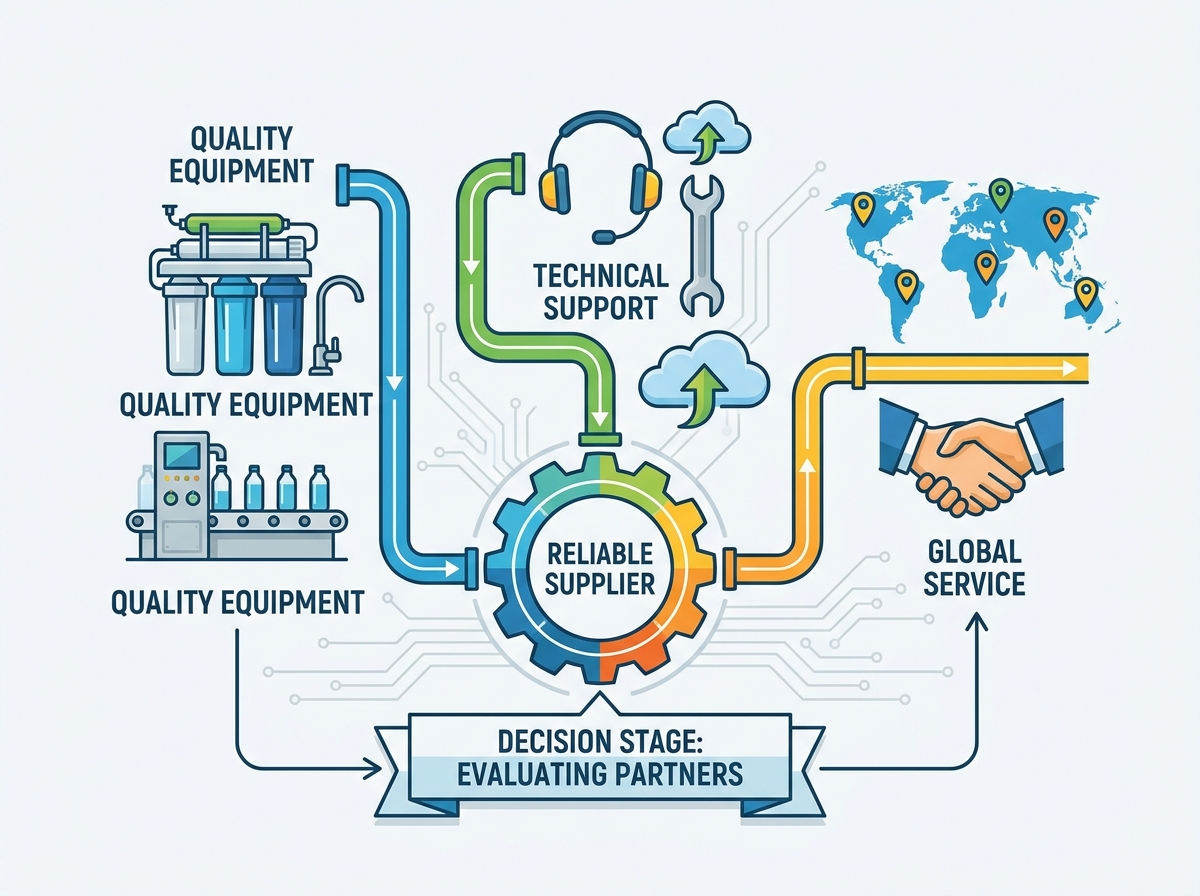
A commercial purified water production line requires rigorous multi-stage filtration components. Standard configurations include Reverse Osmosis, UV sterilization, Ozonation, and Ultrafiltration modules. You must evaluate the supplier’s sanitary piping design meticulously. Look for 316L stainless steel construction, zero dead-leg valves, and high-quality orbital welding. These specific design choices prevent biofilm accumulation and bacterial contamination within the fluid path. Proper sanitary design ensures the final product consistently meets strict health and safety standards.
Orbital welding is non-negotiable for the product fluid path. Manual welding leaves microscopic pits and crevices inside the pipe. Bacteria colonize these pits. Even aggressive chemical cleaning cannot reach them. A proper supplier uses automated orbital welders and inspects the welds with a borescope. They will provide a weld log documenting the gas purge and heat settings for every joint. Furthermore, all valves must be sanitary diaphragm valves or butterfly valves designed to eliminate dead legs where stagnant water can sit.
Evaluate the mechanics of gravity filling versus volumetric and flow-meter filling for specific water applications. Gravity filling works well for still water, while volumetric systems offer exact fill levels regardless of bottle expansion. Capping torque accuracy is critical to prevent leakage and maintain product integrity. Neck-handling technology allows the machine to transport bottles securely without crushing lightweight PET walls. Cap sterilization modules are necessary to minimize material waste and prevent downstream contamination. You must also evaluate the versatility of the filling valves when handling different bottle volumes and neck diameters.
Modern PET bottles are incredibly thin to save plastic. If the filler grips the bottle by the base, the downward pressure of the filling valve will crush it. Neck-handling systems suspend the bottle by the rigid plastic ring just below the threads. This allows you to run ultra-lightweight bottles without jamming the machine. The capping heads must feature magnetic clutches. This ensures the machine applies the exact rotational force required to seal the cap without stripping the plastic threads. Mechanical clutches wear out and apply inconsistent torque, leading to leaking bottles in the warehouse.
The integration of upstream blow molding machines dictates the rhythm of the entire plant. You must evaluate preform heating efficiency and blowing air recovery systems to ensure operational stability. Downstream drinking water bottling equipment requires equal scrutiny for seamless operation. This includes laser date-coding, hot-melt or sleeve labeling, shrink-wrapping, case packing, and robotic palletization. A disruption in the labeling machine will quickly cause backups at the filler if accumulation tables are not properly sized. End-to-end integration ensures continuous flow without bottlenecking.
Air recovery in the blow molder is a massive operational factor. Blowing a PET bottle requires high-pressure air, often up to 40 bar. Once the bottle is formed, that high-pressure air exhausts into the atmosphere. Advanced blow molders capture this exhaust air and route it to the low-pressure pneumatic cylinders that operate the machine's moving parts. This reduces the load on your factory air compressors. When evaluating a supplier, inspect the pneumatic schematics to confirm they utilize air recovery technology.
Evaluate the supplier’s use of standardized Programmable Logic Controllers (PLCs) and Human-Machine Interfaces (HMIs). Industry-standard platforms like Siemens or Allen-Bradley ensure you can find local technicians for troubleshooting. Automated Clean-in-Place (CIP) and Sterilize-in-Place (SIP) systems maintain operational hygiene without manual intervention. Sensor-driven line synchronization is absolutely vital for high-speed operations. Accumulation tables and speed-matching sensors prevent bottle collisions, jams, and line starvation. These controls dynamically adjust machine speeds based on upstream and downstream conditions.
A proprietary PLC is a massive red flag. If the supplier uses a custom circuit board, you are locked into buying parts from them forever. If they go out of business, your multi-million dollar line becomes a paperweight. Always specify open-architecture controls. The HMI screens should provide deep diagnostic data. Instead of a generic "Fault 404," the screen should display a 3D model of the machine, highlighting the exact photo-eye sensor that is blocked. This reduces troubleshooting time from hours to seconds.
The supplier must provide detailed 2D and 3D facility layout planning before manufacturing begins. This ensures optimal workflow, safety clearance, and spatial efficiency within your specific building footprint. Standard FAT protocols are non-negotiable for mitigating implementation risks. Require the supplier to run the fully integrated line at specified contract speeds using your actual preforms, caps, and labels. This must happen before the equipment ships. Emphasize the value of video-documented run-throughs and structural component inspections during this pre-shipment phase to verify build quality.
Do not accept a FAT that only runs for twenty minutes. A machine can run perfectly for a short burst. You need to see it run continuously for at least four hours to identify thermal expansion issues, bearing overheating, or software memory leaks. Bring your own operators to the FAT. Let them perform a bottle size changeover under the supervision of the supplier's engineers. If the changeover takes four hours instead of the promised forty-five minutes, you have leverage to demand mechanical modifications before the equipment leaves their factory.
A global supplier must meet strict, non-negotiable certifications to ensure safety and legality. Look for CE marks, ISO 9001 compliance, UL listings, and FDA food-grade material verification. Equipment design directly impacts local health department approvals and operational licensing. Third-party food safety audits, such as NSF, SQF, or FSSC 22000, rely heavily on the sanitary design of your machinery. Non-compliant equipment will fail these audits, halting your production and delaying market entry indefinitely.
Inspect the electrical cabinets. They must carry a UL or CE rating depending on your region. Uncertified electrical panels will fail local fire marshal inspections, preventing you from turning on the power. The supplier must provide material certificates for all plastics and rubbers that touch the water. The gaskets in the filling valves must be food-grade EPDM or Viton. If the supplier cannot produce a binder full of material traceability documents, your facility will fail its first SQF audit.
Mechanical wear and tear is an unavoidable reality in high-speed bottling operations. A reliable Service Level Agreement (SLA) defines your recovery time during unexpected breakdowns. Demand guaranteed response times for technical support and remote PLC diagnostics capabilities. The supplier must maintain regional warehousing of critical spare parts to prevent extended downtime. Wear parts like seals, cutting blades, and heating elements must be readily available. Fast access to these components keeps your production line running and protects your delivery schedules.
Remote diagnostics change the game for maintenance. The supplier should install a secure VPN router in the main control panel. When a complex software fault occurs, their engineers can log into your PLC from across the world. They can monitor sensor inputs in real-time and force outputs to test valves. This eliminates the need to fly a technician out for a simple programming glitch. Ensure your IT department clears the security protocols for this remote access before the machines arrive on site.
A: Commercial bottling equipment typically lasts 10 to 15 years with rigorous preventive maintenance. However, electronic components, sensors, and PLC platforms may require upgrading or software patching much sooner to maintain peak efficiency.
A: Request their ISO and CE certifications directly. Review third-party food-grade material compliance reports for their fluid-path components. Most importantly, demand case studies or direct site visits to operational plants they have successfully commissioned.
A: Purified lines rely heavily on Reverse Osmosis to strip all minerals and impurities from the source water. Mineral water lines use selective microfiltration and ozone treatment to retain natural mineral profiles, requiring entirely different filtration modules.
A: Depending on line capacity and facility readiness, the process varies. Installation, physical line integration, and Site Acceptance Testing (SAT) typically range from 3 to 8 weeks after the equipment is delivered to your facility.
A: FAT proves the machinery meets contractual speeds and quality standards using your specific preforms and caps. This testing occurs before the equipment leaves the supplier's facility, effectively mitigating expensive onsite integration failures.
A: Generally, dual-material lines are uncommon and highly expensive. They require entirely different conveying, rinsing, filling, and capping mechanisms. It is highly recommended to select a dedicated line optimized specifically for either PET or glass.