Call Us
+86-15800763021
Send Us
Add
775 Chihua Road, Zhelin Town, Fengxian District, Shanghai
- All
- Product Name
- Product Keyword
- Product Model
- Product Summary
- Product Description
- Multi Field Search
Views: 0 Author: Site Editor Publish Time: 2026-08-09 Origin: Site

Industrial cream cheese and spreadable cheese manufacturing requires precise control over emulsion stability, thermal processing, and mechanical shear to maintain product integrity at scale. Transitioning from pilot-scale to high-volume production often introduces batch inconsistencies, syneresis (whey separation), and texture degradation. Processors must balance throughput demands and short processing times with strict rheological and food safety requirements. Scaling up magnifies minor formulation errors. A slight miscalculation in shear rate ruins an entire batch. You need equipment that handles high viscosity without breaking the protein matrix.
This guide breaks down the critical components of a commercial cream cheese production line, providing a technical evaluation framework for selecting equipment that ensures consistent quality, operational flexibility, and regulatory compliance. We examine the exact mechanics of raw material handling, thermal treatment, and homogenization. You will learn how to evaluate machinery based on shear adjustability and footprint constraints. We also address the physical bottlenecks that occur during commissioning and scale-up, offering practical mitigation strategies for your facility.
Identifying the baseline mechanical requirements to transform raw dairy or recombined ingredients into a stable, spreadable emulsion within an optimized processing time determines your operational success. You must move highly viscous materials through various thermal and mechanical stages. Each stage must perform its function without degrading the work of the previous step. A poorly integrated component creates a bottleneck that compromises the entire batch. Plant engineers must map the rheological changes of the cheese mass from a liquid state to a semi-solid gel.
Integrating industrial cutters to efficiently break down bulk cheese blocks or raw curds before they enter the blending phase saves immense processing time. Solid blocks of dairy fat and protein resist immediate blending. Heavy-duty flakers and twin-screw grinders slice these blocks into uniform ribbons or pellets. This increases the surface area of the raw material. Greater surface area allows heat and mechanical shear to penetrate the mass faster during the initial mixing phase. If you drop whole 20-kilogram blocks directly into a mixing vat, you risk bending the agitator shafts and extending your batch time by hours.
Evaluating systems for incorporating dry ingredients (milk powders, stabilizers) and fats (anhydrous milk fat, cream) into the aqueous phase without agglomeration requires looking at powder induction technology. Dumping powders directly onto the surface of a liquid creates floating clumps. The outside of the clump hydrates, forming a gel barrier. The inside remains dry powder. Inline high-shear mixers pull powders directly into the liquid stream under a vacuum using the venturi effect. This forces immediate hydration and prevents fish-eyes from forming. The rotor-stator workhead shears the powder into the liquid at tip speeds exceeding 25 meters per second.
Assessing vacuum mixing technology to prevent aeration is non-negotiable for premium spreads. High-speed blending naturally whips air into the product. Trapped oxygen accelerates lipid oxidation, leading to rancid off-flavors. Air pockets also ruin the smooth visual finish of the cheese and cause inaccurate fill weights at the packaging machine. Pulling a hard vacuum (often down to -0.8 bar) during the blending phase extracts this air before the emulsion sets. Vacuum processing also lowers the boiling point of the mixture, allowing for gentle moisture evaporation if you need to adjust the final solids content.
The role of scraped surface heat exchangers (SSHE) vs. direct steam injection in managing highly viscous products without causing burn-on defines your heating strategy. Standard plate heat exchangers fail with thick cheese spreads. The product clogs the plates and burns onto the hot surfaces. SSHE units feature internal rotating blades made of PEEK or Teflon. These blades continuously scrape the heated cylinder walls. This action prevents fouling and ensures uniform heat transfer throughout the thick mass. The scraping action also provides a secondary mixing effect, keeping the emulsion homogeneous during the critical heating phase.
Direct steam injection (DSI) offers a faster heating alternative. Steam injects directly into the cheese mass, raising the temperature instantly. This method requires culinary-grade steam free of boiler chemicals. You must calculate the added moisture from the condensed steam and adjust your initial water ratios accordingly. DSI is highly efficient but applies intense localized heat. Maintaining precise cooking temperatures ensures proper melting and blending of cheese, water, and fats without breaking the emulsion. Temperature spikes cause fat separation, leaving a greasy layer on the final product.
Establishing required heating and cooling cycles achieves microbial safety while initiating the desired protein denaturation. Pasteurization kills pathogenic bacteria and extends shelf life. The exact time and temperature parameters dictate the final firmness of the cheese. Heating unfolds the dairy proteins. As the product cools, these proteins form a new, stable matrix holding the water and fat in place. Rapid, controlled cooling is just as important as the heating phase. Slow cooling allows the fat globules to coalesce, resulting in a grainy mouthfeel.
Thermal Processing Methods Comparison
| Heating Technology | Mechanism of Action | Viscosity Handling | Moisture Impact |
|---|---|---|---|
| Scraped Surface Heat Exchanger | Indirect heating via jacketed cylinder with internal scraper blades. | Excellent for high-viscosity and particulate-heavy spreads. | No moisture added to the product. |
| Direct Steam Injection | Direct introduction of culinary steam into the product flow. | Good for medium-viscosity pumpable cheese masses. | Adds moisture via steam condensation. |
| Jacketed Processing Vat | Indirect heating through the vessel walls with internal agitation. | Handles all viscosities but heats slower than inline systems. | Allows for moisture reduction if operated under vacuum. |
Analyzing homogenizer valve designs and pressure ratings required to achieve uniform fat globule size ensures a stable emulsion. The homogenizer acts as a high-pressure positive displacement pump. It forces the hot cheese mixture through a microscopic gap in the homogenization valve. This intense pressure and sudden drop in velocity tear the fat globules apart through cavitation and turbulence. Smaller fat globules distribute more evenly throughout the aqueous phase. This prevents the fat from pooling together and separating later.
Balancing mechanical force ensures a smooth, spreadable texture without over-processing the protein matrix. You must find the exact pressure setting for your specific formulation. Two-stage homogenization is standard for dairy emulsions. The first stage applies high pressure (e.g., 150 bar) to break the fat globules. The second stage applies lower pressure (e.g., 30 bar) to break up any clusters of fat globules that formed after the first stage. Too little pressure leaves large fat globules, resulting in a grainy texture and potential whey separation. Too much pressure shatters the protein structure entirely. Over-homogenized cream cheese loses its body and becomes a runny liquid.
Requirements for jacketed storage tanks with low-shear agitation maintain product temperature and viscosity prior to filling. Once the cheese leaves the homogenizer, it must wait for the packaging line. The product must stay hot enough to flow but cool enough to begin setting. Jacketed tanks circulate warm water or glycol through their outer walls to hold the exact target temperature. Insulation on the outside of the jacket prevents heat loss to the factory environment.
Agitation inside these buffer tanks must remain gentle. High-speed impellers will destroy the newly formed emulsion. You need wide anchor-style agitators that move slowly. They scrape the tank walls to prevent localized cooling while keeping the mass homogeneous. The tank geometry must feature a steep conical bottom to ensure complete drainage into the filler pumps. Flat-bottom tanks leave residual product that goes to waste during the cleaning cycle.
Comparing all-in-one processing vats against modular, continuous-flow systems requires analyzing your production volume and recipe diversity. All-in-one vats handle the entire process inside a single jacketed vessel. They mix, heat, vacuum, and cool the batch sequentially. Modular systems string separate machines together in a continuous line. The product flows from a mixer to a heater, then to a homogenizer. Each approach demands a different factory layout and utility infrastructure.
Variable frequency drives (VFDs) on mixers and cutters allow operators to fine-tune shear rates for different product formulations. A static motor speed limits your product range. Block cream cheese requires gentle blending to maintain a firm, sliceable texture. Whipped spreads demand aggressive, high-speed shear to incorporate stabilizers and create a light mouthfeel. VFDs give you granular control over the RPMs of every motor on the line. You can program specific acceleration ramps to avoid shocking the emulsion.
This adjustability prevents mechanical damage to sensitive ingredients. When adding particulate inclusions like herbs, garlic, or fruit pieces, you must drop the shear rate immediately. High speeds will pulverize the inclusions, turning the cheese a muddy color. VFDs allow you to program distinct mixing phases. You run high shear for the base emulsion, then switch to low shear for folding in the final ingredients. The agitator design must support both high-speed dispersion and low-speed folding.
Evaluating equipment flexibility means asking if the system handles the hydration demands of 20-40% added water and dry powders as effectively as fresh milk and cream. Traditional production uses liquid dairy. Recombined production builds the cheese from scratch using water, milk protein concentrates (MPC), and anhydrous milk fat (AMF). Recombined formulas place a massive hydration burden on the mixing equipment. The mixers must force dry powders to absorb large volumes of water rapidly. MPC is notoriously difficult to hydrate and requires intense mechanical action.
Assessing the efficiency of inline powder induction systems compared to traditional batch dumping reveals stark differences in batch times. Batch dumping requires long holding periods to let powders hydrate naturally. Inline induction forces hydration instantly through mechanical shear. This cuts mixing times drastically. It also maximizes ingredient yield. You stop losing expensive stabilizers and milk powders to clumps that get filtered out and thrown away. The induction system must be sized correctly to match the liquid flow rate, preventing powder blockages in the hopper.
Evaluating whether the Cheese Making Machines can pivot between standard cream cheese and industrial processed cheese production expands your market reach. Both product categories rely on similar physical principles: blending fat, protein, and water into a stable emulsion under heat. A well-designed line handles the specific melting salts (like sodium citrates or phosphates) used in processed cheese just as easily as the lactic ferments used in cream cheese. The metallurgy of the processing vessel must resist the corrosive nature of these melting salts.
Maximizing capital investment means selecting flexible solutions that allow facilities to produce block cream cheese, spreadable dips, and processed cheese blends on the same line. Dedicated lines for single products sit idle when market demand shifts. Versatile equipment acts as a hedge against supply chain disruptions. If fresh milk prices spike, you can immediately switch the line to run recombined formulas using stored powders and fats. This requires a control system capable of storing hundreds of distinct recipes with different heating and mixing parameters.
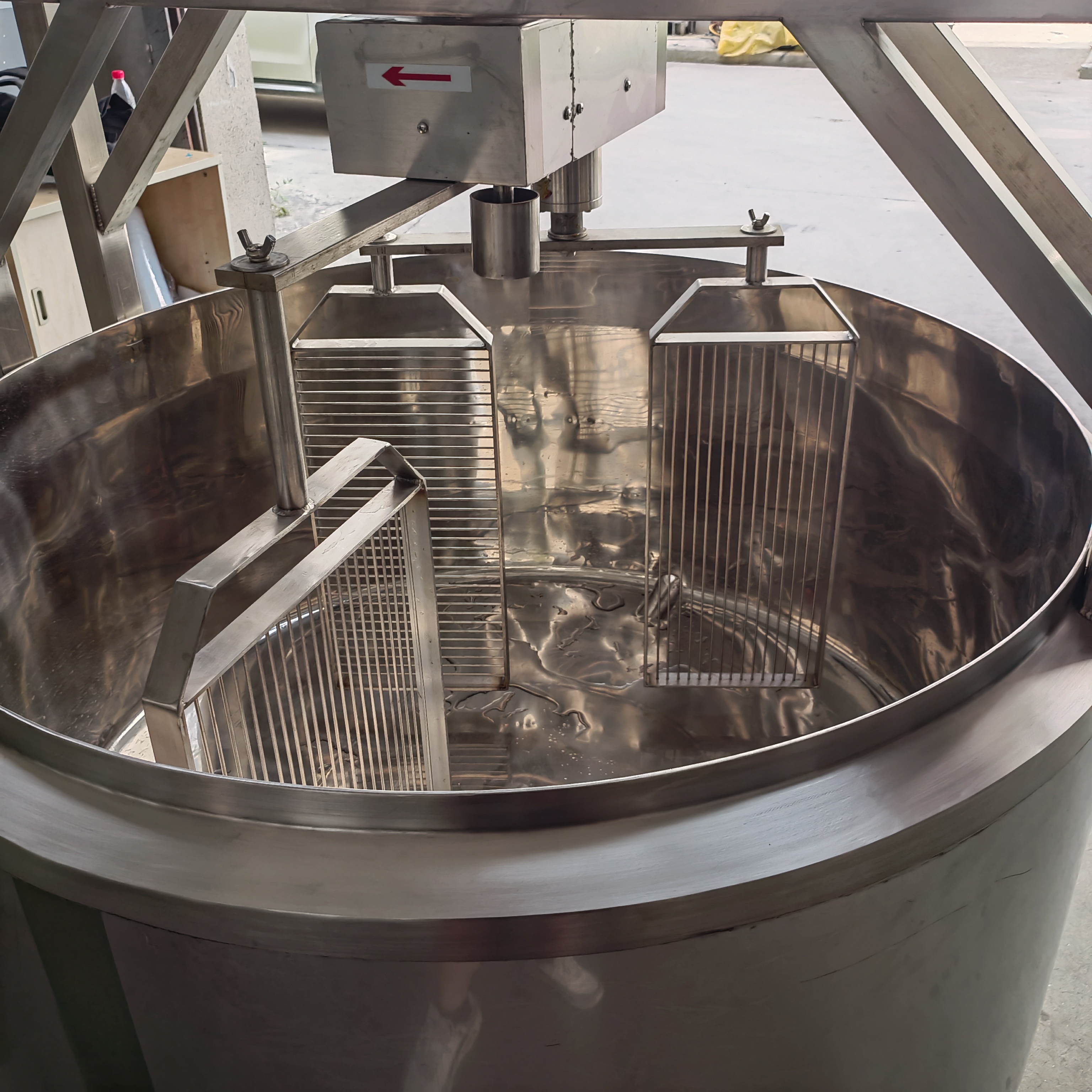
The trade-offs of utilizing multifunctional, all-in-one units for smaller facilities versus multi-stage continuous lines for high-throughput industrial plants dictate your facility layout. All-in-one units combine a high-shear bottom mixer, a steam-jacketed bowl, and a vacuum pump into one skid. They require minimal floor space and minimal piping. Cleaning is straightforward because there are fewer transfer lines and valves. These units are ideal for facilities producing less than 2,000 kilograms per hour.
All-in-one units process in batches. While one batch cooks, the downstream filler might sit idle waiting for product. Multi-stage continuous lines solve this by keeping product moving constantly. Raw materials enter one end, and finished cheese exits the other. Continuous lines demand significant floor space, complex piping networks, and advanced automation to keep the flow balanced across multiple distinct machines. They require surge tanks between stages to absorb minor flow fluctuations and prevent the line from shutting down if a single pump faults.
Measuring operational value requires looking closely at labor reduction, yield optimization, and energy efficiency. Manual operations consume massive labor hours and introduce human error. Automated systems run leaner and produce tighter specification tolerances. Capturing every percentage point of yield directly impacts profitability. Efficient systems waste less raw material and consume less utility power per ton of finished product. You must evaluate the utility consumption of the motors, steam valves, and chilled water loops.
Analyzing the integration advantages of a turnkey Cream Cheese Production Line against the capital flexibility of upgrading individual units requires long-term planning. A turnkey system provides a fully integrated network of pasteurization units, cutters, homogenizers, mixers, and storage tanks. One vendor designs the entire flow. The pumps perfectly match the heat exchangers. The software communicates flawlessly across all skids. Single-vendor accountability eliminates finger-pointing if the line fails to hit target throughput. The vendor handles the factory acceptance testing (FAT) as a complete system.
Modular upgrades allow you to replace the weakest link in your current setup. You might install a new high-shear mixer while keeping your old pasteurizer. This requires less immediate capital. Integrating a new machine into an old line often creates unexpected bottlenecks. The new mixer might process batches faster than the old pasteurizer can heat them. You also face the challenge of bridging different software protocols between equipment brands. You must ensure the new PLC can communicate with the legacy SCADA system.
The necessity of programmable logic controllers (PLCs) for repeatable batch consistency and shorter processing times cannot be overstated. Manual valve operation and stopwatch timing lead to inconsistent moisture levels and fluctuating textures. PLCs execute exact sequences. They ramp up shear rates, open steam valves, and trigger vacuum pumps at the precise millisecond required by the recipe. This automation guarantees that batch 100 matches batch 1 exactly. PID loops continuously monitor temperature sensors and adjust steam flow to maintain a flat temperature curve without overshooting.
Evaluating software capabilities for automated dosing, temperature profiling, and real-time viscosity monitoring separates average lines from elite operations. Automated dosing systems pull exact weights of water and oil directly from silos, eliminating manual weighing errors. Real-time viscosity sensors inside the mixing vessel monitor the thickness of the emulsion. The software can automatically adjust the shear rate or extend the mixing time until the product hits the exact target viscosity. Data logging records every parameter for quality control and traceability.
Addressing the physical and operational bottlenecks that occur during commissioning and scale-up prevents disastrous production delays. What works perfectly in a 50-liter pilot plant often fails catastrophically in a 5,000-liter industrial vessel. The physics of heat transfer and mechanical shear change drastically as volume increases. You must anticipate these shifts and engineer specific safeguards into the equipment design. Scale-up requires recalculating agitator tip speeds and heat transfer surface areas.
High-viscosity cheese spreads resist flow, leading to uneven heating and localized protein degradation. When thick cheese moves slowly through a heat exchanger, the product touching the hot metal walls overheats. The product in the center of the pipe remains cold. Overheated dairy proteins denature aggressively, creating a gritty, sandy texture. The emulsion breaks, and free oil pools in the piping. This fouling restricts flow further, creating a dangerous pressure buildup in the system.
Specifying positive displacement pumps mitigates this risk entirely. Twin-screw or rotary lobe pumps handle high-viscosity handling without excessive shear. They grab large pockets of cheese and push them forward smoothly. Combine these low-shear pumps with optimized heat exchanger geometries. Using corrugated tubes or scraped surface designs ensures constant mixing during the heating phase, preventing localized burn-on and maintaining a uniform temperature profile.
Dead legs in piping or improper tank geometries harbor bacteria, leading to batch spoilage. A dead leg is a section of pipe where product flows in but cannot flow out easily. Cheese gets trapped in these dead zones. Standard cleaning cycles cannot generate enough turbulence to wash this trapped product away. The rotting cheese breeds bacteria, which then contaminates every subsequent batch passing through the main line. Spores can survive standard pasteurization temperatures, making physical removal during CIP mandatory.
Mandating EHEDG or 3-A sanitary design certifications eliminates these hazards. Verify that all cutters, homogenizers, and valves are fully drainable and compatible with automated CIP/SIP protocols. Sanitary valves must sit flush with the main pipe wall. Tanks must feature spray balls that provide 100% coverage of all internal surfaces, including the undersides of agitator blades and manway doors. Automated CIP sequences guarantee the correct chemical concentrations and temperatures are applied every time. The CIP supply pump must generate a flow velocity of at least 1.5 meters per second to create the turbulent flow necessary to scour fat deposits off the pipe walls.
Fluctuations in raw milk composition or powder quality cause inconsistent moisture retention. Dairy is a natural product. Protein and fat levels change with the seasons. If your milk powder has lower protein solubility one month, it will bind less water. If you run the standard recipe, the resulting cheese will be too soft, and you will lose yield as free whey separates and drains away. Operators often try to fix this by over-mixing, which only damages the emulsion further.
Implementing inline standardization equipment solves this variability. Utilize precise mass flow meters to control ingredient ratios dynamically. Coriolis flow meters measure the exact mass and density of the liquid ingredients entering the mixer. Near-infrared (NIR) sensors can read the exact protein and moisture content of the mass in real-time. The automation system then adjusts the flow of dry powders or water on the fly. This dynamic standardization ensures you hit your exact moisture targets, maximizing yield and preventing out-of-spec product.
A reliable cream cheese production line requires a calculated balance between high-shear emulsification for ingredient incorporation and gentle handling during the final cooling and pumping stages. You cannot force a stable emulsion with brute mechanical force alone. Success depends on precise temperature profiling, exact shear rates, and flawless hygienic design. The equipment must adapt to varying raw materials while delivering absolute consistency at the filler nozzle.
Prioritize vendors that offer transparent pilot-testing facilities, allowing you to validate texture, yield, and thermal performance using your specific formulations before capital expenditure. Do not rely on theoretical calculations. Run your toughest recombined recipes through their test skids. Measure the exact processing times and evaluate the final spreadability after a full cooling cycle. This physical validation protects your capital investment.
A: Processing times vary based on equipment and formulation. Modern, high-shear, all-in-one processing vessels are designed to deliver an ideal production process in a short processing time, often reducing blending and emulsification to under 30 minutes per batch. Fermentation and cooling stages will dictate the total production time.
A: Yes, many modern cheese making machines are highly flexible. With adjustable shear rates, integrated cutters, and precise temperature controls, a single line can often be adapted to produce processed cheese blocks, cheese dips, and liquid cheese sauces.
A: Homogenization reduces the size of fat globules and distributes them evenly throughout the protein matrix. This prevents fat separation, improves the whiteness of the product, and creates the signature smooth, consistent texture.
A: Traditional production relies on fresh milk and cream, requiring separation and fermentation. Recombined production utilizes water, milk powders, and anhydrous milk fat, requiring specialized high-shear mixers to hydrate powders and create a stable emulsion without raw dairy.
A: Viscous dairy products must be moved using low-shear, positive displacement pumps such as twin-screw or rotary lobe pumps. Centrifugal pumps apply too much mechanical force, which can break the emulsion and cause the cheese to become runny.
A: Pasteurization temperatures for cream cheese typically range between 72°C and 85°C, depending on the specific formulation and desired shelf life. The exact holding time at these temperatures dictates the level of protein denaturation and final product firmness.