Call Us
+86-15800763021
Send Us
Add
775 Chihua Road, Zhelin Town, Fengxian District, Shanghai
- All
- Product Name
- Product Keyword
- Product Model
- Product Summary
- Product Description
- Multi Field Search
Views: 0 Author: Site Editor Publish Time: 2026-08-15 Origin: Site

Transitioning from artisanal batch processing to a commercial-scale gouda cheese production line requires a fundamental shift in equipment architecture and process control, without losing the traditional characteristics that define export-quality Dutch cheese. Scaling Gouda production introduces vulnerabilities in moisture retention, eye formation, and rind integrity. Inconsistent curd washing, temperature drops during transfer, or imprecise pressing leads to yield loss, batch variability, and compromised shelf stability.
To achieve consistent quality and operational profitability, plant operators must evaluate the sequencing, automation levels, and specific capabilities of modern dairy processing equipment. This guide breaks down the technical requirements and evaluation frameworks for operating a high-yield Gouda manufacturing facility.
Before selecting equipment, facility managers must establish a rigid operational baseline. This involves defining target production volumes in terms of liters of milk processed per day and mapping out desired product variations. A facility producing young Gouda for immediate domestic slicing requires different downstream handling than a plant aging traditional export wheels for twelve months. You must also determine the physical format of the cheese. Standardized rectangular blocks optimize slicing yields and packaging efficiency, while traditional round wheels cater to premium retail markets.
Establishing these parameters early dictates the sizing of vats, the geometry of molds, and the capacity of the brining infrastructure. Plant engineers typically follow a specific sequence to lock in these baselines:
Profitability in cheese manufacturing relies heavily on yield optimization. You must balance moisture content with structural integrity. Mechanical handling directly impacts how much fat and protein remain trapped within the curd matrix. If pumps run too fast or agitators shear the curds aggressively, fat globules escape into the whey, drastically reducing final cheese yield. Equipment must facilitate the gentle, rapid transfer of warm curds.
Any delay during transfer causes the curds to cool, which hardens their exterior and prevents proper fusion during the pressing phase. This leads to mechanical openings inside the cheese and a brittle texture. Operators must utilize positive displacement lobe pumps rather than high-shear centrifugal pumps. Optimized pipe routing with wide-radius sweeps instead of sharp 90-degree elbows prevents curd shattering and temperature loss during the transfer from vat to pre-press.
The defining characteristic of Gouda is its sweet, nutty flavor profile and flexible texture. This is achieved through a highly specific process known as curd washing. Technical requirements for this phase demand precise whey drainage and accurate water addition. During coagulation, lactic acid bacteria consume lactose and produce acid. To prevent the cheese from becoming too sharp or crumbly, a portion of the whey is extracted from the vat and replaced with warm water.
This washes away excess lactose, effectively starving the bacteria and halting acid production at the target pH. The volume and temperature of the wash water dictate the final moisture content and texture. Automated flow meters and temperature sensors are mandatory components for any commercial setup. If the wash water is too hot, the curd skin hardens prematurely. If it is too cold, the curds retain excess moisture, leading to late-blowing defects during maturation.
Standardized Washing Parameters
| Parameter | Target Range | Operational Impact |
|---|---|---|
| Whey Extraction Volume | 30% - 40% of total vat volume | Determines the amount of lactose removed from the curd mass. |
| Wash Water Temperature | 33°C - 36°C | Controls the final cooking temperature and moisture expulsion rate. |
| Water Addition Volume | 15% - 25% of original milk volume | Dictates the final pH buffer and sweetness of the aged cheese. |
| Agitation Speed During Wash | 10 - 15 RPM | Prevents curd matting while ensuring even heat distribution. |
Consistent cheese starts with consistent milk. Evaluating continuous flow pasteurizers and centrifugal separators is the first step in line design. Raw milk fluctuates in fat and protein content depending on the season, feed, and herd genetics. To produce uniform batches, you must implement automated fat-to-protein ratio standardization. Centrifugal separators divide the raw milk into skim milk and cream.
In-line standardization units then blend the exact required amount of cream back into the skim milk before it enters the pasteurizer. For Gouda, operators typically target a fat-to-protein ratio of 1:0.8 to 1:0.85. High-Temperature Short-Time (HTST) pasteurization units ensure food safety by eliminating pathogens while preserving the structural proteins necessary for strong curd formation. Predictable aging and consistent flavor profiles rely entirely on this initial standardization phase.
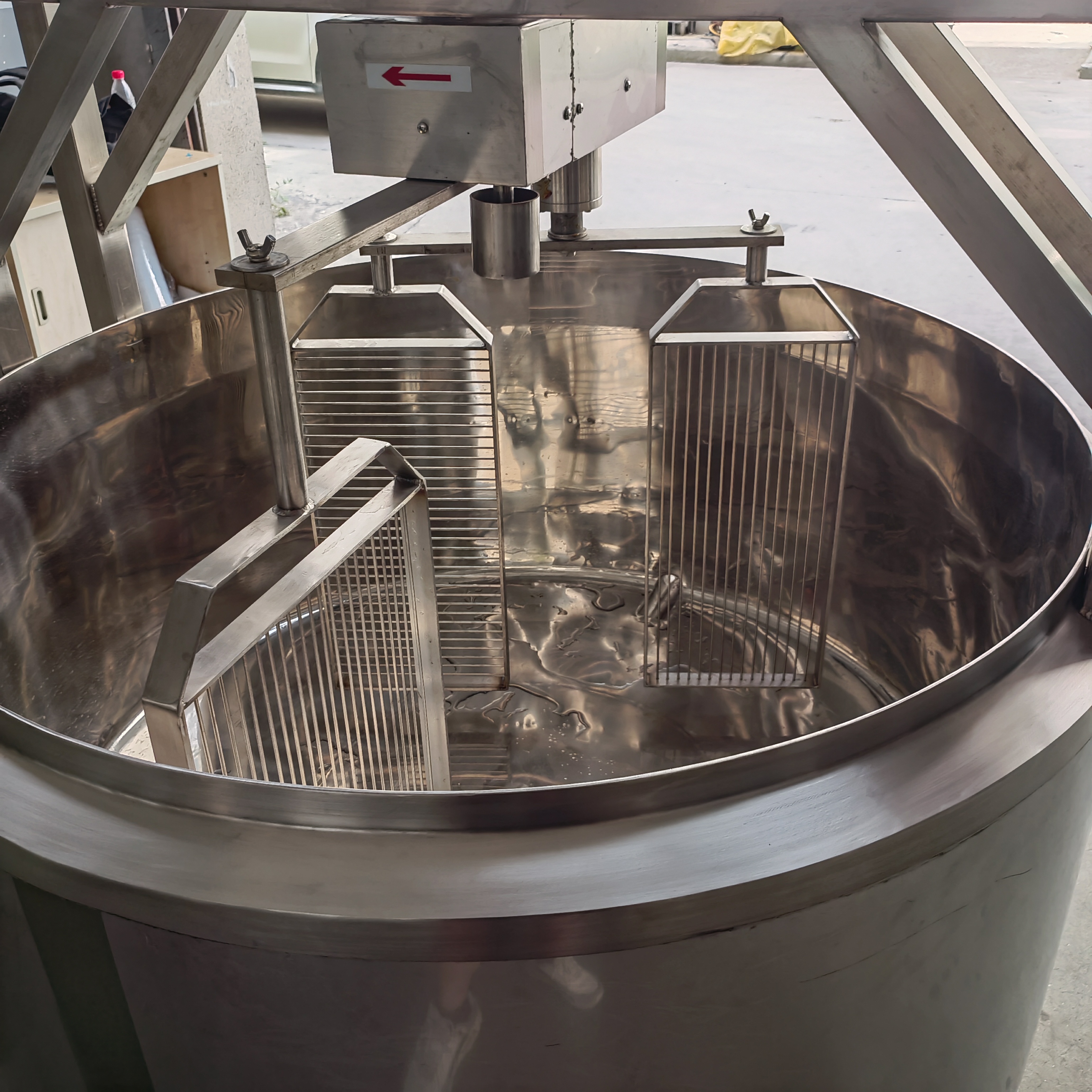
The transition from open vats to fully enclosed, automated systems is a hallmark of modern manufacturing. When comparing horizontal versus vertical vat geometries, operators must consider optimal curd cutting and hygiene. Vertical double-O vats are widely preferred for Gouda because their intersecting circular design eliminates dead zones, ensuring uniform mixing. You must assess agitator designs carefully.
The cutting blades must be sharp enough to slice the coagulum cleanly without tearing, which minimizes fat loss into the whey. The agitators must reverse direction to stir the curds gently during the cooking and washing phases. Uniform heat distribution is mandatory here; the vat jackets must circulate hot water precisely to raise the curd temperature evenly without scorching the product on the vat walls. Automated recipe controls manage the exact timing of the cut, the speed of the agitation, and the temperature ramps.
Once the curds reach the target consistency, they must be separated from the whey and formed into a cohesive mass. The role of continuous drainage belts versus batch pre-press vats is a major consideration. In a batch pre-press vat, the curd and whey mixture is pumped into a large rectangular vessel. The whey drains through perforated plates, and a pneumatic head presses the curd mass under the remaining whey.
Pressing under whey prevents air pockets from forming between the curds, ensuring a perfectly closed texture. Continuous drainage belts offer higher throughput for massive operations but require strict temperature control enclosures to maintain warm curd temperatures during the rapid whey separation process. Evaluating whey separation efficiency is vital, as residual whey can lead to localized acidity and flavor defects.
Pre-Pressing Technology Comparison
| System Type | Throughput Capacity | Curd Temperature Control | Air Pocket Prevention | Footprint Requirement |
|---|---|---|---|---|
| Batch Pre-Press Vat | Medium to High | Excellent (Submerged in whey) | Superior | Moderate |
| Continuous Drainage Belt | Very High | Requires enclosed heating | Moderate (Requires vacuum pressing later) | Large |
| Block Formers | High | Good (Vacuum assisted) | Excellent | Compact |
Transitioning from manual pressing to multi-tier pneumatic or hydraulic presses drastically increases output and consistency. Modern facilities rely on advanced Cheese Making Machines to handle the heavy lifting. Evaluating micro-perforated molds, often referred to as cassettes, is a primary engineering task. These advanced molds eliminate the need for traditional cheesecloth lining.
Removing cheesecloth from the process drastically reduces labor, cuts down prep time, and eliminates a major vector for bacterial contamination. Pressure profiling is another mandatory feature. Programmable pressing cycles apply graduated pressure to the cheese. The cycle starts with low pressure (around 0.5 bar) to allow initial whey drainage without sealing the rind too quickly. Over several hours, the pressure ramps up (often reaching 3 to 5 bar) to ensure uniform rind formation without trapping whey inside or crushing the delicate curd structure.
After pressing, the cheese must be salted to halt bacterial activity, expel remaining moisture, and develop flavor. Evaluating deep brining basins with automated gantry cranes versus continuous flow brine channels depends on facility scale. Deep basins maximize vertical space, utilizing cages lowered by cranes. Continuous channels float the cheese along a serpentine path, which is highly efficient for standardized blocks.
Replacing manual flipping is a necessity for commercial operations. Automated submersion cages and mechanical flippers ensure even salinity uptake across the entire wheel. Technical requirements for brine management include heavy-duty chilling units to maintain the brine at 12–14°C, microfiltration or UV systems to remove yeast and mold spores, and automated dosing systems for salinity concentration management. The brine must be maintained at a specific pH (typically 5.2 to 5.4) and a calcium level that matches the cheese to prevent the rind from softening and dissolving.
Gouda requires a protective layer to regulate moisture loss and prevent mold growth during aging. Transitioning from hand-painted rinds to mechanized application is essential for scale. Spray or roller systems apply breathable protective coatings, typically food-grade polyvinyl acetate (PVA) or natural waxes. These coatings allow proper gas exchange, letting the cheese breathe while blocking external contaminants.
Evaluating drying tunnel configurations is just as important as the coating application. If the cheese is not dried adequately before the next layer is applied, or before it is placed on a ripening board, moisture becomes trapped. This leads to rapid mold growth and rind rot. High-velocity, climate-controlled air must circulate evenly around the coated wheels on the conveyor. Operators must calibrate the conveyor speed to match the drying time of the specific PVA formulation used.
The maturation phase defines the final quality of the product. HVAC requirements for ripening rooms are incredibly strict. You must maintain precise temperature control, typically between 12–15°C, and relative humidity levels between 80–85%. If the humidity drops, the cheese loses too much moisture and the rind cracks. If it rises, unwanted molds proliferate.
Evaluating automated cheese turning robotics, such as Automated Guided Vehicles (AGVs), is a strategic move to manage labor costs. These robots navigate the ripening aisles, extract boards, flip the heavy cheese wheels to ensure consistent rind development and moisture distribution, and replace them without human intervention. This automation prevents repetitive strain injuries among staff and ensures turning schedules are executed flawlessly. The wooden or plastic ripening boards must also be integrated into an automated washing system to maintain hygiene between batches.
Determining the correct level of automation requires a rigorous framework for calculating return on investment. You must weigh the upfront capital expenditure against long-term labor savings. Automated mold washing, filling, and turning equipment require significant initial investment. You must identify operational bottlenecks where manual intervention causes the highest yield loss and labor drain.
Hand-lining molds with cheesecloth or manually loading wheels into brine pools are highly inefficient tasks prone to human error. By automating these specific bottlenecks, facilities often realize a rapid return on investment through increased daily throughput and drastically reduced product downgrade rates. Plant managers must analyze the hourly throughput of each machine to ensure no single piece of equipment throttles the entire line.
A rigid production line limits market responsiveness. Assessing the agility of the production line to switch between different Gouda formats is vital. Can the system seamlessly transition from producing 1kg loaves for retail to 12kg traditional export wheels? This requires adjustable pre-press cutting grids and interchangeable pressing cassettes.
Modular line design is the most effective strategy for growth. Investing in scalable architecture allows for phased capacity expansion without overhauling the entire facility. You can add additional vats, extend the brining channels, or integrate more pressing stations into the existing framework as market demand increases. Piping manifolds and valve matrices should be oversized during the initial build to accommodate future flow rates.
Hygiene failures in dairy processing lead to catastrophic financial losses. The primary risk is cross-contamination and bacteriophage outbreaks leading to downgraded or destroyed product. Phages are viruses that attack lactic acid bacteria, completely halting the acidification process and ruining the batch. Mitigation requires mandating sanitary welds, dead-leg-free piping, and fully automated, verifiable CIP cycles across all equipment.
Every vat, pipe, and press must be integrated into a central CIP station that controls the time, action, chemical concentration, and temperature of the cleaning fluids. Manual cleaning is insufficient for commercial scale and introduces unacceptable risk. Conductivity sensors must be installed on return lines to verify that caustic and acid washes have reached the correct concentrations before the cycle timer begins.
A common failure during expansion is underestimating the physical and infrastructural demands of the new equipment. The risk of underestimating the floor space required for brining and maturation is high, as these processes require significant square footage. Lacking sufficient boiler or chiller capacity will throttle production.
Mitigation involves conducting comprehensive utility audits during the procurement phase. You must calculate peak demand for chilled water, steam, compressed air, and electricity. Ensure your facility can handle the simultaneous operation of pasteurizers, CIP heating cycles, and brine chilling units before finalizing equipment layouts. Air compressors must deliver oil-free, food-grade air to operate the pneumatic presses and automated valves safely.
Even the most advanced Gouda Cheese Production Line will experience mechanical wear. The risk of extended downtime due to proprietary parts or a lack of local OEM support can cripple a production schedule. If a custom pneumatic valve fails and the replacement takes three weeks to ship, the financial impact is severe.
Mitigation requires prioritizing equipment vendors with guaranteed Service Level Agreement (SLA) response times. Insist on machinery built with standardized, off-the-shelf pneumatic and electronic components. When sensors, motors, and seals can be sourced from local industrial suppliers, maintenance teams can resolve issues in hours rather than weeks. Request a complete spare parts list and secure critical wear items during the initial equipment purchase.
A: Curd washing is the defining step. Removing a portion of the whey and replacing it with warm water lowers the lactose content, which dictates the sweet flavor and flexible texture characteristic of Gouda.
A: Commercial pneumatic presses typically apply graduated pressure, starting low to allow initial whey drainage and increasing to higher pressures (often equivalent to 20-40 lbs per square inch depending on wheel size) to form a tight, closed rind without breaking the warm curds.
A: While pasteurizers and vats can be shared, the downstream equipment differs significantly. Gouda requires specific curd washing capabilities, pre-pressing under whey, and brining systems, whereas Cheddar requires cheddaring belts, milling, and dry salting equipment.
A: Brining time depends strictly on the size of the cheese wheel and desired salt content, ranging from 12 hours for small formats to several days for large, traditional wheels. Automated systems control this via timed extraction and mechanical flipping to ensure even salt distribution.
A: A breathable coating mimics traditional hand-painted rinds, protecting the cheese from unwanted mold and excessive moisture loss while allowing the cheese to breathe and expel gasses during the maturation process.
A: Automating the coating and turning process yields high ROI for facilities producing over 2,000 kg per day, primarily through drastic reductions in manual labor, decreased product damage, and highly consistent rind formation.