
Views: 0 Author: Site Editor Publish Time: 2026-08-17 Origin: Site


Scaling semi-hard cheese varieties like Gouda, Edam, Havarti, and Emmental requires strict mechanical control. Profitability hinges on microscopic margins of moisture retention, precise eye-formation, and absolute texture consistency. Legacy manufacturing systems often fail in these areas because poorly integrated setups introduce severe operational risks. You face yield loss, moisture deviation, and heavy manual labor during the pressing, de-molding, and brining phases. When operators manually handle molds, timing varies. A five-minute delay in whey drainage alters the pH curve, leading to inconsistent block weights and downgraded product.
A modern semi hard cheese production line solves these bottlenecks by operating on predefined, repeatable, fixed-time schedules. This guarantees batch-to-batch stability and removes human error from the equation. Automating the sequence from coagulation to the brining racks eliminates timing variables. You secure your margins by locking in the exact mechanical parameters required for your specific cheese variety, allowing your staff to shift their focus from physical labor to advanced quality control.
Moisture Accuracy Drives ROI: Consistent moisture levels dictate yield and shelf-life; achieving this requires precise, automated timing from coagulation through whey drainage.
Automation Reduces Variance & Elevates QC: Minimizing operator intervention in molding, pressing, and de-molding directly correlates with fewer product defects, lower operational expenditures (OPEX), and allows staff to focus on high-level quality control.
Scalability Requires Modular Design: Selecting the right cheese making equipment involves balancing current throughput requirements with the physical footprint, continuous downstream conveyance, and future expansion capabilities.
Hygienic Design is Non-Negotiable: Integration of automated Clean-in-Place (CIP) systems across the entire line is critical for meeting stringent food safety compliance and minimizing downtime.
Engineering a production line starts with the end product specifications. Semi-hard cheeses require highly specific physical and chemical parameters to meet grading standards. Moisture content typically falls between 36% and 49%. Hitting this exact window dictates the cheese's texture, shelf life, and slicing characteristics on high-speed deli lines. You must also manage specific pH targets during coagulation and pressing to control acidification, usually aiming for a pH of 5.2 to 5.4 at the brining stage.
Varieties like Emmental demand distinct eye-formation. This requires specialized propionic acid fermentation phases. Your equipment must support precise temperature gradients in the warm ripening rooms, typically holding the cheese at 20°C to 24°C for two to four weeks. This facilitates gas expansion without fracturing the cheese matrix. If the initial pressing phase fails to create a perfectly fused curd mat, the gas will escape through micro-fissures, resulting in blind cheese or irregular eye distribution.
Semi-hard cheeses demand robust pressing architectures. Unlike semi-soft varieties that rely heavily on gravity drainage, semi-hard curds require active, mechanical pressing. This expels residual whey and forms a tight, impermeable rind. The equipment must withstand continuous high-pressure cycles, often applying between 2 to 5 bar of pressure depending on the mold size and cheese variety. The pressing profile is usually staged, starting with low pressure to prevent fat loss, and ramping up to maximum pressure to seal the rind.
Aging durations also differ significantly. Semi-hard cheeses ripen for months rather than weeks. This extended timeline requires highly controlled atmospheric conditions in the ripening rooms, maintaining humidity levels around 85% to 90% and temperatures between 10°C and 15°C. Your upstream pressing and molding equipment establishes the baseline structural integrity needed to survive this long maturation process without developing mold ingress or structural collapse.
Variability destroys yield. Operating on a rigid, repeatable time schedule prevents over-acidification and ensures uniform whey expulsion batch after batch. When a line operates on fixed intervals controlled by Programmable Logic Controllers (PLCs), the curd spends the exact same amount of time in the vat, on the drainage belt, and under the press. This synchronized flow eliminates bottlenecks.
It prevents curds from sitting idle and cooling prematurely. If curd cools before pressing, the whey drainage halts, trapping excess moisture inside the cheese block. Fixed-time scheduling ensures that the curd enters the molds at the optimal temperature, usually around 30°C to 32°C, maintaining the pliability required for perfect rind fusion under the pneumatic presses.
Measuring success requires tracking specific mass balance metrics. The primary indicator is the conversion rate of milk solids to cheese. You want maximum protein and fat retention in the final block. A standard benchmark is converting roughly 10 liters of standardized milk into 1 kilogram of semi-hard cheese, though this varies by exact moisture targets.
The secondary metric is the minimization of fines in the whey stream. Excessive mechanical agitation or poor cutting tool design shatters the curd. This sends valuable cheese solids down the drain with the whey. Optimizing the cutting and stirring phases directly improves your overall mass balance. Implementing rotary screens with 0.5mm mesh on the whey discharge line helps recover these fines, which can be pressed into secondary products, but preventing their creation in the vat is the primary engineering goal.
The foundation of consistent cheese begins upstream in the milk reception and treatment area. Raw milk must undergo precise pasteurization, typically at 72°C for 15 seconds, to eliminate pathogens while preserving essential enzymes required for ripening. Standardization is the next critical step. You must adjust the fat-to-protein ratio to match the specific recipe of the cheese variety, often targeting a ratio of 1:0.8 for standard Gouda.
This is achieved using centrifugal separators and in-line standardizers that continuously monitor and adjust the fat content. Temperature control prior to vat entry is also strictly regulated. Milk must enter the coagulation phase at the exact temperature required for optimal rennet activity and starter culture proliferation, usually between 30°C and 32°C. Any deviation here alters the coagulation time and the firmness of the resulting gel.
Large-scale production heavily favors enclosed double-O cheese vats over open designs. Enclosed vats provide superior hygiene, better temperature retention, and allow for fully automated CIP integration. Inside the vat, coagulation dynamics dictate curd quality. The mechanical design of the cutting tools is paramount. Blades must slice cleanly through the coagulum to achieve a uniform curd grain size, typically between 5mm and 8mm for semi-hard varieties.
Dull blades or excessive rotational speeds cause shattering. This leads to uneven moisture retention and high fat losses in the whey. Modern vats utilize variable frequency drives (VFDs) on the agitator motors, allowing the PLC to execute precise cutting and stirring profiles. The scalding phase, where hot water is added to the vat to shrink the curd grains and expel whey, must be controlled to within 0.5°C to ensure consistent moisture targets.
Once the curd reaches the desired consistency, it moves to the drainage phase. Continuous drainage belts offer high throughput for large operations. They allow whey to drain rapidly while the curd mat travels toward the molding station. Alternatively, block-mold pre-pressing systems submerge the curd in whey during the initial pressing phase.
Pre-pressing under whey prevents air from entering the curd matrix. This is critical for achieving the closed, blind texture required for cheeses like Gouda and Edam. The engineering challenge here is separating curds and whey efficiently while maintaining the curd mat's temperature and structural integrity. The pre-press vat utilizes a massive pneumatic plate that compresses the curd mass into a solid bed before rotary knives cut it into individual blocks for final molding.
The transition from pre-press to final molds must be seamless. Automated cassettes or robotic arms transfer the pre-pressed blocks into individual micro-perforated molds. These modern molds eliminate the need for traditional cheese cloths, drastically reducing labor and contamination risks. Final pressing utilizes pneumatic systems because they apply consistent, adjustable pressure across multiple stages.
A typical pressing profile might start at 1.5 bar for 20 minutes, increase to 3 bar for 40 minutes, and finish at 5 bar for 60 minutes. This staged approach removes residual whey evenly across the entire cheese block without sealing the rind too quickly. Following the pressing cycle, automated de-molding lines take over. They use vacuum cups or mechanical pushers to extract the cheese blocks and convey them directly to the brining system.
This continuous downstream conveyance eliminates manual lifting and reduces the risk of product contamination. The empty molds and lids then enter an automated handling loop. They pass through integrated washing stations, undergoing a high-pressure rinse, a 1.5% caustic wash at 65°C, and a final sanitizing rinse, ensuring they are fully sanitized before returning to the filling phase.
Brining halts acidification, adds flavor, and hardens the rind. Static brining pools are common in smaller plants but require significant manual labor to manage the racks. Dynamic or flume brining systems automate this process for high-yield lines. They use the flow of the brine itself to transport the cheese blocks through the cooling and salting phases.
You must manage cooling requirements strictly, keeping brine temperatures between 10°C and 14°C. Salt concentration is typically maintained around 18% to 22% Baumé. Furthermore, the calcium equilibrium between the cheese and the brine must be monitored; if the brine lacks calcium, it will strip it from the cheese, resulting in a soft, slimy rind. After brining, automated gantry cranes or rack loading systems prepare the cheese for the extended ripening phase, moving the blocks into climate-controlled storage.
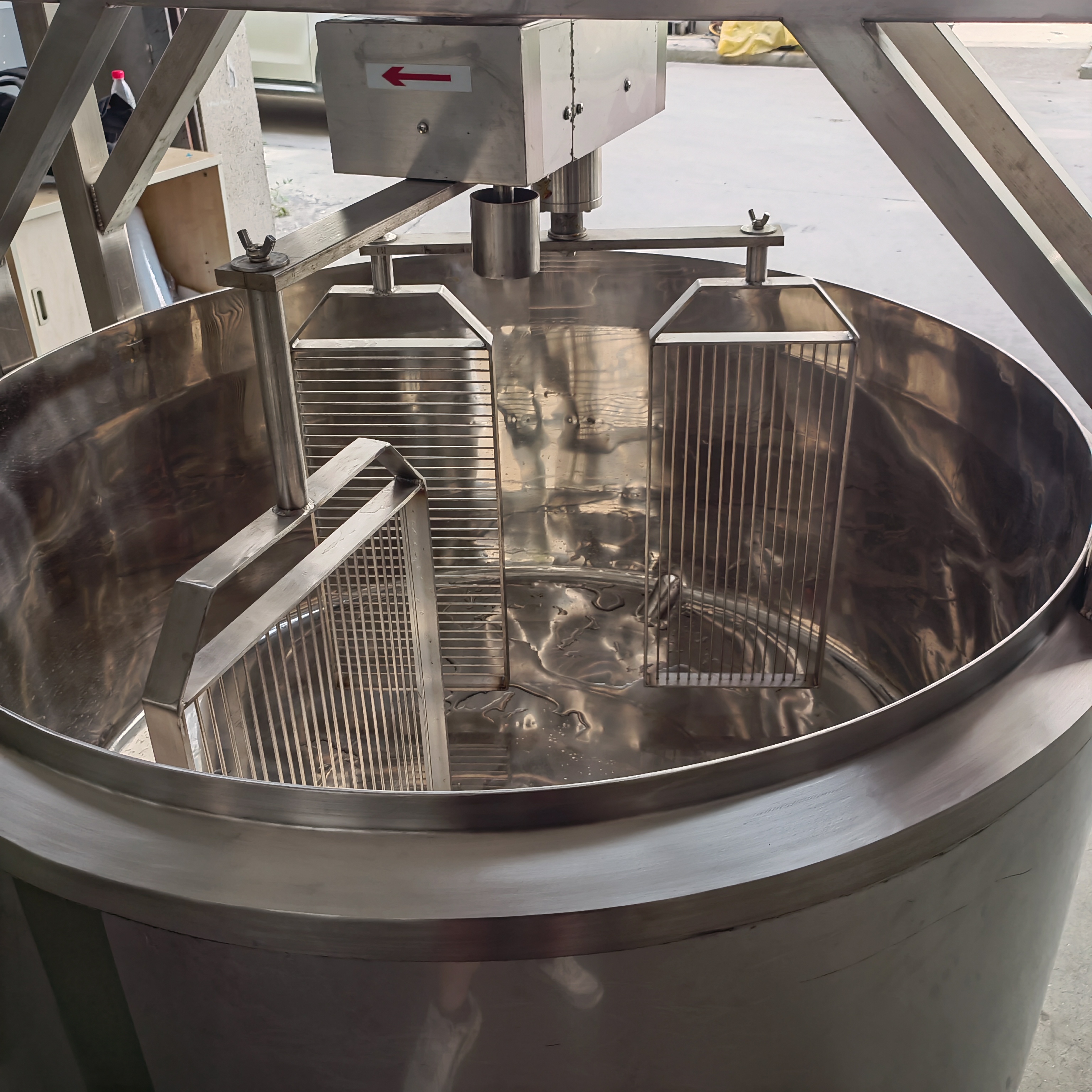
Choosing the right processing model depends on your daily milk volume and product variety. Batch vats offer flexibility for operations producing multiple cheese types in a single day. You can run a batch of Havarti in the morning and a batch of Edam in the afternoon simply by changing the PLC recipe. Continuous coagulation systems are designed for massive, uninterrupted runs of a single product, typically requiring daily milk volumes exceeding 500,000 liters.
When selecting Cheese Making Equipment, you must align the machinery's capabilities with your facility's throughput goals. Over-engineering a line with continuous coagulators for a mid-sized plant will result in excessive downtime during product changeovers and CIP cycles.
Processing Model Comparison
| System Architecture | Throughput Capacity | Product Flexibility | Automation Level | Footprint Requirement |
|---|---|---|---|---|
| Enclosed Double-O Vats | Medium to High | High (Easy recipe changes) | Moderate to High | Moderate |
| Continuous Coagulators | Very High | Low (Best for single variety) | Very High | Large |
| Block-Mold Pre-Press | High | Moderate | High | Moderate |
| Continuous Drainage Belts | Very High | Low | Very High | Large |
Modern production lines rely on PLCs and SCADA (Supervisory Control and Data Acquisition) systems for centralized monitoring. These systems track pH, temperature, and pressure in real-time, logging data for every batch to ensure traceability. Automated material handling, such as conveyors and robotic arms for mold handling, drastically reduces workplace injuries.
It eliminates the need for operators to manually lift heavy, wet cheese blocks, which often weigh between 10kg and 15kg each. By automating these physical tasks, you shift human capital from manual labor to advanced quality control and system oversight. Operators become process managers, analyzing SCADA trends and performing preventative maintenance rather than acting as manual laborers.
Sanitation dictates production uptime. Industry-standard sanitary design principles, such as EHEDG or 3-A standards, must be engineered into every component. CIP-ready molds, presses, and piping ensure zero cross-contamination between batches. Automated CIP systems circulate caustic and acid solutions at precise temperatures and flow rates.
To achieve proper mechanical scouring inside the pipes, the CIP system must maintain a minimum fluid velocity of 1.5 meters per second. Spray balls inside the vats and presses must be positioned to provide 100% coverage, eliminating shadow zones. Dead legs in piping must be eliminated, and all surfaces must be self-draining to prevent bacterial harborage. This guarantees rapid turnaround between production runs and protects the biological integrity of your starter cultures.
Upgrading to a fully automated line requires a significant initial capital expenditure. However, you must evaluate this against long-term operational savings. Automated lines drastically reduce labor requirements, often cutting the required headcount in the pressing and brining rooms by 70%. Energy efficiency is also vastly improved.
Modern enclosed vats retain heat better than legacy open vats, reducing the steam required for scalding. Furthermore, the precise moisture control achieved by automated pressing reduces product waste and giveaway. When you consistently hit your target moisture of 42% instead of fluctuating between 40% and 44%, your overall yield increases, directly improving your operational margins over the lifespan of the equipment.
Installing a high-capacity line requires navigating strict spatial realities. Greenfield builds offer the luxury of designing the building around the equipment. Upgrading an existing facility requires shoehorning massive machinery into confined spaces. You must balance your desired throughput with your available footprint.
The processing line itself is only one part of the equation. Brining systems and ripening rooms often consume significantly more square footage than the vats and presses. To maximize vertical space in restricted footprints, facilities often deploy high-density brining racks and Automated Guided Vehicles (AGVs) to stack and retrieve cheese blocks up to the ceiling, minimizing the required floor space.
You must evaluate the trade-off between a highly optimized line and a versatile one. A line engineered exclusively for Gouda will achieve maximum throughput and consistency for that specific product. The mold sizes, press heads, and brining times are locked in for peak efficiency. However, it will struggle to adapt if market demands shift toward a different variety.
A versatile line capable of handling various semi-hard and semi-soft variants requires adjustable pressing heads, variable speed drainage belts, and programmable brining times. This flexibility often comes at the cost of slightly lower overall throughput and longer changeover times compared to a specialized, single-product system.
Tying new downstream equipment into legacy infrastructure presents significant engineering risks. Your new Semi Hard Cheese Production Line must communicate flawlessly with existing raw milk silos and pasteurizers. Utility systems often require massive upgrades to handle the increased load.
You must ensure your facility can supply the necessary volumes of culinary steam (typically at 3 bar) for heating vats, chilled water (at 1°C) for the brining heat exchangers, and clean, dry compressed air (at 6 bar) for the pneumatic presses and valve manifolds. Failure to map utility requirements accurately leads to pressure drops and temperature fluctuations during critical processing phases, resulting in lost batches.
Replacing core equipment halts production. To prevent total shutdowns, you must develop strategies for phased installation and commissioning. This often involves installing the new line parallel to the old one, if space permits. Once the new line is validated, the tie-ins are made over a single weekend.
Alternatively, you can schedule modular upgrades during planned maintenance windows, replacing the vats one month and the presses the next. Clear communication with your systems integrator is required to establish a realistic timeline. Every day of unexpected downtime directly impacts your supply chain and fulfillment capabilities.
The startup phase carries a high risk of initial yield losses. Mechanical systems require fine-tuning to match the specific biological behavior of your milk supply and starter cultures. Rigorous, vendor-supported calibration is necessary to hit target moisture and weight specifications consistently. Do not rush the commissioning phase. Follow a strict validation sequence.
Execute comprehensive water trials to verify pump sizing, valve sequencing, and pipe integrity without risking product.
Run full CIP validation cycles, using riboflavin testing to ensure all shadow zones and dead legs are properly cleaned.
Conduct small-batch milk trials to calibrate the cutting tool RPMs and the pneumatic pressing profiles.
Perform yield optimization runs, adjusting the scalding temperatures and drainage belt speeds to hit the exact 36-49% moisture targets.
A successful semi-hard cheese operation relies on the seamless integration of precise timing, automated downstream handling, and rigorous moisture control. You cannot achieve batch-to-batch consistency with disjointed, manual processes. Upgrading to a fully automated system removes variance, protects your yield, and elevates your final product quality. When selecting an equipment manufacturer, demand transparent utility consumption modeling and robust post-installation support. The right partner will engineer a solution that fits your physical footprint while meeting your exact throughput targets.
Initiate a comprehensive site audit to map your existing utility capacities, specifically steam, chilled water, and compressed air.
Define your exact throughput requirements, target moisture levels, and product specifications before requesting equipment proposals.
Request detailed utility consumption data from potential vendors to ensure your plant infrastructure can support the new line without causing pressure drops.
Develop a phased installation and commissioning plan to minimize production downtime during the equipment upgrade.
A: The standard moisture range for semi-hard cheese falls between 36% and 49%. Achieving this precise window dictates the cheese's texture, slicing ability, and shelf life. Equipment design, specifically the use of fixed-time scheduling and automated pressing, controls whey expulsion to guarantee this outcome batch after batch.
A: Automated pressing utilizes pneumatic or mechanical cylinders to apply consistent, programmable pressure across multiple stages. This forms a uniform, tight rind and expels residual whey evenly. It prevents curd fracturing and eliminates the structural defects often caused by uneven manual pressing.
A: Yes, with the right modular design, these lines offer flexibility. While some semi-soft cheeses can be processed, semi-hard cheeses require much more intense pressing architectures and significantly longer aging durations. The equipment must be programmed to adjust pressure and drainage times accordingly.
A: Space requirements vary heavily based on throughput. However, the brining systems and climate-controlled ripening rooms almost always consume more square footage than the actual processing line. High-density vertical racking and automated guided vehicles are often required to manage the footprint in commercial facilities.
A: Continuous systems flow the curd and whey mixture directly onto moving drainage belts or into continuous block-molds under the whey level. This prevents air pockets and contrasts with manual batch molding. Continuous systems provide massive throughput advantages, maintain uniform curd temperatures, and drastically reduce operator intervention.
A: These lines require robust utility support. Critical requirements include high-volume CIP fluids for sanitation, culinary steam at 3 bar for heating the vats, high-capacity chilled water at 1°C for the brining systems, and clean, dry compressed air at 6 bar to drive the pneumatic presses.