Call Us
+86-15800763021
Send Us
Add
775 Chihua Road, Zhelin Town, Fengxian District, Shanghai
- All
- Product Name
- Product Keyword
- Product Model
- Product Summary
- Product Description
- Multi Field Search
Views: 0 Author: Site Editor Publish Time: 2026-10-09 Origin: Site

Have you ever wondered how raw, watery milk transforms into that thick, sugary delight prized by bakers and confectioners worldwide? While consumers merely open a tin to enjoy the rich final product, manufacturing it requires a symphony of highly specialized industrial machinery.
Turning a perishable agricultural liquid into a shelf-stable, viscous syrup is a complex feat of food engineering. In this comprehensive guide, we will pull back the curtain on how a modern condensed milk processing plant operates. You will learn the exact mechanics of the sweetening process, the thermodynamics of water removal, and the precision engineering required for packaging.
Before examining the specific mechanics of sweetening, it is essential to understand the broader architectural flow of the facility. The transformation from a raw liquid to a highly concentrated commercial product requires a sequence of strictly controlled thermodynamic and mechanical processes. As a frontline engineer walking the floor of a modern facility, you are immediately met with the hum of centrifuges and the towering presence of stainless-steel silos.
The production cycle kicks off at the reception bay. Here, raw milk transfers from insulated transport tankers into massive storage silos. Upon arrival, chillers immediately drop the liquid temperature to approximately 4 degrees Celsius to halt any microbial activity. The milk then passes through centrifugal clarifiers. These machines spin at high speeds to strip away physical impurities and somatic cells.
Following clarification, the critical standardization process occurs. Raw milk naturally varies in fat and protein content depending on the season and cattle breed. Using automated inline centrifugal separators, plant operators meticulously adjust the ratio of butterfat to non-fat milk solids. For standard commercial production, engineers typically standardize the fat content to 8 percent, while adjusting the non-fat solids to 20 percent. This exact standardization ensures that every single batch reacts predictably during the intense heating phases ahead.
Once standardized, heavy-duty pumps push the milk through a plate heat exchanger for pasteurization. This step involves heating the milk to temperatures between 85 and 90 degrees Celsius for several seconds. However, pasteurization here is not merely a safety protocol to eliminate pathogenic microorganisms. It is actually a vital structural preparation step.
The heat treatment denatures specific whey proteins, namely beta-lactoglobulin. In practical terms, this prevents the milk from coagulating and turning into a solid mass during the intense evaporation process. Stabilizing these proteins early on ensures a smoother emulsion, which prevents unsightly fat separation when the tin sits on a retail shelf for months.
To justify the heavy machinery required to process the product, one must first understand the fundamental biochemistry at play. Operators do not dump sugar into the vats merely to satisfy a sweet tooth. It is the primary preservation mechanism utilized in the formulation.
Unlike standard evaporated milk, which relies on intense retort sterilization by heating sealed cans to over 115 degrees Celsius to achieve shelf stability, sweetened condensed milk relies on a phenomenon called osmotic pressure. When a plant adds massive volumes of sucrose, typically making up 40 to 45 percent of the final product weight, it drastically reduces the water activity of the fluid.
Water activity measures the amount of free water available for microbial survival. By dissolving such a staggering concentration of sugar into the remaining water, the resulting osmotic pressure physically draws water out of any surviving bacterial cells. This effectively neutralizes them. This elegant biochemical trick allows the product to remain safe for years at room temperature without requiring post-packaging thermal sterilization.
Beyond preservation, the integration of sugar fundamentally alters the physical properties of the dairy base. As sucrose molecules interact with concentrated milk proteins and suspended fat globules under heat, the fluid viscosity increases dramatically. This creates that signature syrupy pour.
Furthermore, the presence of sugar during the thermal processing stages induces a highly controlled Maillard reaction. This chemical interaction between amino acids and reducing sugars creates the slight caramel flavor and off-white creamy color that consumers instantly recognize.
Introducing thousands of kilograms of sugar into a continuous liquid stream is a significant engineering hurdle. The sugar must dissolve completely. Even a handful of undissolved granules can cause severe blockages in downstream valves and ruin the texture of the final batch. Facilities generally employ one of two mechanical methods to achieve flawless integration.
In traditional or smaller-scale operations, workers add dry refined sucrose directly to the standardized milk before it even reaches the pasteurizer. This process utilizes massive jacketed mixing tanks equipped with high-shear agitators.
Operators gently warm the milk to approximately 40 to 50 degrees Celsius to increase its solubility. Dry sugar is then fed into the tanks via automated hoppers or vacuum conveyors. The high-shear mixers create a powerful vortex, pulling the dry powder deep into the liquid and violently breaking apart any clumps. While this method requires less specialized peripheral equipment, it demands rigorous mixing times. It can also introduce airborne dust into the milk stream if the hoppers lack perfect sealing.
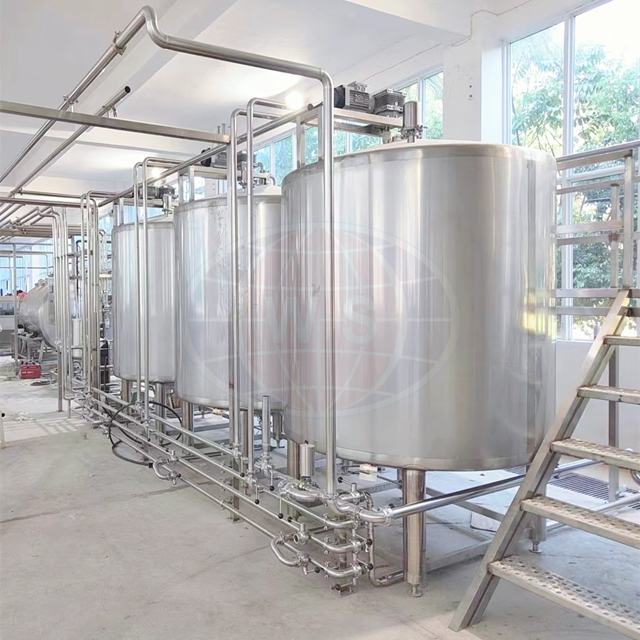
Conversely, modern high-capacity facilities typically utilize the sugar syrup method. In a completely isolated processing area, water and dry sugar combine in heated tanks to create a highly concentrated and sterile sugar syrup, often reaching 65 to 70 Brix.
Pumps force this liquid syrup through micro-filters to capture any physical impurities or stubborn undissolved crystals. Finally, the sterile syrup injects directly into the evaporation stream via precision dosing pumps. This method offers superior hygiene and guarantees absolute dissolution, though it requires a higher initial capital investment for the separate syrup preparation tanks.
| Integration Method | Process Injection Point | Primary Engineering Advantages | Operational Drawbacks |
|---|---|---|---|
| Dry Sugar Addition | Before pasteurization | Lower initial capital expenditure; simpler facility footprint. | Requires longer mixing times; risk of airborne contamination and undissolved granules. |
| Sugar Syrup Method | During evaporation stage | Guarantees 100 percent dissolution; superior hygiene; seamless continuous processing. | Higher equipment costs for separate syrup preparation tanks and micro-filtration units. |
Looking at the broader landscape of dairy processing, the industry is undergoing a significant transformation driven by environmental concerns and technological advancements. Market analysis reveals a strong pivot toward energy recovery and digital integration.
Historically, boiling off massive amounts of water made dairy concentration one of the most energy-intensive sectors in food manufacturing. Today, the trend is heavily skewed toward decarbonization. Plants are increasingly retrofitting older setups with Mechanical Vapor Recompression technologies. These systems run on electricity rather than fossil-fuel-generated steam. By capturing and compressing waste vapor to reuse as a heating medium, facilities are slashing their carbon footprints by up to 60 percent.
In addition, the integration of Industrial Internet of Things sensors is revolutionizing quality control. Modern plants now utilize inline refractometers and smart viscosity sensors that monitor the sugar-to-water ratio in real-time. Instead of waiting for manual batch testing, AI-driven control systems automatically adjust steam pressure and feed rates second by second. Interestingly, while consumer trends push for low-sugar alternatives across the food sector, formulating reduced-sugar condensed milk remains a massive technical challenge. Because the product relies entirely on sugar for osmotic preservation, substituting sucrose with low-calorie sweeteners like stevia or erythritol often compromises shelf stability. This forces manufacturers to explore complex blends of hydrocolloids and alternative bulking agents to mimic traditional preservation.
Once the milk is standardized, pasteurized, and mixed with sugar, it enters the most critical phase of the operation. The vacuum evaporator is the undisputed heart of the facility. It is responsible for removing the majority of the water content efficiently and safely.
If one were to boil sweetened milk in an open vat at standard atmospheric pressure at 100 degrees Celsius, the intense heat would instantly burn the sugars. It would scorch the delicate proteins and create an unusable dark brown paste. To solve this, industrial engineers manipulate thermodynamics.
By utilizing heavy-duty vacuum pumps to extract air and lower the atmospheric pressure inside the evaporator chambers, the boiling point of the liquid drops drastically. Inside these industrial chambers, the sweetened milk mixture boils vigorously at a mere 45 to 50 degrees Celsius. This low-temperature boiling allows the machinery to extract massive amounts of water vapor without causing heat damage. It preserves the nutritional integrity and smooth flavor profile of the product.
The most common design deployed in the dairy industry is the falling film evaporator. Heavy pumps push the liquid to the top of a towering vertical chamber containing hundreds of tightly packed stainless-steel tubes known as the calandria. The milk distributes evenly, flowing down the inside of these tubes as a microscopically thin film.
Simultaneously, operators apply steam to the outside of the tubes. Because the interior is under a vacuum, the heat from the steam causes the water in the milk film to vaporize almost instantly. The resulting mixture of concentrated milk and water vapor exits the bottom of the tubes and enters a centrifugal separator. The lighter water vapor pulls upward and exits the system, while the heavy concentrated sweetened milk pumps out from the base, ready for the next stage.
For plant managers and machinery investors, the operational cost of removing water represents a massive portion of total plant expenditure. Optimizing the evaporation line is not merely a matter of product quality. It dictates the overall profitability of the facility.
In early dairy processing, single-effect evaporators were the standard. These systems utilize fresh steam to boil the milk, and the resulting water vapor is simply condensed and discarded. This approach is highly inefficient. It requires roughly one kilogram of steam to evaporate one kilogram of water.
Modern facilities rely almost exclusively on multi-effect configurations. In this setup, several evaporation chambers called effects connect in a series. The hot water vapor extracted from the milk in the first effect is not thrown away. Instead, piping routes it into the heating jacket of the second effect to boil the milk there. Because the second effect operates at an even lower vacuum pressure, the recycled vapor is hot enough to cause boiling. This cascading reuse of thermal energy can involve up to four or five effects, drastically reducing the total steam required.
To push efficiency even further, advanced plants integrate Thermal Vapor Recompression technology. A TVR system utilizes a specialized steam ejector to capture low-pressure exhaust vapor. It mixes this captured vapor with a small amount of high-pressure motive steam, compressing it and upgrading its temperature.
This recycled high-energy steam then feeds back into the first effect of the evaporator. By recycling vapor that would otherwise go to waste, a TVR-equipped line can cut boiler energy consumption by up to 50 percent. This makes it a highly attractive upgrade for large-scale operations focused on long-term yield and operational cost reduction.
Once the highly concentrated fluid exits the evaporator, it is hot and dangerously supersaturated with lactose, specifically milk sugar. If this sticky product cools naturally in a holding tank, the lactose will crystallize uncontrollably. The result is large jagged crystals that create a gritty sandy texture consumers will immediately reject. Controlling this phase is a critical mechanical step.
To prevent spontaneous crystallization, pumps move the hot concentrate, usually around 50 degrees Celsius, directly into specialized vacuum cooling tanks. The pressure inside these tanks drops suddenly, causing a portion of the remaining water to instantly flash into vapor. This phase change absorbs latent heat, causing the temperature of the entire batch to plummet rapidly to approximately 30 degrees Celsius. This rapid temperature drop forces the lactose into a state of extreme supersaturation, priming it for controlled manipulation.
At exactly 30 degrees Celsius, operators introduce seed lactose into the cooling tanks. This is a highly pulverized pharmaceutical-grade lactose powder where the particles are incredibly fine. Powerful mechanical agitators whip this seed powder into the thick fluid.
The presence of these millions of tiny seed particles provides a template for the dissolved lactose to attach to. Instead of forming a few large gritty crystals, the lactose is forced to form billions of microscopic crystals measuring under 10 microns in size. Crystals of this microscopic size are completely undetectable by the human tongue, ensuring the final product maintains a flawlessly smooth and velvety mouthfeel.
The final major mechanical phase is packaging. Handling a fluid with such high viscosity and sugar content requires specialized downstream equipment designed specifically for heavy industrial output.
Standard gravity-fed liquid fillers, such as those used for bottling water or fresh milk, are entirely ineffective here. The thick sticky nature of the concentrate means it will not flow quickly enough under its own weight. Worse, it is highly prone to trapping stubborn air bubbles.
To overcome these physical hurdles, facilities deploy a specialized filling machine equipped with positive displacement pumps or heavy-duty servo-driven piston fillers. These robust machines use mechanical force to pull a precise volume of the thick fluid into a cylinder, then forcefully extrude it into the packaging container. Often using bottom-up filling nozzles, this forceful extrusion ensures exact weight accuracy per unit and prevents air pockets. Trapped air could harbor aerobic bacteria and compromise shelf life.
Packaging formats vary widely based on market demand. While the traditional seamed tin can remains the global standard for retail, modern filling lines frequently handle aseptic aluminum squeeze tubes, plastic pouches, and large bulk industrial drums for commercial bakeries.
Regardless of the format, the filling environment must remain meticulously sanitary. Tin cans, for example, undergo sterilization with UV light or superheated steam just milliseconds before filling. Immediately after fluid injection, a high-speed seaming machine crimps the metal lid onto the can. This creates a permanent airtight hermetic seal that secures the multi-year shelf life of the product.
For corporate investors and facility managers, selecting the correct machinery is a monumental decision that dictates the operational viability of the business for decades. Procurement requires a rigorous evaluation of engineering specifications, scalability, and maintenance protocols.
Equipment must size accurately to match both current market demand and projected growth. Plant capacity is measured in liters per hour of raw milk intake. An undersized system creates a severe production bottleneck. Conversely, an oversized system results in massive energy waste because evaporators cannot run efficiently at partial capacity. Forward-thinking buyers look for modular designs offering capacities from 500 LPH up to 10,000 LPH. Ensure all product contact parts utilize food-grade SUS304 or superior SUS316L stainless steel to withstand harsh cleaning chemicals and high temperatures.
Because of the extreme sugar concentrations, the internal surfaces of pipes, tanks, and heat exchangers are highly susceptible to sticky residue buildup and caramelization. Manual cleaning of miles of piping is physically impossible.
Therefore, investing in a fully automated Clean-in-Place system is non-negotiable. An integrated CIP system uses Programmable Logic Controllers to automatically flush the entire production line with precisely heated sequences of caustic soda, nitric acid, and sterile water rinses. This automated protocol drastically reduces plant downtime, minimizes manual labor costs, and guarantees strict compliance with international food safety standards.
Building a dairy concentration facility is not simply a matter of purchasing individual machines from different vendors and piping them together. The thermodynamic balance between the pasteurizer, the evaporator, and the cooling tanks is incredibly sensitive.
Investors are strongly advised to partner with turnkey machinery manufacturers who provide end-to-end engineering solutions. A reliable partner handles the complex thermodynamic calculations, 3D facility layout, installation, and rigorous Factory Acceptance Testing. Procuring a unified system ensures flawless communication between the mixing tanks and the packaging line, resulting in a highly efficient and profitable production environment.
Transforming raw milk into a sweet shelf-stable syrup requires an impressive orchestration of precise engineering. From the initial standardization of raw dairy to the delicate balance of osmotic preservation, every step is calculated. Advanced vacuum evaporation safely removes water without scorching, while controlled flash cooling and seeding guarantee that luxurious smooth texture. Finally, robust positive displacement filling systems protect the finished product from contamination, sealing in years of shelf life.
Ultimately, the success of a dairy concentration business hinges on the technology it employs. Investing in high-quality and energy-efficient machinery not only ensures long-term profitability but also guarantees consistent product safety. For those looking to enter or upgrade in this space, consulting with engineering experts to configure a custom automated plant setup is the crucial first step. We highly recommend exploring professional turnkey solutions and equipment specifications at WFoodMachinery to match your exact production requirements and secure your operational excellence.
Unlike standard evaporated milk, this specific product does not require post-packaging thermal sterilization such as retorting. The preservation mechanism relies entirely on the science of osmotic pressure. By introducing a massive concentration of sugar, the amount of unbound free water in the product drastically reduces. This high osmotic pressure creates a harsh environment where bacteria, yeasts, and molds simply cannot survive or multiply. Subjecting the product to high-heat sterilization would not only be redundant for safety but would also cause severe caramelization, ruining the color and flavor profile.
While both products begin with the mechanical removal of water via vacuum evaporation, their preservation methods and ingredient profiles are fundamentally different. Evaporated milk contains no added sugar. Therefore, it relies entirely on high-heat commercial sterilization inside the sealed can to achieve shelf stability. This extreme heat treatment gives evaporated milk a slightly cooked flavor and darker color. In contrast, the sweetened variant utilizes sugar as a natural preservative, bypassing the need for extreme thermal sterilization and resulting in a much thicker, sweeter, and lighter-colored product.
The precise formulation varies slightly depending on regional consumer preferences and specific brand recipes, but sugar typically constitutes between 40 and 45 percent of the total volume of the finished product. From a food science perspective, the critical metric is the sugar-in-water ratio. To effectively inhibit microbial growth and ensure shelf stability at room temperature, the concentration of sugar within the remaining water phase of the milk must exceed 60 percent, typically targeted at 62.5 to 64.5 percent.
Yes, from a thermodynamic standpoint, the same primary vacuum evaporation equipment can concentrate both types of milk. However, the operational logistics require strict management. Transitioning between the two products necessitates rigorous automated Clean-in-Place procedures to ensure no sticky sugar residue contaminates the unsweetened batches. Furthermore, the downstream processing routes diverge completely. Unsweetened milk must route to homogenizers and canning retorts for sterilization, whereas the sweetened product directs toward specialized vacuum cooling and crystallization tanks.
A gritty or sandy texture is the result of uncontrolled lactose crystallization, where lactose molecules bind together to form large jagged crystals during the cooling phase. Industrial machinery prevents this defect through the precise application of flash cooling and mechanical seeding. By rapidly dropping the temperature in vacuum coolers and using high-shear agitators to evenly distribute microscopic seed lactose powder, the equipment forces the lactose to crystallize uniformly. This engineered process generates billions of microscopic crystals measuring under 10 microns in size that are completely imperceptible to the human tongue, ensuring a perfectly smooth product.
In a continuous, highly automated processing plant, the journey from raw milk reception to the final sealed tin can take anywhere from 3 to 5 hours. The most time-consuming phases are the evaporation process, which relies on steady thermodynamic balance, and the controlled flash cooling and crystallization phase. Rushing the cooling phase risks improper lactose crystal formation, which would compromise the smooth texture of the final product.
Thanks to the extremely high osmotic pressure created by the sugar content, the final sealed product is shelf-stable at ambient room temperature. However, for optimal quality preservation and to prevent age-thickening or subtle color changes over long periods, manufacturers recommend storing the product in a cool, dry environment between 15 and 20 degrees Celsius. Extreme temperature fluctuations should be avoided to maintain the perfect emulsion and viscosity.