Call Us
+86-15800763021
Send Us
Add
775 Chihua Road, Zhelin Town, Fengxian District, Shanghai
- All
- Product Name
- Product Keyword
- Product Model
- Product Summary
- Product Description
- Multi Field Search
Views: 0 Author: Site Editor Publish Time: 2026-08-04 Origin: Site

Investing in industrial food processing equipment leaves zero margin for downtime during seasonal harvesting windows. Plant operators face the challenge of balancing initial capital outlays with long-term operational efficiency. You must maximize yield, optimize energy consumption, and maintain consistent Brix levels across every batch. Selecting the right processing equipment goes beyond comparing basic specification sheets. It requires evaluating engineering capabilities, system integration expertise, and aftermarket reliability. Partnering with the right tomato paste production line manufacturer ensures your facility handles peak harvest loads while delivering a scalable, consistent operation year after year.
Properly sizing an industrial processing facility begins with calculating capacity backwards. Rather than starting with the raw tomato input, engineers must first define the expected daily throughput of the finished paste. Once you establish the target output, you calculate the required raw material volume based on the desired concentration level and expected waste percentages. This reverse-engineering approach ensures every component synchronizes perfectly to prevent bottlenecks.
Scaling operations introduces significant engineering complexities. A small batch operation processing 5 to 50 tons per day relies on semi-automated systems and simpler concentration methods. Transitioning to a continuous industrial processing environment handling 500 or more tons per day demands highly automated, continuous-flow machinery. At this scale, minor inefficiencies in raw material intake compound into massive daily losses. Precise capacity calculations remain an absolute necessity before finalizing equipment orders.
Brix represents the concentration of soluble solids in a liquid. It serves as the primary metric for tomato paste quality and classification. Standard industrial paste typically ranges between 28% and 30% Brix. High-density specialized pastes reach 36% to 38% Brix. The target Brix level directly dictates the required evaporation capacity and thermal processing power of the equipment. Achieving higher Brix levels necessitates advanced multi-effect vacuum evaporators capable of removing massive volumes of water without scorching the product.
Product variations demand flexible processing capabilities. Shifting production from standard bulk paste to a specialized tomato sauce production line requires adaptable concentration, precise blending tanks, and sophisticated recipe-management systems. Facilities must adjust viscosity and soluble solid concentrations on the fly to meet varying client specifications.
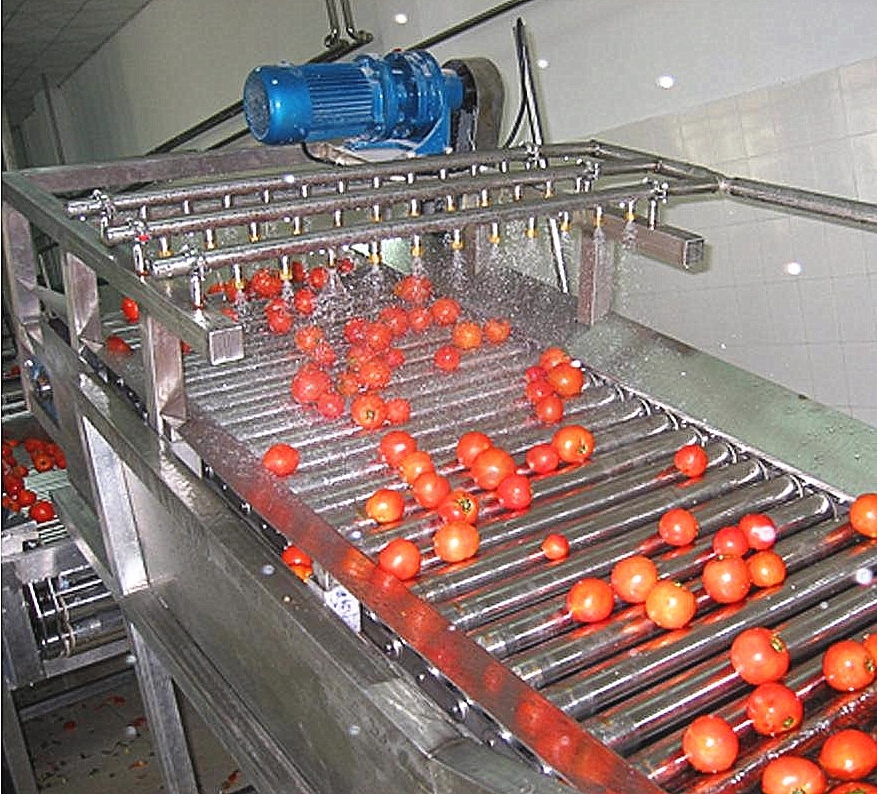
The first stage of processing sets the baseline for product quality and equipment longevity. Water-flume washing systems utilize turbulent water flow to gently transport tomatoes while loosening soil, pesticides, and debris. These systems significantly reduce mechanical damage to the fruit compared to dry conveyor belts. They preserve the integrity of the tomato before it reaches the sorting stage.
Integrating optical sorting technology provides a substantial return on investment by minimizing manual labor and preventing contamination. High-speed optical sorters utilize advanced cameras and sensors to detect and eject green, yellow, or moldy tomatoes. Removing defective fruit early prevents mold spores and off-flavors from contaminating the entire batch.
For facilities producing whole peeled or diced tomatoes alongside paste, blanching and peeling systems remain critical. Steam blanchers rapidly heat the exterior of the tomato, loosening the skin while keeping the core firm. Thermophysical peeling systems then utilize vacuum pressure or mechanical pinch rollers to cleanly remove the skins with minimal flesh loss.
A high-quality tomato processing equipment supplier designs dual-use lines that offer operational flexibility. By incorporating bypass valves and modular routing, a single facility can alternate between continuous paste production and whole peeled tomato canning. This maximizes the utility of the raw material intake and sorting infrastructure.
The preheating stage fundamentally determines the physical characteristics of the final product. The choice between Hot Break and Cold Break processing depends on the intended application of the tomato paste.
| Process Type | Temperature Range | Enzyme Activity | Viscosity | Ideal End Products |
|---|---|---|---|---|
| Hot Break | 85°C - 100°C | Inactivated rapidly | High (Pectin retained) | Ketchup, thick sauces, pizza base |
| Cold Break | 65°C - 75°C | Partially active | Low (Pectin broken down) | Juices, light purees, soups |
Following preheating, the crushed tomato mass enters the pulping and refining stage to separate the valuable juice and pulp from the seeds, skins, and stems. Multi-stage turbo refiners utilize high-speed rotating paddles to force the tomato mass through cylindrical screens. A two-stage system ensures maximum yield extraction while achieving a smooth consistency.
The selection of screen mesh sizes directly correlates to yield optimization and waste separation. The first stage typically utilizes a coarser screen (1.5mm to 2.0mm) to remove large debris. The second stage utilizes a fine screen (0.4mm to 0.8mm) to achieve the desired smoothness. Proper calibration of the paddle clearance prevents seed fragmentation, which introduces bitter flavors into the paste.
Homogenization breaks down cellular structures and reduces particle size by forcing the refined tomato juice through a microscopic valve under extreme pressure. This prevents phase separation and significantly enhances the mouthfeel of the final product.
Industrial homogenizers operate at pressures ranging from 150 to 250 bar. Tomato fibers are highly abrasive. The homogenization valves must consist of highly wear-resistant materials such as tungsten carbide or stellite to maintain efficiency and prevent frequent maintenance shutdowns.
Multi-effect vacuum evaporators handle the massive water removal required at the industrial scale. Forced circulation evaporators prevent thermal degradation of the tomato paste while operating at lower boiling points under vacuum conditions. This preserves the color and nutritional profile of the paste.
The design of the evaporator dictates the steam efficiency of the entire plant. Triple-effect or quadruple-effect evaporators reuse vapor from the preceding stage to heat the subsequent stage. This cascading thermal design drastically reduces the total steam required per ton of evaporated water.
Tube-in-tube sterilizers handle high-viscosity fluids effectively. They heat the concentrated paste to sterilization temperatures (typically around 105°C to 115°C) and hold it for a specific duration before rapidly cooling it. This continuous thermal process eliminates spoilage microorganisms.
Aseptic bag-in-drum filling systems ensure ambient shelf-life without preservatives. The filling heads operate within a sterile steam chamber. The system automatically sterilizes the fitment, removes the cap, fills the bag with sterile paste, and replaces the cap without exposing the product to the ambient atmosphere.
Standardized machinery rarely fits perfectly into existing facility footprints. Evaluating a manufacturer's engineering capability involves assessing their ability to customize equipment layouts, adapt piping routes, and modify electrical panels. A competent manufacturer engineers a cohesive system tailored to your spatial and infrastructural realities.
During the proposal phase, request and rigorously review detailed P&ID (Piping and Instrumentation Diagrams) and 3D layout designs. These documents reveal the manufacturer's understanding of fluid dynamics, maintenance accessibility, and operational flow. They ensure no spatial conflicts exist before fabrication begins.
Investing in a turnkey tomato paste plant offers distinct advantages for new facilities. Turnkey solutions provide single-source accountability. One entity remains responsible for the entire process from raw material intake to aseptic filling. This ensures perfectly synchronized PLC controls, seamless mechanical integration, and unified warranties.
Modular integration works effectively for existing facilities looking to expand capacity. Upgrading specific components, such as replacing an outdated single-effect evaporator with a modern multi-effect system, yields significant operational improvements. The manufacturer must demonstrate the ability to integrate modern modules seamlessly with legacy infrastructure.
Industrial food processing demands strict adherence to sanitary design principles to prevent microbial contamination. The baseline expectation for metallurgy is the extensive use of AISI 304 stainless steel for all general product contact surfaces. For high-acid environments and high-temperature zones, such as evaporators and sterilizers, AISI 316L stainless steel is mandatory due to its superior corrosion resistance.
Evaluate the manufacturer's integration of automated CIP (Clean-in-Place) and SIP (Sterilize-in-Place) systems. These systems must provide adequate flow velocity, temperature, and chemical concentration to thoroughly clean tanks, pipes, and valves without requiring manual disassembly. Compliance with international sanitary standards such as FDA, CE, 3-A, or EHEDG remains a non-negotiable requirement.
Evaluate a manufacturer's claims regarding steam efficiency, cooling water recycling, and electrical load. The design of the evaporation system heavily influences steam consumption. A triple-effect evaporator requires a higher upfront investment but delivers substantial long-term savings in steam consumption compared to double-effect systems.
Cooling water recycling systems reduce the environmental footprint and municipal water costs. Closed-loop cooling towers paired with heat exchangers allow the facility to reuse water for the vacuum condensers and sterilization cooling zones. Analyze the utility consumption matrix provided by the manufacturer to project daily operating expenses accurately.
Centralized SCADA/PLC systems provide real-time Brix monitoring, automated flow control, and temperature logging. Advanced automation reduces the risk of human error during critical sterilization and clean-in-place phases. Operators monitor the entire line from a central control room, adjusting pump speeds and steam valves via touchscreen interfaces.
Automated systems require fewer manual operators on the floor but demand higher-skilled technicians for maintenance and troubleshooting. Factor in the cost of specialized training for your maintenance staff when evaluating highly automated production lines.
Procuring heavy industrial machinery involves significant lead times, typically ranging from 4 to 8 months for manufacturing. You must align equipment delivery schedules with local harvest seasons. Missing the harvest window due to equipment delays results in an entire year of lost revenue. Build buffer periods into the procurement timeline to account for unforeseen delays.
Site preparation must occur concurrently with equipment manufacturing. This includes reinforcing concrete floors, installing proper drainage systems, and completing utility hookups for steam boilers and cooling towers. Conduct Factory Acceptance Testing (FAT) at the manufacturer's facility before the equipment ships to verify performance and identify defects.
The installation and commissioning phase requires the physical presence of the manufacturer's engineers on-site. The commissioning process involves rigorous dry testing to check motor rotations and sensor alignments. Wet testing follows to identify leaks and verify flow rates. Initial production runs with actual tomatoes fine-tune the evaporators, sterilizers, and fillers under real-world loads.
Comprehensive, localized training programs for plant operators and maintenance staff ensure long-term success. Operators must thoroughly understand the HMI, alarm troubleshooting, and CIP procedures. Maintenance teams require hands-on training for replacing wear parts, lubricating bearings, and servicing mechanical seals.
Evaluating post-sale reliability requires a clear understanding of the aftermarket support infrastructure. Demand guaranteed response times for technical support and remote troubleshooting capabilities via secure VPN connections to the plant's PLC network.
Maintain an on-site inventory of critical wear parts, including refiner screens, scraper blades, homogenizer valves, and mechanical seals. The manufacturer should provide a detailed recommended spare parts list and guarantee the long-term availability of proprietary components.
A: Industrial lines typically start at a minimum capacity of 50 tons of raw tomatoes per day. Continuous industrial efficiency is generally realized at 150 tons per day and above.
A: Hot Break processing heats crushed tomatoes to 85°C-100°C to inactivate enzymes, retaining pectin for thick products. Cold Break processes at 65°C-75°C, allowing enzymes to break down pectin, resulting in thinner paste with brighter color.
A: Consumption varies based on capacity and evaporator efficiency. A modern multi-effect evaporator significantly reduces steam usage. Facilities utilize cooling towers and water recycling systems to minimize fresh water intake.
A: Standard industrial multi-effect vacuum evaporators easily achieve the standard 28-30% Brix. Advanced forced-circulation evaporators can concentrate paste up to high-density levels of 36-38% Brix without scorching the product.
A: Homogenization breaks down particles to prevent phase separation and creates a smooth mouthfeel. This is critical for consumer-facing sauces, whereas bulk industrial paste is often used as an ingredient and may not require immediate homogenization.
A: Mechanical installation typically takes 4 to 8 weeks after the equipment arrives. Commissioning requires an additional 2 to 4 weeks depending on the line's complexity and automation level.
A: Yes. With proper engineering, cleaning protocols, and minor equipment adjustments, a tomato paste line can efficiently process other fruits like apples, mangoes, or peaches into purees.