Call Us
+86-15800763021
Send Us
Add
775 Chihua Road, Zhelin Town, Fengxian District, Shanghai
- All
- Product Name
- Product Keyword
- Product Model
- Product Summary
- Product Description
- Multi Field Search
Views: 0 Author: Site Editor Publish Time: 2026-08-26 Origin: Site

Transitioning from a natural water source to a commercial bottling operation involves high capital risk and technical complexity. Poorly planned facilities frequently face crippling downtime, regulatory rejection, and compliance failures. The core friction points lie in aligning hydrogeological yield, strict regulatory compliance, and industrial-scale packaging without overcapitalizing on unnecessary machinery. You need a structured, engineering-first framework to navigate these challenges effectively. This involves evaluating equipment, planning capital budgets, designing the facility layout, and selecting a manufacturing partner capable of delivering verifiable production metrics. A systematic approach ensures your investment translates into a reliable, compliant, and profitable operation. Success requires treating the facility as a single, continuous ecosystem rather than isolated pieces of machinery. You must proactively address local health departments, FDA guidelines, and international food safety standards before breaking ground.
Aligning plant capacity with target demographic demands forms the foundation of your operation. A regional niche focusing on glass bottling requires a vastly different setup compared to high-volume PET commodity markets. You must determine the distribution strategy early to size the warehouse and logistics bays accurately. This ensures smooth outbound operations and prevents bottlenecks at the loading dock. If your market research indicates a demand for premium glass bottles, your equipment specifications will shift toward heavier-duty conveyors and specialized rinsing systems. Conversely, high-volume PET production demands high-speed rotary systems and integrated blow molding capabilities.
Verifying source yield, flow rate consistency, and seasonal mineral composition variations is non-negotiable. This prevents running dry during peak production seasons and ensures the mineral profile remains consistent. A thorough hydrogeological survey must be completed before committing capital to a mineral water production line. You need to know exactly how much water you can extract sustainably over a 24-hour cycle. This data directly dictates your maximum production capacity. Ignoring seasonal fluctuations can lead to severe operational disruptions when the water table drops during dry months.
Understanding the timeline and requirements for water extraction licenses, environmental impact assessments, and municipal zoning approvals is critical. Operating without full compliance risks immediate shutdown and severe penalties. Secure these approvals before finalizing equipment purchases. Local municipalities often have strict zoning laws regarding industrial water extraction and heavy truck traffic. You must engage with local authorities early in the planning phase to identify potential roadblocks. Environmental impact assessments can take months to complete, so factor this into your project timeline.
Establishing frameworks for calculating target Bottles Per Hour (BPH) based on market research, source limits, and shift schedules keeps your project grounded in reality. Analyze capital expenditure brackets, ranging from entry-level semi-automated lines to high-speed, fully automated turnkey production plants. Align your budget with realistic production goals. Overestimating source yield or market absorption leads to underutilized equipment and stranded capital. Base your capacity planning on conservative estimates and verifiable data to mitigate financial exposure.
| Production Variable | PET Bottling Line | Glass Bottling Line |
|---|---|---|
| Conveyor Requirements | Standard air conveyors for empty bottles | Heavy-duty stainless steel slat conveyors |
| Rinsing Technology | Standard ionized air or water rinse | Intensive hot water and chemical sterilization |
| Filling Mechanism | Neck-handling gravity or volumetric | Base-handling isobaric or gravity |
| Packaging | Shrink wrapping and standard palletizing | Cardboard cartons with dividers |
Evaluating filtration stages such as multi-media sand, activated carbon, and microfiltration based on raw water chemical analysis determines your treatment strategy. Reverse Osmosis (RO), UV sterilization, and ozonation play specific roles in maintaining shelf stability while preserving natural mineral profiles or implementing remineralization strategies. The goal is to remove impurities without stripping the water of its defining characteristics. If your source water contains high levels of iron or manganese, you will need specialized oxidation and filtration steps before the water reaches the final polishing filters.
Comparing gravity filling, isobaric filling, and volumetric filling technologies based on bottle type and carbonation levels is necessary for optimal performance. Assess sanitary design features, including CIP (Clean-in-Place) compatibility, cleanroom enclosures (ISO Class 5/Class 100), and neck-handling mechanisms. Selecting the right mineral water filling equipment ensures product integrity and minimizes product loss. Neck-handling systems are standard for PET bottles because they accommodate various bottle sizes with minimal changeover parts. Glass bottles require base-handling systems, which demand more complex changeover procedures when switching bottle formats.
Analyzing blow-molding integration involves comparing in-line rotary blow molders versus standalone linear blow molders. Rotary systems offer higher speeds and seamless integration with the filler, while linear systems provide flexibility for lower-speed operations. Evaluate labeling systems like hot melt, OPP roll-fed, cold glue, or shrink sleeve, along with shrink-wrapping and palletizing systems for scalability. Contrasting the high initial cost of fully automated, integrated monoblocks against the higher labor costs and contamination risks associated with semi-automated, segmented lines helps clarify your investment strategy. Automation reduces long-term operational expenses and human error.
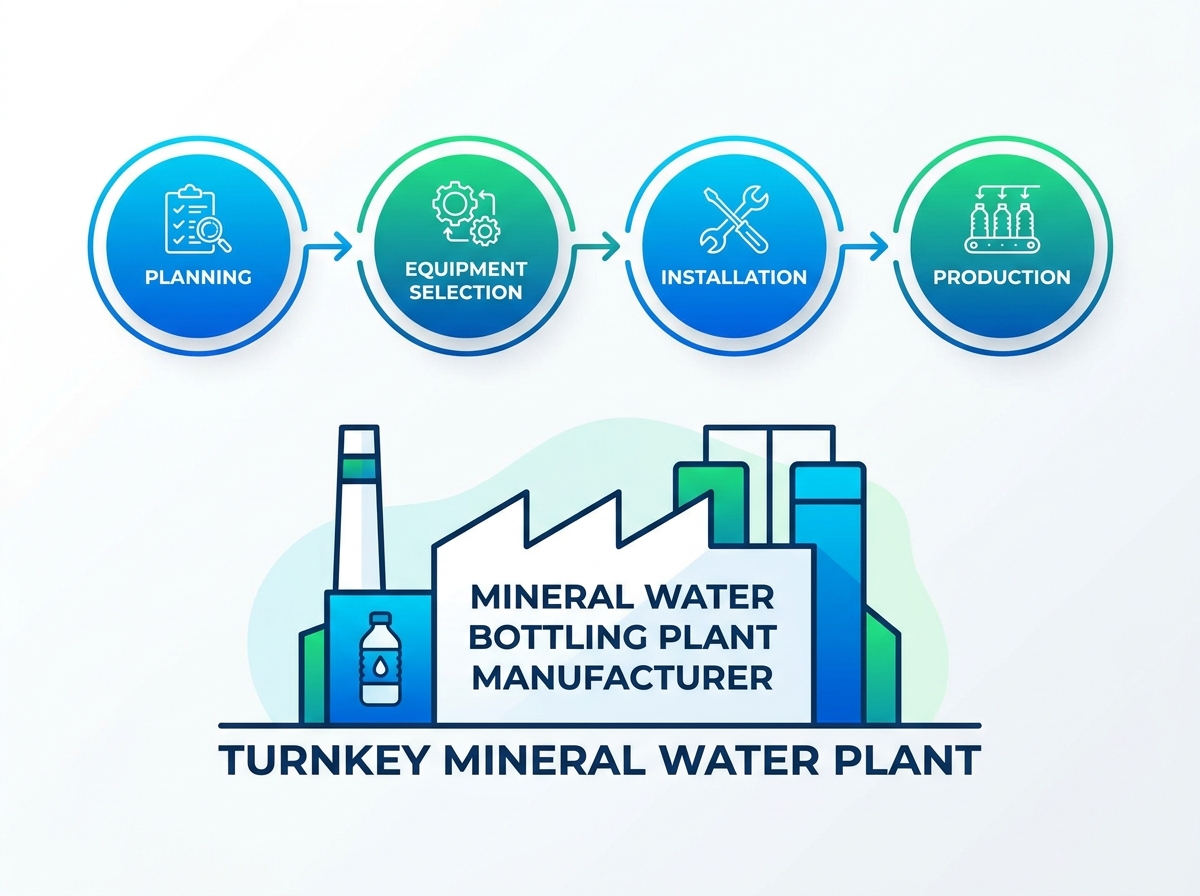
A true turnkey mineral water plant encompasses conceptual engineering, customized manufacturing, installation, commissioning, and validation. This approach ensures all components function cohesively under a unified system architecture. The manufacturer takes full responsibility for the line's performance, from the water treatment system to the final palletizer. This single-source accountability simplifies project management and accelerates the commissioning phase. You avoid the common pitfall of incompatible software protocols between different machines.
Sourcing treatment systems, filling equipment, and packaging lines from different specialized vendors requires meticulous coordination. This scenario often demands significant internal engineering resources or third-party integrators. While you might find specialized machines for specific tasks, making them communicate effectively is a massive challenge. Conveyor speeds must synchronize perfectly to prevent bottle jams and line stoppages. If the labeler faults, the filler and blow molder must automatically adjust their speeds or pause to prevent a catastrophic pile-up.
| Evaluation Dimension | Turnkey Approach | Multi-Vendor Approach |
|---|---|---|
| System Integration | Seamless PLC handshakes and unified HMI | Requires third-party integrators and custom coding |
| Accountability | Single point of contact for all issues | High risk of vendor finger-pointing during faults |
| Installation Timeline | Streamlined and coordinated by one team | Often delayed due to scheduling conflicts between vendors |
| Maintenance | Standardized spare parts and unified service contracts | Multiple service contracts and diverse spare parts inventory |
Demanding comprehensive OEE (Overall Equipment Effectiveness) guarantees in the contract, regardless of the chosen approach, mitigates implementation risk. This ensures the equipment delivers the promised performance metrics under actual operating conditions. An OEE guarantee forces the vendor to prove the line can run at the specified speed, with the specified yield, over a sustained period. Do not accept a successful 15-minute test run as proof of performance. Require a continuous 8-hour or 24-hour validation run using your actual bottles, caps, and labels.
Implementing strict physical separation of wet zones from dry zones is a fundamental hygienic requirement. Establish positive pressure cleanrooms around the filling block to prevent airborne contamination and maintain product safety standards. The wet zone includes water treatment, rinsing, and filling. The dry zone encompasses blow molding, labeling, and packaging. Airflow must always move from the cleanest area (the filler) outward to the less critical areas. This prevents dust and cardboard particles from the packaging area from entering the filling enclosure.
Specifying industrial flooring using heavy-duty epoxy or polyurethane is necessary to withstand constant moisture, chemical spills from CIP processes, and heavy forklift traffic. Ensure proper drainage gradients, specialized HVAC filtration, and high-voltage power stability to support continuous heavy machinery operation. Drains must be constructed of stainless steel and designed for easy cleaning to prevent bacterial growth. The HVAC system must provide adequate air changes per hour and utilize HEPA filters in the filling room.
Mapping the optimal flow of raw materials and finished goods minimizes forklift traffic, prevents cross-contamination, and optimizes loading dock utilization. Efficient logistics reduce bottlenecks and improve overall throughput. Raw materials like preforms, caps, and labels should enter the facility through a dedicated receiving dock and flow logically toward the production line. Finished pallets should move directly from the palletizer to the warehouse or outbound shipping dock without crossing paths with raw material flow.
Evaluating the cost implications of retrofitting an existing standard warehouse versus building a custom-designed greenfield food-grade facility is a major decision. Retrofits often uncover hidden costs related to structural upgrades, insufficient power capacity, and hygiene compliance. A standard warehouse rarely has the necessary drainage infrastructure or floor coatings required for a wet bottling environment. Cutting trenches for drains and upgrading the electrical service can quickly consume your contingency budget.
Assessing the manufacturer's ability to adapt standard machinery to specific bottle designs, cap types, and factory footprints is the first step. Flexibility in design ensures the equipment meets your exact operational requirements. A rigid manufacturer who forces you to adapt your facility to their standard machine footprint will cause layout headaches. Look for a partner who provides detailed 3D layout drawings and is willing to customize conveyor routing to fit your building's constraints.
Defining criteria for rigorous pre-shipment testing is vital. This includes sustained high-speed runs using actual customer bottles and simulated fault recoveries to verify system resilience before delivery. Factory Acceptance Testing (FAT) is your last chance to identify and fix issues before the equipment ships. Bring your lead operator and maintenance technician to the FAT. Have them practice changeovers, clear simulated jams, and navigate the HMI panels. If the machine fails a specific test, require the manufacturer to fix it and repeat the test before signing off.
Evaluating the manufacturer's Service Level Agreements (SLAs), remote diagnostic capabilities, and domestic spare parts inventory ensures long-term viability. Rapid support minimizes downtime and maintains production schedules. Modern PLCs should include secure remote access modules, allowing the manufacturer's engineers to troubleshoot software faults from their headquarters. Verify that they stock critical spare parts, such as filling valves, capping chucks, and specialized sensors, in a location that allows for overnight delivery to your facility.
Interviewing the manufacturer's past clients regarding actual uptime, maintenance costs, and responsiveness after year one provides invaluable real-world feedback. Do not just ask for a list of references; ask for references who operate similar equipment at a similar capacity. Ask these references about the installation process, the frequency of unexpected breakdowns, and how quickly the manufacturer responds to emergency service calls. A reputable mineral water bottling plant manufacturer will gladly provide this information.
A: A turnkey plant is designed, manufactured, installed, and commissioned by a single vendor, ensuring seamless integration and single-point accountability. A custom-built line involves sourcing individual machines from multiple vendors, requiring complex integration and increasing the risk of compatibility issues.
A: Space requirements vary significantly based on capacity and automation. A standard automated line typically requires between 10,000 to 30,000 square feet. This must accommodate water treatment, filling, packaging, raw material storage, and finished goods warehousing.
A: Industrial bottling equipment requires stable, high-voltage three-phase power. Additionally, facilities need robust compressed air systems for blow molding and pneumatic controls, along with substantial clean water supply and industrial-grade drainage systems.
A: Delivery and installation typically take between 6 to 12 months from the time the order is placed. This timeline includes conceptual engineering, manufacturing, Factory Acceptance Testing (FAT), shipping, on-site installation, and final commissioning.
A: Essential permits include water extraction licenses, environmental impact approvals, municipal zoning permits, and health department clearances. Securing these before purchasing equipment prevents stranded capital if regulatory approval is denied.
A: Hygiene is maintained through strict zoning, separating wet and dry areas, and using positive pressure cleanrooms around the filling block. Equipment must feature sanitary design and Clean-in-Place (CIP) capabilities to ensure thorough sanitation between production runs.