Call Us
+86-15800763021
Send Us
Add
775 Chihua Road, Zhelin Town, Fengxian District, Shanghai
- All
- Product Name
- Product Keyword
- Product Model
- Product Summary
- Product Description
- Multi Field Search
Views: 0 Author: Site Editor Publish Time: 2026-07-31 Origin: Site

Selecting the right equipment infrastructure for beverage manufacturing represents a high-stakes capital expenditure. Choosing the wrong machinery can permanently bottleneck throughput, cause excessive yield loss, and erode profit margins on the factory floor. Factory owners must align specific beverage formulations—including carbonation levels, acidity, foaming characteristics, and viscosity—with the mechanical realities of automated filling and packaging systems. A mismatch here leads to constant downtime and product waste.
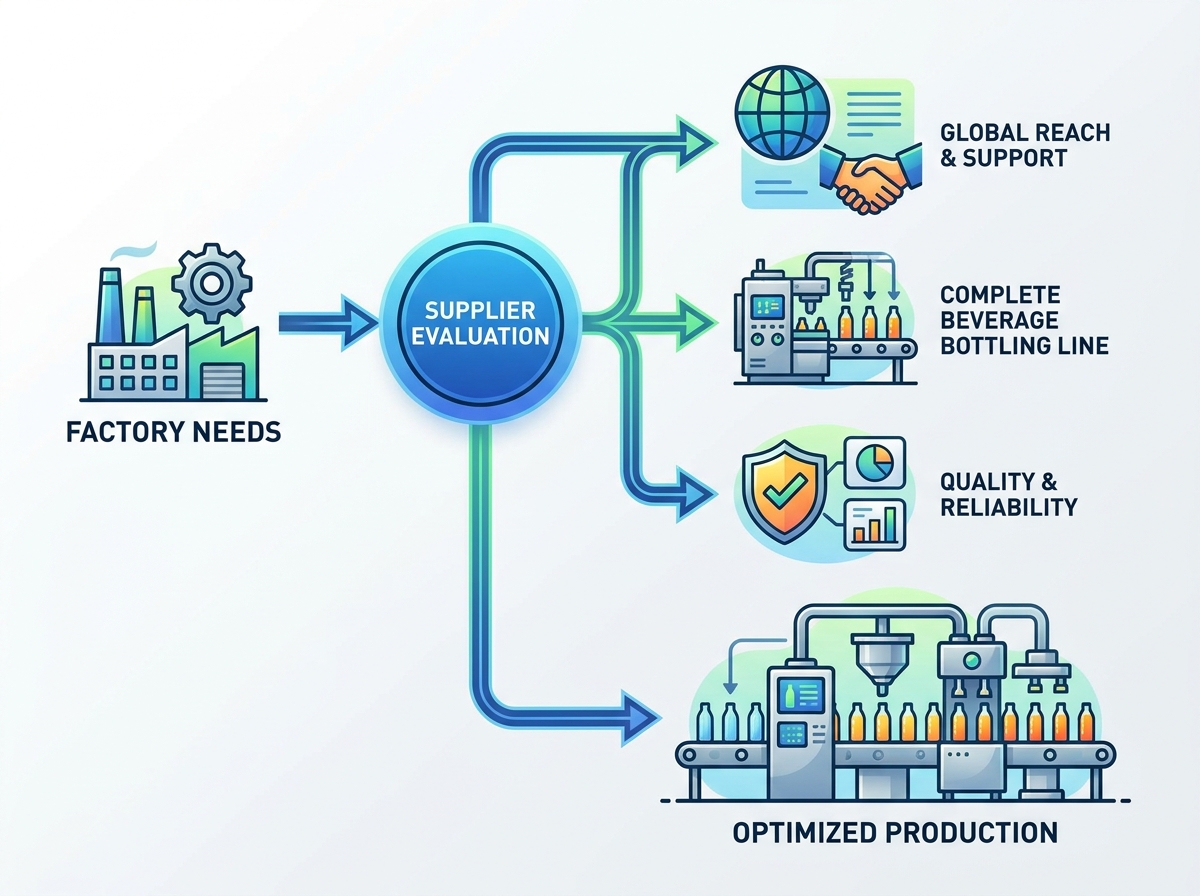
Evaluating a soft drink production line supplier requires a systematic, engineering-first framework. You must move beyond marketing claims to assess technical capabilities, integration expertise, and long-term vendor viability. This guide provides actionable steps to define your production requirements, evaluate core components, and mitigate implementation risks before finalizing your machinery investment. We will look at the exact mechanical specifications and factory floor realities that dictate success.
Establish the operational baseline and formulation limits that any viable soft drink plant manufacturer must meet. Without clear parameters, suppliers cannot accurately size or engineer your machinery. You need to lock down your liquid specifications and facility constraints before requesting a single equipment drawing.
Different beverages require vastly different mechanical approaches. Carbonated soft drinks demand isobaric or counter-pressure filling systems to maintain CO2 saturation during the filling process. If you try to run highly carbonated liquids through a standard gravity filler, you will lose carbonation and create massive foaming issues. Still, pulpy, or functional beverages often rely on hot fill or aseptic filling technologies to ensure product stability and safety without chemical preservatives.
Coordinate closely with professional beverage formulators. You must provide your supplier with exact physical properties, including Brix levels, foaming tendencies, liquid density, and chemical acidity. These metrics directly dictate valve construction and nozzle design. High syrup viscosity and specific carbonation volumes heavily impact the engineering of upstream soft drink processing equipment. For example, high-Brix syrups require stronger positive displacement pumps and larger diameter piping to prevent cavitation and flow restriction.
Calculate your target Bottles Per Hour (BPH) using a formulaic approach. Translate your desired daily or monthly output into a required BPH, then apply a 15-20% safety buffer. This buffer accounts for scheduled downtime, maintenance, and realistic operational efficiency. If you need 10,000 bottles per shift, do not buy a machine rated for exactly 10,000 bottles per shift. You will never hit 100% Overall Equipment Effectiveness (OEE) in a real-world factory environment.
Evaluate the mechanical capabilities of small-to-medium lines versus high-speed mass production systems. A rotary filling line handling 1,000 to 1,500 BPH offers different flexibility compared to a massive 20,000 BPH linear system. Address minimum batch runs based on equipment dead volume. Residual syrup left in mixing tanks and piping dictates the minimum viable production run to prevent excessive product waste. If your system holds 50 gallons of dead volume, running a 100-gallon batch is economically unviable.
Outline your physical footprint and facility constraints. Communicate available utilities, electrical loads, drainage layouts, ceiling heights, and floor load capacities to your supplier early in the consultation phase. A massive rotary filler requires reinforced concrete floors and specific trench drain placements to handle CIP (Clean-in-Place) washdown cycles.
Break down the modular segments of a production line to evaluate a supplier's breadth of expertise. A truly complete beverage bottling line integrates multiple complex systems. You are not just buying a filler; you are buying a synchronized fluid dynamics and packaging system.
Evaluate reverse osmosis (RO) systems, UV sterilization, deaeration units, and continuous blending systems. Precise Brix control and multi-stage CO2 dosing are critical in the processing phase. Proper engineering design minimizes dead volume and maximizes product recovery during batch transitions. The deaeration unit must effectively remove dissolved oxygen from the source water before carbonation, otherwise, the CO2 will not bind properly, leading to flat beverages and excessive foaming at the filler bowl.
Compare rotary filling lines against linear fillers. Rotary systems excel in medium-to-high volume environments, utilizing continuous motion to achieve high speeds. Linear fillers offer high flexibility for low-volume applications and frequent changeovers. Evaluate capping precision, magnetic hysteresis torque control, and seaming reliability for PET, glass, or aluminum containers. If the capping heads lack precise torque control, you will experience leaking bottles or stripped threads.
Assess oxygen-pickup prevention mechanisms. Nitrogen flushing or pre-evacuation systems are vital to extend product shelf life and maintain flavor integrity. For canned beverages, under-cover gassing just before the seamer places the lid is a non-negotiable requirement to displace headspace oxygen.
Assess integration capabilities for shrink-wrapping, carton packing, and robotic palletizing. A unified Programmable Logic Controller (PLC) system across the entire line prevents synchronization bottlenecks. Consistent communication between machines reduces jams and operational delays. If the labeler faults, the filler needs to know to slow down or pause to prevent a massive backlog of unlabelled bottles crashing into each other on the conveyor.
| Equipment Module | Key Engineering Considerations | Primary Function |
|---|---|---|
| Processing & Blending | Brix control, CO2 dosing accuracy, dead volume reduction | Syrup preparation and carbonation |
| Filling & Capping | Torque control, oxygen prevention, valve design | Container filling and sealing |
| End-of-Line Packaging | PLC synchronization, robotic integration, footprint | Labeling, wrapping, and palletizing |
| Conveyor Systems | Accumulation tables, variable frequency drives (VFDs) | Bottle transport and buffering |
Use technical and authoritative lenses to vet potential partners. Look past glossy brochures and focus on engineering reality. You need to know how they build the machines and what materials they use.
Verify if a supplier is a true specialist in your specific beverage category. A manufacturer excelling at hot-fill juice may struggle with the nuances of highly carbonated soft drinks. Audit their historical portfolio of active, comparable installations to confirm their expertise. Ask for references from factories running similar Brix levels and carbonation volumes.
Assess a supplier's ability to customize line layouts. L-shape, U-shape, or linear configurations are often necessary for tight or unconventional factory footprints. Look for dedicated, in-house engineering and automation teams. Avoid suppliers who merely white-label or integrate third-party machinery without deep design control. If they cannot modify the PLC code in-house, you will face massive delays during commissioning.
Verify the use of 316L stainless steel for all product-contact surfaces and food-safe gaskets. Evaluate the design and integration of automated Clean-in-Place (CIP) and Sterilize-in-Place (SIP) systems. Review chemical consumption rates and validation cycle times to ensure cross-contamination prevention. The piping must feature sanitary welds with zero dead legs where bacteria can hide and multiply.
Demand a checklist of non-negotiable certifications. Ensure the equipment meets CE, UL, ISO 9001, and ASME standards for pressure vessels. All materials must be FDA-compliant and food-grade. If the carbonation tank is not ASME certified, it poses a severe safety risk to your operators.
Protect your investment during design, delivery, and deployment. Vendor accountability ensures the machinery performs as promised on your factory floor. Do not sign off on final payments until the equipment proves its capability.
Define the critical stages of the Factory Acceptance Test (FAT) at the supplier's facility. Run actual product formulations through the machinery before shipping. Document performance metrics, reject rates, and changeover times. Follow up with a rigorous Site Acceptance Test (SAT) once the equipment is installed in your facility to verify real-world operational efficiency. The SAT must include a continuous run of at least 8 hours to prove thermal stability and mechanical reliability under full production stress.
A: Isobaric machines fill under pressure to keep carbon dioxide dissolved in carbonated drinks. Hot fill machines heat the liquid to sterilize the product and the container, typically used for juices and still beverages.
A: Divide your target daily production volume by your operational hours per shift. Add a 15 to 20 percent buffer to account for machine maintenance, cleaning cycles, and unexpected downtime.
A: 316L stainless steel offers superior corrosion resistance against acidic beverage formulations and harsh cleaning chemicals used during CIP processes, preventing rust and contamination.
A: Dead volume refers to the residual liquid trapped in pipes, tanks, and valves that cannot be bottled. High dead volume leads to excessive product waste during batch changeovers.
A: A unified PLC system ensures all machines on the line communicate seamlessly. This synchronization prevents bottlenecks, reduces container jams, and simplifies troubleshooting for operators.