Call Us
+86-15800763021
Send Us
Add
775 Chihua Road, Zhelin Town, Fengxian District, Shanghai
- All
- Product Name
- Product Keyword
- Product Model
- Product Summary
- Product Description
- Multi Field Search
Views: 0 Author: Site Editor Publish Time: 2026-08-06 Origin: Site

Acquiring processing equipment represents a critical capital expenditure where equipment failure or sub-optimal particle size reduction directly impacts product shelf-life, mouthfeel, and brand reputation. Facility managers and process engineers face the difficult task of navigating complex technical specifications, including pressure ratings, valve geometries, and flow rates. You must balance upfront capital requirements against long-term maintenance needs and energy consumption.
Selecting the right equipment requires moving beyond basic spec sheets. You must rigorously evaluate the engineering quality, application-specific design, and post-sale infrastructure of your chosen high pressure homogenizer manufacturer. A poorly specified machine leads to unstable emulsions, frequent downtime, and wasted utility resources, while a properly engineered system ensures consistent product quality and operational reliability.
Understanding the physical principles of homogenization is the first step in specifying the right machinery. The mixing mechanism involves forcing a product through a narrow, highly confined space under high velocity. This intense mechanical action differs significantly from standard high-shear mixing. It relies on a combination of shear, cavitation, and turbulence to physically disrupt particles and droplets. When fluid accelerates through the homogenizing valve, the sudden drop in pressure causes cavitation bubbles to form and collapse, generating shockwaves that tear apart fat globules and solid particles.
Before evaluating specific machines, you must identify the target outcome for your product. Specific physical changes are required depending on the application. You might need to prevent cream separation in milk, improve the viscosity and stability of sauces, or enhance flavor encapsulation in fruit juices. Each of these goals requires a different approach to fluid dynamics and pressure application. For example, plant-based milks often require higher shear forces to break down fibrous cellular structures compared to standard bovine milk.
Precise micron reduction directly impacts customer-facing attributes. Achieving the correct particle size distribution establishes aesthetic and sensory benchmarks. Proper processing yields a softer texture, uniform color distribution, enhanced flavor penetration, and an improved overall mouthfeel. When particles are reduced to a uniform size, the product remains stable on the shelf, preventing unsightly phase separation. This physical stability is paramount for clear beverages and complex emulsions alike.
Target micron sizes dictate the required mechanical forces. If your goal is a sub-micron emulsion, you will need equipment capable of generating intense cavitation and shear. Throughput and scalability also play a vital role. You must establish baseline flow rate requirements in liters per hour. Calculate necessary capacity buffers for future production scaling to ensure you do not over-specify the machine, which leads to wasted energy, or under-specify it, which creates production bottlenecks. Integrating the right beverage homogenization equipment ensures these production targets are met consistently.
To properly define success, consider the following operational parameters:
The operational realities of pressure settings dictate machine selection. Standard homogenization operates between 0 and 50 MPa (0 to 500 bar). True High Pressure Homogenization (HPH) requires capabilities ranging from 50 to 200+ MPa (500 to 2000+ bar). Moderate pressure ranges, typically utilizing 150 to 250 bar, are ideal for achieving an optimal, smooth mouthfeel in standard dairy products. Operating within these moderate ranges minimizes wear on the compression block while achieving the necessary fat globule reduction.
Extreme HPH ranges exceeding 500 bar are necessary for specialized applications. Nanometre-range plant-based milk stabilizers and complex pharmaceutical emulsions require these intense pressures to maintain long-term stability. However, there are diminishing returns associated with excessive pressure. While higher pressure improves emulsion stability, it exponentially increases energy use and accelerates mechanical wear on internal components. You must find the exact pressure threshold where product stability is achieved without wasting mechanical energy.
Consider the following pressure applications across different product categories:
| Product Category | Typical Pressure Range (bar) | Primary Processing Goal |
|---|---|---|
| Standard Pasteurized Milk | 100 - 150 | Prevent cream line formation |
| Yogurt Base | 200 - 250 | Improve viscosity and texture |
| Plant-Based Milks (Oat, Almond) | 300 - 600 | Cellular disruption, stabilize suspension |
| Flavor Emulsions | 500 - 800+ | Sub-micron encapsulation |
Understanding the difference between single and two-stage processing is critical for product stability. Single-stage homogenization utilizes one valve to apply pressure and shear. It works well for products requiring high viscosity, simple dispersions, and low-fat content. In contrast, two-stage homogenization uses a primary high-pressure valve followed immediately by a secondary low-pressure valve.
Two-stage systems are mandatory for dairy applications. After the initial pressure drop in the first stage, fat globules tend to re-agglomerate or clump together due to surface tension changes. The second stage applies a lower pressure (typically 10-20% of the first stage pressure) to break up these clusters, ensuring a smooth, stable emulsion. This is why specifying a two-stage milk homogenizer machine is standard practice in dairy processing facilities.
Different manufacturers approach valve design with varying philosophies. Common designs include parallel discs and knife-edge valves, each engineered to maximize shear force while minimizing energy input. Efficiency-focused valve designs are a major differentiator among equipment providers. The geometry of the gap where the fluid accelerates directly dictates the intensity of the cavitation field.
Evaluate whether the manufacturer offers advanced multi-disc parallel valve designs. These components are engineered to run multiple discs in parallel, which lowers operational pressure requirements while maintaining equal particle reduction. Valve material also impacts performance. Tungsten carbide and specialized ceramics are necessary for handling abrasive ingredients like fruit pulps or plant fibers, preventing premature wear and maintaining consistent processing efficiency. Standard stainless steel valves will degrade rapidly when processing abrasive slurries, leading to a loss of homogenization pressure and inconsistent product quality.
Food and beverage processing requires strict adherence to hygienic design standards. The equipment must eliminate dead legs where bacteria can harbor. It must fully support automated CIP and SIP protocols to ensure rapid, effective cleaning between production runs. The compression block must be machined from high-grade forged stainless steel to withstand both high mechanical stress and corrosive cleaning chemicals.
Request specific documentation during the vetting process. Ensure the manufacturer provides FDA-approved material certificates for all elastomers and product-contact surfaces. Verify 3-A Sanitary Standards compliance or EHEDG documentation to guarantee the equipment meets industry hygiene requirements. Without these certifications, you risk failing regulatory audits and compromising food safety.
Empirical testing is necessary before committing to a full-scale production unit. A credible supplier should offer pilot-plant testing facilities. This allows you to validate pressure settings and valve configurations on your actual product matrix. Testing on a pilot scale reveals how the fluid behaves under shear and helps identify the exact pressure required to achieve your target particle size.
Scaling from a 50 L/hr lab unit to a 10,000 L/hr production unit involves complex mathematical and engineering realities. Fluid dynamics change at scale. Pilot testing ensures the particle size distribution achieved in the lab can be replicated reliably on the factory floor without unexpected pressure drops or flow inconsistencies. The manufacturer must demonstrate a proven track record of successfully scaling similar applications.
High-capacity homogenizers consume significant electrical and water resources. Examine the utility requirements carefully during the specification phase. Evaluate manufacturers based on their integration of variable frequency drives (VFDs) and high-efficiency motor designs, which actively lower operational energy consumption by matching motor output to actual process demands. VFDs also allow for softer start-ups, reducing mechanical stress on the drive train.
Analyze the relationship between energy-saving valve technology and long-term utility savings. Parallel-disc designs often achieve the same homogenization effect at lower pressures compared to standard valves, directly reducing the electrical load on the main drive motor. Furthermore, evaluate the cooling water requirements for the lubricating oil and plunger seals, as excessive water consumption can drive up operational overhead.
Mechanical degradation is an unavoidable reality of high-pressure processing. The intense forces inherently destroy internal components over time. You must establish a framework for evaluating the lifespan of consumables, including plunger packings, pump valves, and high-pressure gaskets. Understanding the replacement intervals for these parts is critical for scheduling preventative maintenance and avoiding unplanned downtime.
Compare the ease of maintenance across different machine designs. Determine whether your internal maintenance staff can replace wear parts using standard tools, or if the equipment requires specialized OEM technicians for routine servicing. Accessible compression blocks and standardized packing designs significantly reduce planned downtime. Look for designs that allow front-loading access to the plungers and packings.
| Component | Typical Lifespan (Hours) | Failure Indicators |
|---|---|---|
| Plunger Packings | 500 - 2000 | Product leakage at the plunger housing |
| Homogenizing Valve | 1000 - 4000 | Inability to maintain set pressure, poor emulsion |
| Pump Valves (Suction/Discharge) | 2000 - 5000 | Knocking sounds, erratic pressure gauge readings |
Integrating a new homogenizer into an existing processing line presents several engineering challenges. Synchronizing the equipment with upstream pasteurizers (HTST/UHT) and downstream filling equipment requires precise flow control. To mitigate integration risks, require comprehensive P&ID (Piping and Instrumentation Diagram) reviews and automated control system (PLC) compatibility checks during the initial design phase. Ensure the homogenizer can communicate seamlessly with the central plant control system.
Supply chain disruptions for spare parts pose a severe threat to production schedules. Prolonged downtime due to unavailable proprietary parts can halt a facility. Negotiate strict SLAs for part delivery and require the manufacturer to maintain localized inventory for critical wear components. Maintain a critical spares inventory on-site, including extra packings, gaskets, and a spare homogenizing valve assembly.
High-pressure systems also pose severe safety risks if mishandled. Operator error can lead to catastrophic equipment failure or injury. Mandate comprehensive on-site training programs from the manufacturer. Ensure the equipment features robust physical safety interlocks, overpressure relief valves, and vibration monitoring systems. The relief valves must be properly sized and piped safely to a drain or recovery tank.
Choosing a homogenizer requires balancing precise fluid dynamics with the management of long-term mechanical wear. The right equipment ensures product stability while minimizing energy consumption and maintenance downtime. Proper specification directly impacts the operational efficiency of your entire processing line.
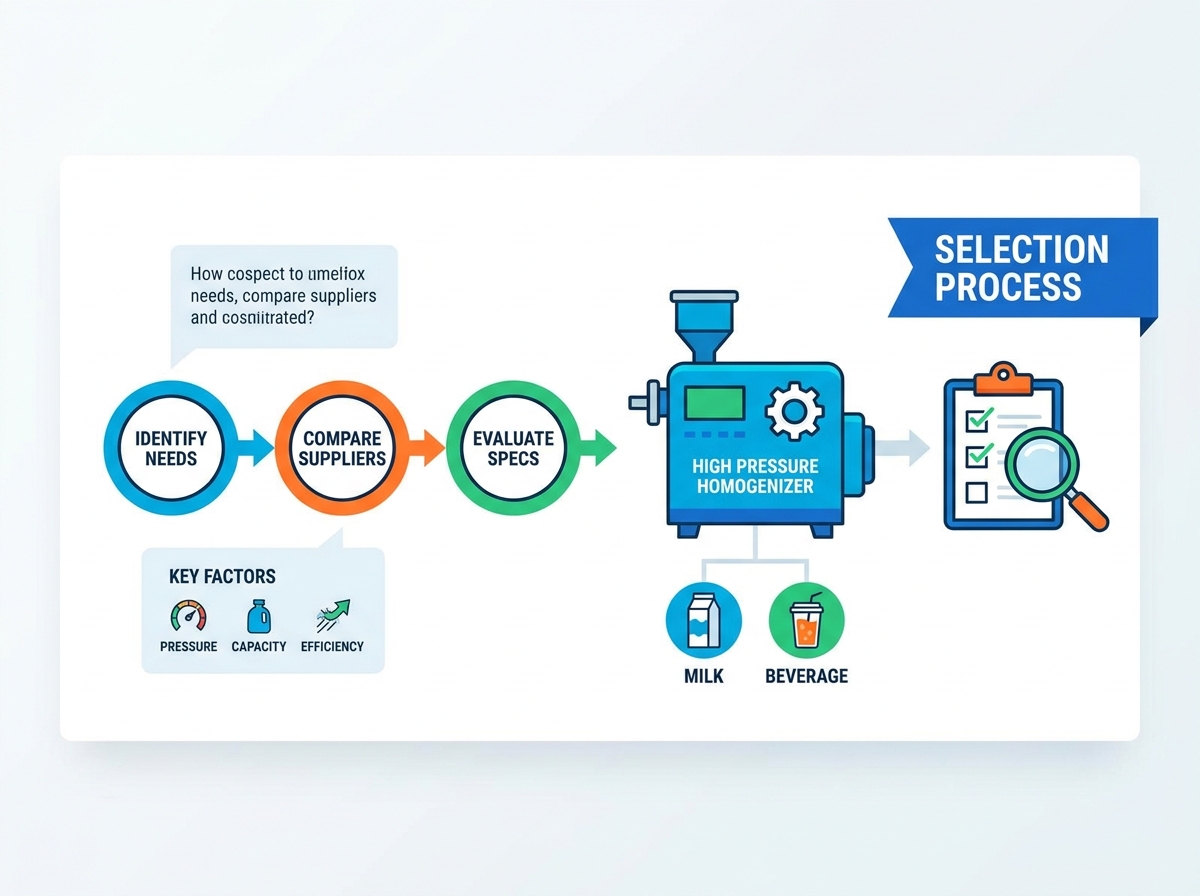
To finalize your selection process, execute the following steps:
A: Standard homogenizers operate between 0 and 50 MPa (up to 500 bar), suitable for basic dairy. High pressure homogenizers operate above 50 MPa, providing intense shear forces necessary for complex emulsions, sub-micron particle reduction, and plant-based beverages, though they require significantly more energy.
A: You need a two-stage system if you process dairy or high-fat emulsions. After the first high-pressure stage, fat globules often clump together. The second, lower-pressure stage breaks up these clusters, ensuring a stable emulsion and a smooth mouthfeel.
A: Lifespan varies wildly based on operating pressure and product abrasiveness. Parts may last a few hundred hours for abrasive, high-pressure applications, or several thousand hours for standard milk processing. Utilizing durable valve materials like tungsten carbide extends component life.
A: Optimal pressure ensures consistent particle size reduction, which improves texture, creates uniform flavor distribution, and increases physical stability. This prevents phase separation, directly extending the product's shelf-life and enhancing sensory attributes.
A: Look for comprehensive coverage on major components like the compression block and drive mechanism. Ensure you understand exclusions for standard wear parts (packings, valves) and verify guaranteed response times for technical support and emergency service.
A: Standard pumps struggle with high viscosity. Highly viscous products require specialized forced-feeding systems, modified valve geometries, and robust pump block designs to maintain consistent flow rates and prevent cavitation within the homogenizing chamber.