Call Us
+86-15800763021
Send Us
Add
775 Chihua Road, Zhelin Town, Fengxian District, Shanghai
- All
- Product Name
- Product Keyword
- Product Model
- Product Summary
- Product Description
- Multi Field Search
Views: 0 Author: Site Editor Publish Time: 2026-08-03 Origin: Site

Commercial dairy processing operates under strict margins and relentless schedules. Increasing market demand requires higher throughput from your facility. However, scaling up introduces severe risks to product consistency, moisture targets, and overall yield. Plant managers face constant tension between expanding capacity and maintaining strict sanitary compliance. You have to manage facility footprint constraints while avoiding curd degradation during mechanized handling. Pushing old equipment past its rated limits destroys product quality and reduces profitability. Evaluating facility bottlenecks is the first step to fixing this operational strain. Selecting appropriate high-capacity equipment and integrating automated systems allows facilities to scale output predictably. This transition spans from raw milk standardization to final block pressing. Optimizing a Cheese Production Line requires precise engineering. You must align mechanical shear, thermal dynamics, and chemical dosing to match your target throughput without compromising the final product.
Defining the success criteria for scaling is straightforward. You must increase volume without increasing whey fat losses or compromising the moisture-to-protein ratio. Pushing existing equipment beyond rated capacities creates immediate mechanical and biochemical problems. When operators speed up agitators in undersized vats to shorten processing times, they cause severe curd shattering. The mechanical shear tears the fragile coagulum apart. This generates excessive fines that escape into the whey stream. Lost fines represent direct yield destruction and lost revenue.
Inconsistent whey expulsion is another symptom of overtaxed equipment. When vats are overfilled, the hydrostatic pressure alters syneresis rates. Curd at the bottom of the vat retains different moisture levels than curd at the top. This leads to downgraded product quality across the batch. Fast processing often traps excess moisture within the curd matrix. High-moisture blocks fail quality control, suffer from shortened shelf life, and develop off-flavors during aging. True scaling requires balancing mechanical throughput with the biochemical realities of coagulation. You cannot force milk to coagulate faster simply by turning up the heat or adding more enzyme without altering the fundamental structure of the cheese.
Yield optimization at scale demands a granular look at fat retention. Every percentage point of fat lost to the whey silo reduces your final cheese volume. Upgrading your line means installing equipment designed to handle larger volumes gently. The goal is to move massive amounts of milk and curd with minimal turbulence. This preserves the fat and protein matrix while still meeting aggressive daily production quotas.
You must break down the processing timeline to find true constraints. Bottlenecks rarely exist where you expect them. A facility might blame a slow press for production delays, only to realize the actual delay stems from inconsistent milk standardization at the front end. Mapping the flow requires tracking every minute of the production cycle.
Common stall points disrupt continuous flow. Slow vat drainage leaves curd sitting in warm whey, accelerating acid development. Inefficient whey separation requires extended matting or stirring times. Manual block weighing at the end of the line slows down packaging and palletizing. Identifying these specific inefficiencies allows you to target capital expenditures effectively. You stop throwing money at the wrong machines and start engineering a streamlined process.
Scaling must begin before the milk hits the vat. Raw milk composition fluctuates daily based on herd diet, weather, and seasonality. Automated fat-to-protein standardization is mandatory for high-volume production. Consistent milk composition guarantees predictable coagulation times and uniform curd structure. If you feed unstandardized milk into a high-capacity vat, you will get unpredictable yields and erratic moisture levels.
High-throughput pasteurizers and centrifugal separators ensure a continuous feed. Centrifugal separators strip out excess fat to hit precise recipe targets automatically. Modern pasteurizers utilize regenerative heating sections to process thousands of liters per hour efficiently. They capture heat from the outgoing pasteurized milk to warm the incoming cold raw milk. This drastically reduces steam consumption and lowers utility bills. This continuous, uniform feed of standardized milk prevents downstream vats from waiting empty.
Upgrading front-end processing stabilizes the entire downstream operation. When the milk entering the vat is identical every single time, the PLC can run automated recipes with high confidence. Operators no longer need to manually adjust cutting times or cooking temperatures to compensate for thin or fatty milk. The foundation of a scaled operation is absolute consistency at the standardization phase.
Traditional open vats cannot support industrial scale. They suffer from poor thermal retention and expose the product to airborne contaminants. Fully enclosed, automated double-O or horizontal cheese vats are designed for large-scale, multi-ton production. These enclosed systems offer superior environmental control, precise temperature management, and automated CIP capabilities. They allow facilities to process massive volumes of milk in a single batch while maintaining strict sanitary conditions.
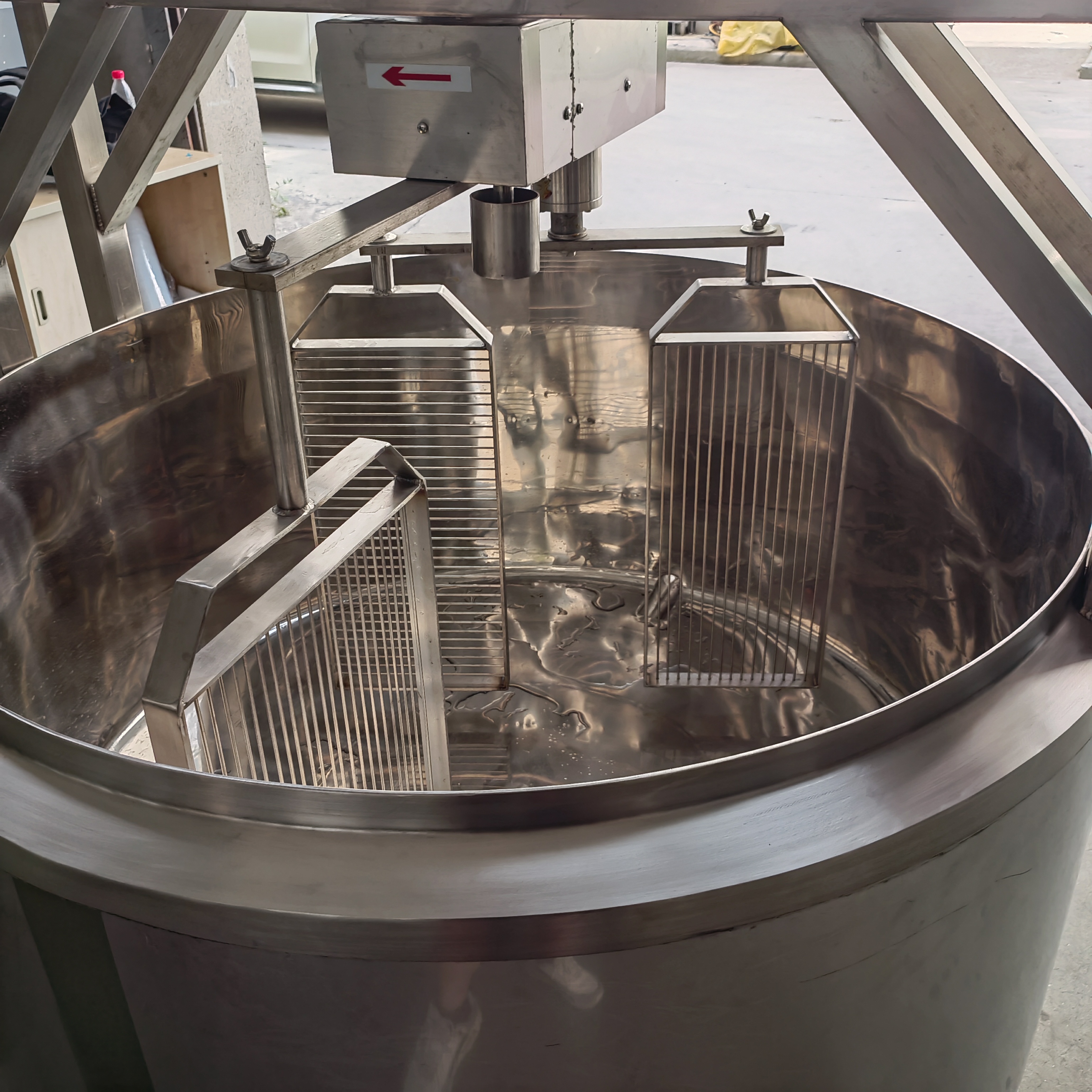
When evaluating Cheese Making Machines, focus on features that drive specific outcomes. Advanced cutting geometries reduce fines by slicing the coagulum cleanly rather than tearing it. The design of the cutting knives and the speed of the agitator drives dictate the amount of fat lost to the whey. Zoned heating jackets are vital for large volumes. They apply heat evenly across the vat surface, utilizing multiple steam or hot water zones.
Zoned heating prevents localized overheating during the cooking phase. If the bottom of the vat gets too hot, it prematurely seals the exterior of the curd particles. This traps unwanted moisture inside the curd, leading to soft, off-spec cheese. High-capacity vats use sophisticated PLC controls to ramp up temperatures gradually, ensuring even heat distribution and consistent syneresis throughout the entire batch.
Moving large volumes of curd requires specialized handling. Manual or semi-manual curd transfer is too slow and labor-intensive for scaled operations. Transitioning to automated vacuum transport or positive displacement pumps moves curd efficiently without destroying its structure. Continuous belt draining systems provide a controlled environment for whey separation and matting. These belts move the curd slowly through a temperature-controlled enclosure, allowing whey to drain naturally while the curd knits together.
Rapid, high-volume whey evacuation is critical. Large batches hold immense thermal mass. If whey drains too slowly, the curd continues to acidify. Over-acidification ruins the texture and flavor profile of the final product, turning a premium cheddar into a crumbly, sour downgrade. High-capacity whey screens and rotary pre-drainers separate the bulk of the liquid instantly, halting the acidification process at the exact right pH.
Mechanical handling directly impacts curd integrity. High-tonnage cheddar milling requires robust rotary blades to achieve uniform chip sizes without mashing the curd into paste. Conversely, continuous mozzarella stretching demands precise auger speeds and hot water integration to align proteins without shearing them apart. The equipment must match the specific rheology of the cheese being produced.
Traditional pneumatic gang presses require significant manual loading and unloading. They consume massive floor space relative to their output and often apply uneven pressure, resulting in lopsided blocks. Continuous pressing systems and automated block formers resolve this bottleneck. Block formers utilize vacuum technology to draw milled, salted curd into vertical towers. They compress the curd under its own weight and automated mechanical pressure, extruding uniform 40-pound blocks continuously.
Block formers eliminate the need for individual hoops and manual pressing. A guillotine blade cuts the extruded cheese to an exact height, and an automated bagging system seals it immediately. This reduces labor, minimizes contamination risks, and ensures perfectly square blocks that stack easily on pallets. The vacuum application also pulls out residual air and whey, creating a tight, closed body in the final cheese.
Brining operations must also scale to match upstream output. Static brine tanks require manual submersion and rotation, which is impossible at high volumes. Automated brining cages and flume systems handle increased output effortlessly. Flume systems use flowing, chilled brine to transport cheese blocks through the cooling process. This ensures uniform salt uptake and rapid core cooling without expanding labor headcount. The flowing brine maintains a consistent concentration around every block.
Yield tracking cannot rely on end-of-day pallet weights. By the time a pallet is weighed, the cheese is already packaged, and any processing errors are locked in. You must integrate dynamic cheese scales before and after the pressing stage. Weighing curd before pressing determines the initial moisture retention. Weighing the final block tracks exact yield and standardizes packaging weights for commercial distribution.
Real-time weight data must feed directly back into the facility's Programmable Logic Controller (PLC). If block weights trend downward, it indicates excessive moisture loss. The PLC can signal upstream equipment to adjust cutting speeds, alter pressing pressures, or modify cooking temperatures on the fly. This closed-loop feedback maintains strict moisture parameters and prevents yield drift.
In-line sensors eliminate the guesswork from yield optimization. Load cells mounted on vats and draining belts provide continuous mass flow data. Operators can see exactly how many kilograms of curd are moving through the system per minute. This data allows plant managers to calculate real-time mass balances, comparing the volume of incoming milk to the volume of outgoing cheese and whey. Any discrepancy immediately highlights a mechanical issue or a leak in the system.
Scaling recipes is highly complex. Linear scaling of rennet, starter cultures, and salt fails in larger volumes. Changes in thermal mass and vat geometry alter how these inputs react. A 10,000-liter vat cools differently than a 1,000-liter vat. Bacterial cultures exhibit different lag phases under altered hydrostatic pressures. Simply multiplying your ingredients by ten will result in unpredictable coagulation and off-target pH levels.
Automated dosing systems provide necessary precision and repeatability. They utilize Coriolis mass flow meters to inject exact volumes of coagulant directly into the milk fill line. This ensures perfectly homogenous distribution before the milk even settles in the vat. Injecting rennet into the line prevents the localized premature coagulation that happens when operators dump buckets of enzyme into a massive, slowly agitating vat.
Integrating in-line pH sensors monitors titratable acidity in real-time. The PLC uses this data to automate the exact timing of acid or enzyme additions, preventing over-acidification. Automated dry salting systems use load cells on the curd belt to measure the exact mass of passing curd. The system then dispenses a precise ratio of salt, ensuring uniform sodium levels in every block. This eliminates the heavy labor of manual salting and prevents the yield loss associated with over-salting.
Sanitary design is a primary evaluation dimension for any new equipment. High-throughput environments amplify the risk of bacterial contamination. A single biofilm in a massive production run can contaminate tons of product, leading to catastrophic recalls. Equipment must meet strict 3-A or EHEDG sanitary standards to ensure it can be cleaned effectively without manual scrubbing.
Inspect machinery for crevice-free welds and polished surfaces. Surface roughness must fall below specific Ra values to prevent bacterial adhesion. Microscopic scratches in stainless steel provide safe harbors for pathogens. Self-draining surfaces are mandatory to prevent standing water after cleaning cycles. Any horizontal surface must have a slight pitch to ensure gravity drainage.
Sanitary seals must withstand harsh caustic chemicals and extreme temperature fluctuations without degrading. Elastomers that crack or shrink create dead zones where milk proteins accumulate. Piping networks must eliminate dead legs—sections of pipe where fluid stagnates and CIP chemicals cannot reach. Proper sanitary engineering ensures that every square inch of the product contact surface receives turbulent chemical flow during the wash cycle.
Facility output is heavily dependent on turnaround times. Automated CIP systems scale line output by drastically reducing manual cleaning hours. They optimize water usage and minimize chemical waste through precise dosing and recovery tanks. Instead of dumping hot caustic down the drain after one use, a modern CIP skid filters and recovers the chemical for the next cycle, saving massive amounts of money and reducing effluent loads.
Multi-circuit CIP systems offer significant operational advantages. They allow simultaneous cleaning and production in different zones of the plant. You can run a caustic wash on the pasteurizer while the vats are still cooking curd. You can sanitize the block formers while the draining belts are still running. This overlapping capability eliminates dead time.
Achieving this requires the installation of mixproof valve matrices. These specialized valves allow cleaning chemicals and food products to flow through intersecting pipelines simultaneously without any risk of cross-contamination. If a seal fails, the valve vents to the floor rather than mixing the fluids. Properly engineered CIP integration keeps the production line moving continuously, maximizing daily tonnage.
New high-capacity equipment demands substantial utility support. You must calculate the exact utility load before installation. This includes steam generation for heating jackets, chilled water for cooling loops, and the total electrical draw of large agitator motors. Undersized boilers will fail to heat large vats fast enough, stalling the entire production schedule. Undersized chillers will fail to cool the brine, leading to soft cheese.
Energy-recovery systems are vital for high-volume operations. Modern pasteurization units capture heat from outgoing milk to pre-heat incoming raw milk. High-volume whey processing and reverse osmosis filtration systems also utilize energy recovery. They concentrate the whey, reducing the volume of liquid that needs to be transported or dried. Minimizing utility consumption per kilogram of cheese produced is essential for sustainable scaling.
Water usage is another critical metric. Cheese plants consume massive amounts of water for cleaning and cooling. Implementing water recovery systems, such as capturing cow water (the clear water removed from milk or whey during reverse osmosis), allows facilities to reuse that water for initial CIP rinses or boiler feed. Managing these utility metrics ensures that scaling up production does not proportionally scale up your overhead costs.
Expanding a facility requires choosing between modular equipment and custom overhauls. Modular, skid-mounted equipment arrives pre-wired and pre-piped. This allows for rapid installation and minimal facility disruption. You simply drop the skid into place, connect the utilities, and begin commissioning. However, skids have fixed dimensions and may not perfectly fit unconventional floor plans or low ceilings.
Custom-engineered, plant-wide overhauls maximize every square meter of the facility. They provide seamless integration but require extensive installation downtime. Contractors must weld piping on-site, pull wire through conduits, and build custom platforms. Evaluate implementation risks carefully. Consider integration challenges with legacy equipment. Operator training requirements also increase significantly with custom, highly automated systems.
Equipment Expansion Strategies Comparison
| Expansion Strategy | Implementation Speed | Footprint Flexibility | Integration Complexity |
|---|---|---|---|
| Modular Skid Systems | Fast (Pre-assembled) | Low (Fixed dimensions) | Low to Medium |
| Custom-Built Overhaul | Slow (On-site assembly) | High (Tailored to space) | High |
| Component Retrofitting | Medium | Medium | High (Legacy matching) |
Scaling a cheese production line requires engineering a balanced, end-to-end system. Simply buying larger vats creates downstream bottlenecks. Milk standardization, curd handling, whey evacuation, and pressing capacities must align perfectly to maintain product quality and maximize yield. Prioritize vendors that offer transparent yield guarantees, robust CIP integration, and modular scalability. Upgrading your facility is an exercise in precise fluid dynamics and thermal management.
A: The most frequent bottlenecks occur at front-end milk standardization limits, vat turnaround times, and manual curd handling. If milk is not standardized quickly, vats sit empty. Slow manual curd transfer delays whey evacuation, leading to over-acidification and stalled production schedules.
A: Automated machines improve yield by reducing mechanical shear and minimizing fines. Precise automated cutting, controlled stirring speeds, and regulated whey separation ensure optimal moisture retention. This prevents valuable fat and protein from escaping into the whey stream.
A: In-line scales are essential for standardizing block weights and tracking moisture loss. By calculating exact yield percentages before and after pressing, facilities can feed real-time data back to the PLC to adjust upstream cutting and cooking parameters instantly.
A: No. Linear scaling fails because thermal mass, coagulation times, and vat geometry change drastically at larger volumes. Non-linear recipe adjustments, automated precision dosing, and continuous in-line pH monitoring are required to achieve consistent biochemical reactions.
A: Automated fat-to-protein ratio control ensures consistent milk composition before it enters the vat. This consistency guarantees predictable coagulation times, uniform curd structure, and stable yields, preventing downstream equipment from handling out-of-spec batches.
A: Integration requires verifying PLC compatibility and matching flow rate requirements. You must ensure your existing CIP pumps can deliver the necessary pressure and volume to achieve turbulent flow through the new equipment's spray balls and piping networks.