Call Us
+86-15800763021
Send Us
Add
775 Chihua Road, Zhelin Town, Fengxian District, Shanghai
- All
- Product Name
- Product Keyword
- Product Model
- Product Summary
- Product Description
- Multi Field Search
Views: 0 Author: Site Editor Publish Time: 2026-11-28 Origin: Site

Starting or upgrading a beverage manufacturing plant is a massive capital endeavor. Imagine walking onto the floor of a newly commissioned bottling facility. You hear the rhythmic hum of air conveyors, see the sterile gleam of stainless steel, and witness the rapid, synchronized movement of thousands of bottles per hour. Achieving this operational harmony is no accident. Missing even a single crucial component can lead to severe production bottlenecks, compromised quality control, or devastating financial downtime.
With an overwhelming array of processing apparatus required—from liquid preparation to final palletizing—plant managers and entrepreneurs often struggle to map out the exact machinery needed for a seamless operation. This comprehensive guide breaks down the essential hardware from start to finish. Whether you are producing purified bottled water, carbonated soft drinks, functional juices, or craft teas, this breakdown will serve as your ultimate facility blueprint.
When industrial plant managers refer to a complete line, they are describing a turnkey, synchronized ecosystem of machinery. This sophisticated infrastructure is meticulously designed to take raw municipal or well water, combine it with specific raw ingredients, and process it into a fully palletized, retail-ready consumer product. Mapping out the necessary hardware is a fundamental step in capital expenditure planning.
Recent industry analyses highlight a significant shift toward modularity in modern bottling setups. As consumer preferences rapidly pivot toward functional beverages, plant-based milks, and low-sugar alternatives, the era of rigid, single-product manufacturing is ending. Today's competitive market demands flexible infrastructure capable of rapid product changeovers without compromising sanitary standards. Furthermore, there is a growing emphasis on energy-efficient motors and smart sensors that provide real-time analytics. These connected systems drastically reduce unplanned maintenance and boost Overall Equipment Effectiveness.
While the core architecture of a bottling plant remains consistent, specific machinery variations depend entirely on the final product's chemical and physical properties. High-acid juices require thermal processing that differs vastly from the pressurized environments needed for carbonated drinks. To ensure logical facility planning, engineers divide the production process into four distinct phases: Water Purification, Processing, Filling, and Packaging.
Because water constitutes the vast majority of almost all beverages, establishing advanced water treatment systems is the most critical foundational step for your facility. The primary objective of this phase is to eradicate all suspended solids, dissolved minerals, organic compounds, and microbial contaminants. This ultimately achieves a standardized, neutral base for your recipes.
Reverse Osmosis remains the undisputed industry standard for commercial purification. Operators rely on high-pressure centrifugal pumps to force pre-filtered liquid through semi-permeable membranes, typically rated at an incredibly fine 0.0001 microns. This intense mechanical process effectively strips away dissolved solids, heavy metals, and microscopic impurities. Depending on the municipal source quality, engineers deploy single-pass or double-pass configurations to guarantee absolute purity and batch-to-batch consistency.
Before any fluid reaches the sensitive membranes, it must navigate primary filtration. Massive silica sand vessels remove large particulates and turbidity, while activated carbon beds absorb chlorine, chloramines, and volatile compounds that cause off-tastes. Following this, the fluid undergoes rigorous biological sterilization. Ultraviolet sterilizers disrupt the DNA of any lingering microorganisms. In addition, ozone generators inject ozone gas directly into the flow. Ozone acts as a highly effective, residue-free oxidizer that maintains absolute sterility inside the storage tanks and sanitary piping.
Once the pure base is established, it is pumped directly into the preparation area. To achieve exact flavor profiles, facilities rely on specialized commercial syrup room equipment. The sweet scent of dissolving sucrose often fills the air here, as this phase involves the precise thermal and mechanical processing hardware where flavors, liquid sugars, concentrates, and preservatives are expertly blended.
The preparation sequence kicks off with sugar melting. Industrial melting tanks utilize steam-heated water jackets and high-shear agitators to dissolve granular sucrose into a high-Brix liquid syrup. This simple syrup is subsequently forced through a duplex mesh filter to catch any un-dissolved particles before entering the main blending vessels. Inside these blending tanks, highly sensitive load cells and mass flow meters ensure the exact dosing of flavor concentrates, citric acids, and purified water.
For beverages susceptible to microbial spoilage like nectars, teas, and dairy-based drinks, thermal processing is non-negotiable to ensure long-term shelf stability. High-Temperature Short-Time pasteurizers heat the liquid to approximately 72 degrees Celsius for 15 seconds, destroying harmful pathogens. In contrast, Ultra-High Temperature systems flash-heat the product to 135 degrees Celsius for a mere 3 seconds. Homogenizers are frequently integrated into this phase to violently break down fat molecules and fruit pulp, preventing unsightly separation and ensuring a smooth consumer mouthfeel.
If the facility is churning out sodas, sparkling water, or hard seltzers, a commercial beverage mixer is indispensable. This specialized apparatus chills the blended mixture to near-freezing temperatures around 2 to 4 degrees Celsius to maximize gas solubility. It then injects food-grade carbon dioxide through static mixers, achieving the precise carbonation volumes required by the brand before sending the volatile liquid toward the filling block.
Universally recognized as the mechanical bottleneck of the entire facility, a high-speed beverage filler is a marvel of modern engineering. Operators watch the interface screens intently, as the operational speed of this specific machine dictates the overall production capacity of the entire plant. Industrial setups typically range from 2,000 to 24,000 bottles per hour depending on the chosen model.
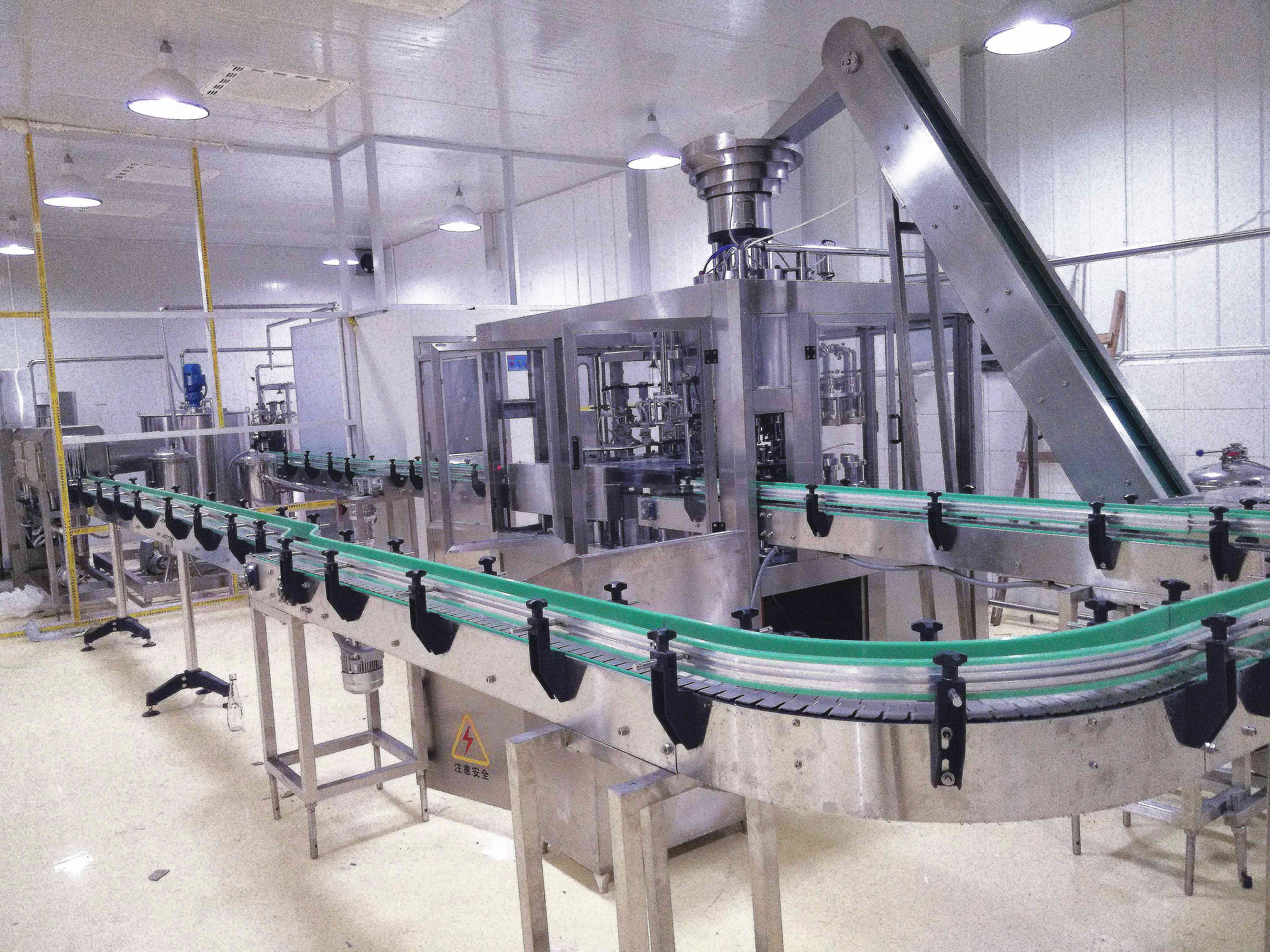
Modern facility engineering heavily favors the 3-in-1 monoblock design. This enclosed rotary system elegantly combines three distinct operations: rinsing, filling, and capping into a single continuous motion. Empty plastic or glass bottles enter via air conveyors, are swiftly inverted and rinsed with sterile water or ionized air, filled with the liquid, and immediately sealed. This continuous rotary motion minimizes the machine's physical footprint and drastically mitigates the risk of airborne contamination between the filling and sealing stages.
The specific type of fluid dynamics dictates the required technology. Selecting the wrong filler will result in foaming, inaccurate fill levels, or collapsed bottles. Here is a practical breakdown for plant engineers:
| Beverage Type | Recommended Technology | Operating Temperature | Engineering Highlight |
|---|---|---|---|
| Purified / Mineral Water | Gravity Filling | Ambient | Utilizes natural liquid weight. Cost-effective and highly reliable for non-viscous liquids. |
| Carbonated Soft Drinks | Isobaric Pressure Filling | 2 to 5 degrees Celsius | Pressurizes the empty bottle with carbon dioxide to prevent violent foaming during the rapid fill cycle. |
| Juices, Teas, Sports Drinks | Hot Filling | 85 to 90 degrees Celsius | Ambient heat sterilizes the bottle walls. Creates a tight vacuum seal as the product naturally cools. |
After the sealed bottles exit the sterile zone and pass through a warming or cooling tunnel to prevent condensation, they enter the final packaging phase. Here, a robust automated case packer and its auxiliary systems prepare the individual units for rough wholesale distribution and pristine retail display.
The choice of labeling hardware depends heavily on the brand's aesthetic design. Shrink Sleeve Labelers drop a printed polymer sleeve over the container, which then passes through a steam tunnel, causing the label to conform tightly to the bottle's unique contours. Alternatively, Hot Melt Glue Labelers are ideal for high-speed water lines, applying a wrap-around plastic label using precise micro-dots of hot adhesive.
Regulatory compliance demands strict traceability. Industrial coders print expiration dates, production times, and batch codes directly onto the plastic or aluminum cap. Continuous Inkjet printers use fast-drying ink, while advanced Laser Coders burn the data directly into the material, offering a permanent, consumable-free coding solution that cannot be rubbed off during transit.
The packaging machinery aggregates individual units into wholesale formats. Film shrink wrapping machines group bottles into 6-packs or 24-packs, securely wrap them in polyethylene film, and pass them through a thermal tunnel to create a tight bundle. For premium products, automated carton packers utilize robotic arms to load glass bottles into pre-formed corrugated cardboard boxes.
The final step on the factory floor is palletization. Automated palletizers eliminate the ergonomic hazards of manual lifting. Depending on line velocity, facilities utilize conventional mechanical layer palletizers or articulated robotic arms to stack the finished cases onto pallets. The pallets are then tightly wrapped in stretch film, ready for immediate forklift transport to the warehousing bays.
When transitioning from the planning phase to facility execution, having a structured, comprehensive inventory of required machinery is non-negotiable. Mapping out this comprehensive equipment checklist ensures that no critical component is overlooked, preventing costly delays during installation and commissioning.
| Production Phase | Equipment Name | Primary Function & Technical Requirement |
|---|---|---|
| Phase 1: Water Treatment | Raw Water Pump, Silica Sand & Carbon Filters, Reverse Osmosis System, Sterilizers | Supplies pressure, removes solids, strips dissolved salts, and eradicates microbes. Requires SUS304 or 316L tanks. |
| Phase 2: Syrup Room | Sugar Melting Tank, Blending Tanks, Homogenizer, Pasteurizer, Carbonator | Dissolves sugar, mixes flavors via precision load cells, ensures uniform texture, sterilizes liquid, and injects carbon dioxide. |
| Phase 3: Filling | Air Conveyor, 3-in-1 Monoblock, Cap Elevator, Light Checker | Transports bottles via HEPA filters, rinses, fills, caps automatically, sanitizes closures, and detects improper fill levels. |
| Phase 4: Packaging | Air Dryer, Laser Coder, Labeling Machine, Shrink Wrapper, Palletizer | Removes exterior moisture, applies batch codes, affixes labels, groups into retail formats, and stacks onto pallets. |
| Auxiliary Systems | Clean-in-Place System, Air Compressor, Industrial Chiller | Automates internal pipe sanitation using acid and caustic tanks, provides oil-free utility air, and supplies process cooling. |
Procuring the items on this inventory is only the first step. Understanding how they interact determines operational success. For instance, the output capacity of your purification plant must exceed the maximum consumption rate of your filling block by at least 20 percent. This crucial buffer prevents the filling machine from starving during peak production hours. Similarly, the packaging hardware must operate at a slightly higher speed than the filler to clear minor conveyor jams without forcing the entire line to halt.
Selecting the vendor to supply your machinery is one of the most critical capital expenditure decisions your business will make. The industrial machinery market is saturated with suppliers ranging from low-cost regional assemblers to premium global engineering firms. To ensure long-term profitability, plant managers must evaluate manufacturers based on objective, data-driven criteria.
Before approaching any manufacturer, you must possess a mathematically sound understanding of your required production capacity. Overestimating your capacity leads to unnecessary capital depreciation, while underestimating it results in missed market opportunities. Industry standards utilize Overall Equipment Effectiveness, which accounts for setup time, maintenance, and cleaning cycles. A well-optimized plant typically runs at an 80 to 85 percent efficiency rate. Therefore, to comfortably produce 5,000 bottles per hour theoretically, you should specify hardware rated for at least 6,000 bottles per hour.
Furthermore, the longevity and safety of a beverage plant are heavily dependent on metallurgical quality. Constant exposure to water, acidic juices, and harsh cleaning chemicals will rapidly degrade inferior metals. Ensure your manufacturer explicitly uses SUS304 for external frames and SUS316L stainless steel for any component that comes into direct contact with the liquid. On the automation front, verify that they utilize globally recognized, open-architecture Programmable Logic Controllers. Proprietary control systems can leave you stranded if the manufacturer goes out of business.
Finally, a fragmented procurement strategy where you buy a filler from one company and a labeler from another often leads to integration nightmares. Conveyor heights may not align, and software communication protocols may clash. Opting for a turnkey solution from a single, reputable manufacturer mitigates these risks, ensuring flawless integration and providing single-point accountability for Factory Acceptance Testing and after-sales spare parts support.
Building a commercial beverage plant requires a highly synchronized ecosystem of industrial machinery. From the initial purification processing and the precise thermal blending in the preparation room, to the high-speed synchronization of the filling block and the structural reliability of the final packaging systems, every piece of the puzzle matters.
Having the complete production infrastructure meticulously mapped out in advance saves critical engineering time, reduces capital waste, and ensures a smooth, predictable launch for your brand. By prioritizing high-grade stainless steel, open-architecture automation, and turnkey integration, you lay the groundwork for decades of profitable manufacturing. If you are ready to transition from planning to execution, explore the high-performance solutions at WFoodMachinery to find the exact equipment specifications that align with your commercial goals.
The capital expenditure required is highly variable and depends on three primary factors: production capacity, the level of automation, and the specific characteristics of the liquid being produced. A small-scale, entry-level bottled water plant operating at 2,000 to 3,000 bottles per hour with manual end-of-line packaging might range between $30,000 and $50,000. However, if you are producing carbonated drinks or pulpy juices, the complexity increases exponentially. A fully automated, mid-speed juice line equipped with robotic palletizers and premium European controls can easily range from $200,000 to well over $1,000,000.
Space requirements extend far beyond the physical footprint of the machinery. A standard 2,000 to 5,000 bottles per hour line typically requires a minimum of 300 to 500 square meters of dedicated manufacturing floor space. However, a compliant, food-safe facility must be divided into distinct hygienic zones. You must also account for extensive peripheral space: raw material storage, finished goods warehousing, utility rooms for boilers and chillers, and forklift maneuvering lanes. For a mid-sized operation, a total facility footprint of 1,000 to 2,000 square meters is a realistic baseline.
Yes, modern rotary monoblock systems are engineered for versatility, but there are strict mechanical limitations. A single machine can typically handle a range of bottle volumes from 330ml to 1.5 liters provided that the neck diameter and neck profile of the bottles remain exactly identical. Because these machines utilize neck-handling technology, switching to a bottle with a different neck size requires purchasing and manually installing specific change parts, such as new star wheels and capping chucks, which involves planned machine downtime.
Clean-in-Place is an indispensable, automated system designed to clean and sanitize the interior surfaces of pipes, vessels, filters, and filling valves without requiring the machinery to be manually disassembled. A standard station utilizes high-pressure pumps to circulate heated purified water, acidic solutions, and caustic solutions through the piping at specific flow rates. By automating these cleaning cycles, the system guarantees consistent sanitation, prevents microbial contamination, and drastically reduces plant downtime.
When engineered with high-grade SUS304 and SUS316L stainless steel and maintained properly, a premium complete beverage line can reliably operate for 15 to 20 years. The longevity heavily depends on strict adherence to preventative maintenance schedules, regular lubrication of moving rotary parts, and prompt replacement of wear-and-tear components like rubber seals and filling valves. Upgrading PLC software and sensors periodically can also extend the functional life of the machinery.
A beverage plant is highly utility-intensive. Beyond the raw water supply needed for the product itself, facilities require massive amounts of purified water for cleaning cycles. Electrically, a mid-sized plant requires a robust three-phase industrial power supply to handle the simultaneous startup surge of multiple heavy-duty motors, chillers, and air compressors. Additionally, you will need industrial-grade boilers to supply steam for thermal pasteurizers and shrink-wrap tunnels, alongside high-pressure, oil-free air compressors to operate pneumatic valves and blow-molding equipment.